



 Multi-industry nationwide (chemical/petrochemical/coking/pharmaceutical/industri
 Emergency accident pools at individual enterprises range from 90 to 2,300 m³, wh
Emergency Pool for Accident Wastewater: Of the Six Variables in the Volume Formula, Only Two Can Be Changed by Design
The three-tier prevention and control system keeps accidental water within three lines of defense: the unit, the plant, and the industrial park. Yet the success or failure of this system often ultimately comes down to whether a single valve is normally open or closed.
The emergency accident pool is probably the most contradictory structure in a wastewater treatment system: it must normally be empty, with not a drop of water in it; yet it must be able to hold at any time the water volume calculated by a formula. The formula is not long—Vtotal=(V1+V2−V3)max+V4+V5, and at the park level it is multiplied by a safety factor k. Breaking it down reveals one thing: among the six quantities, the leaked material volume, firefighting water volume, and safety factor are not determined by the water treatment discipline from the outset; the production wastewater volume depends on whether production is stopped during an accident; only two can truly be changed through design—the temporary storage capacity of containment dikes and pipelines, and the catchment area. And these two point to the same thing: letting as little water as possible need to enter the pool. This article takes a look at this formula, the three-tier prevention and control system behind it, and several real enforcement cases together.
I. Three-Tier Prevention and Control: The Same Matter, Four Documents, Four Ways of Dividing It
The policy starting point of this system is usually traced to the Notice on Strengthening Environmental Impact Assessment Management and Preventing Environmental Risks (Huanfa [2005] No. 152) issued after the 2005 年 Songhua River pollution incident. That document wrote the "comprehensive plan for environmental risk prevention and emergency handling of environmental safety incidents" into the mandatory content of planning EIA and construction project EIA, but it did not provide an engineering definition of "three-tier prevention and control." What truly grounded the "three tiers" in structures was a later batch of industry guidelines, national standards, and local guides.
Thus a somewhat convoluted phenomenon emerged: the same matter is being discussed, but each document draws the boundaries at a different position. The 2005 年 notice of the State Environmental Protection Administration governs the "decision-making source"; the Technical Guideline for Environmental Risk Assessment of Construction Projects (HJ 169—2018) divides it as "unit—plant—park"; the Standard for Environmental Protection Engineering Design of Chemical Construction Projects (GB/T 50483—2019) divides it as "plant unit containment dike—plant accident pool—switching valve before the main outfall"; the Guidelines for Environmental Emergency Management of Tailings Ponds (Trial) divides it as "workshop—plant—river basin"; and the technical key points for refining and chemical enterprises divide it as "plant and tank farm—plant—main outfall before entering river water bodies."
| Document | Level 1 | Level 2 | Level 3 |
|---|---|---|---|
| HJ 169—2018 | Unit (cofferdam, fire dike) | Plant site (emergency accident pool) | Industrial Park (public emergency pool) |
| GB/T 50483—2019 | Cofferdam or ring ditch of the unit, with a switch valve outside the cofferdam | Emergency accident pool of the plant site | Interception and shutoff before the main outfall |
| Guidelines for Environmental Emergency Management of Tailings Ponds (Trial) | Anti-seepage cofferdam of the workshop | Emergency accident pool of the plant site | Interception dam and pollution retention pond on tributaries of the river basin |
| Technical Points for Prevention of Water Environment Pollution in Refining and Chemical Enterprises | Cofferdams and dikes of units and tank farms | Accident buffer pool | Terminal accident pool before the main outfall to rivers, lakes and seas |
From this table, one criterion can be drawn: what the three-level prevention and control system distinguishes is not "three levels of facilities" but "three boundaries" — not leaving the unit, not leaving the plant boundary, and not leaving the industrial park. The facilities are still the same three things: cofferdams, pools, and valves. Change the boundary, and the classification changes accordingly. Therefore, to determine which classification a project should follow, one only needs to ask one question: which boundary is this level supposed to hold back?
The latest action took place in 2024 年. The General Office of the Ministry of Ecology and Environment issued, via the document Huanban Yingji Han [2024] No. 274, the Technical Guidelines for the Construction of a Three-Level Environmental Emergency Prevention and Control System for Sudden Water Pollution Incidents in Chemical Industrial Parks and the Implementation of "One Park, One Policy, One Map" (Trial), requiring parks to "exchange space for time," establish their own emergency pools, connect the emergency pools of qualified adjacent enterprises, and make full use of ponds, river channels, ditches within the park as well as surrounding water systems to build emergency prevention and control space. The tasks fall on three things: "find space, determine plans, and conduct drills." One month earlier, the Ministry of Ecology and Environment had announced the first batch of 17 pilot parks (including Jiangyin Lingang Chemical Industrial Park). According to statistics from the Ministry of Ecology and Environment, the number of chemical industrial parks recognized by provincial-level people's governments across the country has reached more than 600.
The five words "exchange space for time" deserve a pause. Every term in the volume formula is actually "flow × time," and the pool is space. So what the emergency pool does is not "treat the pollutants away," but replace "too late" with "somewhere to hold it first." It is a time machine, and the pool volume is the amount of time it can buy back.
II. The Volume Formula: Of the Six Quantities, Only Two Are Adjustable
The formulation commonly adopted in engineering is:
Vtotal = (V1 + V2 − V3)max + V4 + V5, and at the chemical industrial park level, multiply by a safety factor k (preferably 1.2–1.5, determined according to the park's water environment risk level).
Interestingly, the national standard's own wording is "narrower" than this formula. Clause 1 of Article 6.6.3 of GB/T 50483—2019 only states that "the pool volume shall be determined based on factors such as the amount of accidental material leakage, the amount of firefighting wastewater, and the rainfall entering the emergency accident pool," and the clause explanation 6.6.3 likewise lists only these three items, stating that "the sum of the above three items minus the effective volume of facilities such as relevant cofferdams, ring ditches, and pipelines that can temporarily store accident wastewater may serve as the effective volume of the emergency accident pool." In other words, the national standard governs "what must at minimum be calculated," while V4 (the amount of production wastewater that must still enter the collection system during an accident), the method for taking the max, and that k are added by industry standards, enterprise standards, and local guidelines. The same formula has different numbers of terms across the four types of documents—this is not because someone copied it wrong, but because their respective scopes of jurisdiction differ.
| Symbol | Meaning | Determined By | Can It Be Changed by Design |
|---|---|---|---|
| V1 | Quantity of material leaked in an accident | Process discipline: the largest storage tank in a tank farm, or the reactor/intermediate tank holding the largest quantity of material in a unit | No, it is fixed once the process is fixed |
| V2 | Firefighting water volume in an accident | Fire protection codes: firefighting water supply flow rate × design firefighting duration | No, it is determined by the building fire hazard class |
| V3 | Quantity of material that can be transferred or temporarily stored | Design discipline: temporary storage volume available in bunds, ring ditches, pipelines, etc. | Yes (this is the only term that can "reduce" the basin volume) |
| V4 | Quantity of production wastewater that must still enter the collection system during an accident | Production conditions: whether production stops during an accident | No (depends on whether production is shut down; if shut down during an accident, take 0) |
| V5 | Rainfall entering the collection system during an accident | Meteorology and general layout: average annual rainfall ÷ average annual rainfall days × catchment area | Partially (rainfall intensity cannot be adjusted; catchment area F can be optimized) |
| k | Safety factor (park level) | Water environment risk level of the industrial park | No, it is taken according to the level |
The most easily misread part of the formula is that max. It does not mean adding up all the tank farms in the plant; rather, calculate V1+V2−V3 separately for different tank farms or units and take the largest one—it calculates "the worst single one having an accident," not "all of them having accidents together." This detail determines the order of magnitude of the basin volume, and it is also the source of many wildly inaccurate volume calculations.
What truly deserves repeated scrutiny is still V3, because it is the only one of the six quantities for which "the larger it is, the smaller the tank can be." If the temporary storage capacity of the cofferdam, ring ditch, and piping is made larger, the tank can be made smaller. But it is also the only item on which the authorities have given no definitive answer: when responding to questions on "whether the remaining volume of the equalization tank in a wastewater treatment system can be used, and whether the rainwater pipe network in the plant area and the sloped ramps at workshop entrances can be used to collect accident wastewater and be counted into V3," the "Minister's Mailbox" of the Ministry of Ecology and Environment clearly stated that as to whether an accident emergency tank can be used for dual purposes, there is currently no clear provision, and enterprises may refer to the Technical Requirements for Water Environment Risk Prevention and Control of Petrochemical Enterprises (Q/SH 0729—2018) and apply and manage it in accordance with actual conditions. This is the first criterion of this article: if the value of a quantity can be unilaterally "explained away" by the designer, it will sooner or later be explained away. Counting the workshop ramps and rainwater pipe network into V3, to the point where no accident tank needs to be built, does not formally violate any mandatory provision—this is precisely where the real fragility of this system lies.
III. V2: The same symbol, from 36 m³ to 972 m³
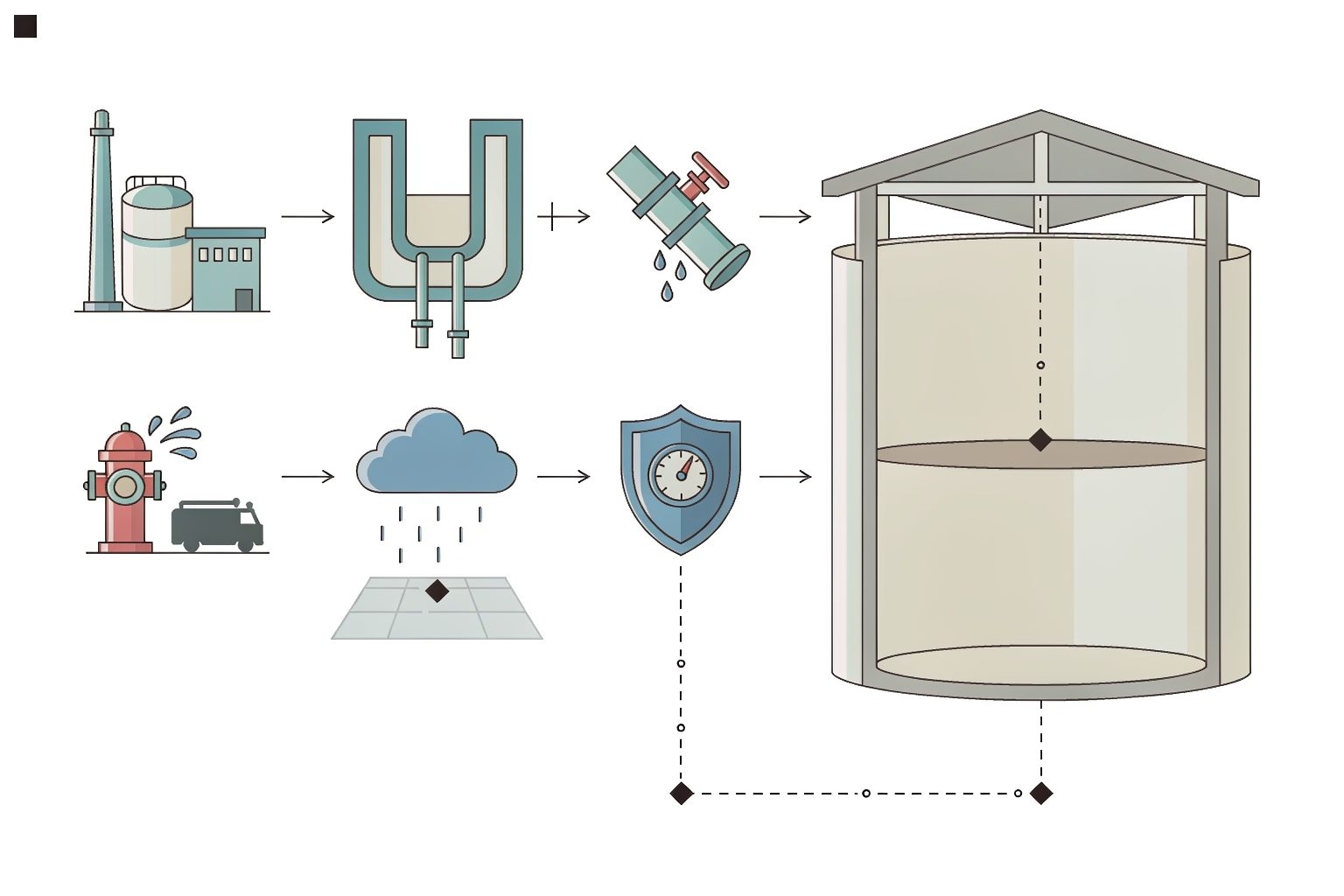
The calculation of the firefighting water quantity V2 is itself very simple: the sum of the water supply flow rates of all firefighting facilities multiplied by the corresponding design firefighting duration. A commonly used formula is:
V2 (m³) = ΣQ (L/s) × t (h) × 3.6
But it is precisely this simple multiplication that, in real projects, can yield values ranging all the way from 36 m³ to 972 m³, a difference of 27 times. The difference is entirely hidden in three qualifiers: how many hours the fire duration is taken as, whether indoor plus outdoor is counted, and whether automatic sprinkler water and spray cooling water for adjacent equipment are counted.
| Real Projects (Based on Public EIA Statements) | Fire Hazard Classification / Structure | Firefighting Flow Rate | Duration | V2 |
|---|---|---|---|---|
| A New Energy Vehicle Parts Project in Lanxi, Zhejiang | Class A workshop, floor height less than 24 m | Indoor 10 + Outdoor 25 L/s | 3 h | 378 m³ |
| A Carbon Black / Pyrolysis Project in Zouping, Shandong (Carbon Black Workshop) | Class B workshop | Indoor 10 + Outdoor 25 L/s | 3 h | 378 m³ |
| Same as above (Pyrolysis Workshop) | Class A, 20000 < V ≤ 50000 m³ | Indoor 10 + Outdoor 30 L/s | 3 h | 432 m³ |
| Same as above (Tire Rubber Particle Separation Workshop) | Class C | Indoor 20 + Outdoor 30 L/s | 3 h | 540 m³ |
| A Class A Workshop Project in the Pearl River Delta | Class A, plus automatic sprinkler system | (30+10) L/s, sprinkler 1280 L/min | 3 h + sprinkler 1 h | 508.8 m³ |
| A Coking Desulfurization Waste Liquid Resource Recovery Project in Shanxi | Firefighting water volume for the facility | Not specified (calculated by facility) | Not specified | 972 m³ |
| An Industrial and Trade Project with Class D/E Workshop | Class D/E, floor height less than 24 m | Indoor 10 L/s (fire hydrant only) | 1.0 h | 36 m³ |
Compiled based on the statements in public Environmental Impact Assessment reports. The values in the first five rows have been verified by independent calculation: 378 = (10+25)×3600×3÷1000; 432 = (10+30)×3600×3÷1000; 540 = (20+30)×3600×3÷1000; 508.8 = ((30+10)×3600×3 + 1280×60)÷1000.
Calculating the same formula twice in two tables reveals where the huge divergence in V2 comes from: Class D and E buildings only require fire hydrants, with a fire duration of 1 h, and V2 is only 36 m³; while Class A and B buildings, according to the Code for Design of Fire Water Supply and Hydrant Systems (GB 50974—2014), take a fire duration of 3 h, and after superimposing outdoor hydrants and automatic sprinklers, V2 jumps directly to the range of 400–540 m³. More than 90% of the difference comes from the single building attribute of "fire hazard classification." Thus the second criterion: When a quantity can differ by 27 times in real projects, don't first ask "what is the standard limit"—first ask "which three qualifiers is this problem calculating." The vast majority of disputes over emergency pool volume are not standards conflicting, but qualifiers not being fully specified.
IV. V5: That 10 in the formula is not an empirical coefficient
The rainfall term is usually written as:
V5 = 10 q F, where q = qa ÷ n
Where q is rainfall intensity (mm), calculated on an average daily rainfall basis; qa is annual average rainfall (mm); n is the annual average number of rainfall days; F is the rainwater catchment area (ha) that must enter the emergency wastewater collection system. The clause explanation 6.6.3 of GB/T 50483—2019 states these three steps very plainly: first determine the rainwater catchment area corresponding to the collection system pipe network, then take the rainfall depth as "annual average rainfall divided by annual average number of rainfall days," and multiply the two to obtain the rainwater volume mixed into the emergency wastewater system.
| Real Project | Annual Average Rainfall qa / Number of Rainy Days n | Daily Average Rainfall Intensity q | Catchment Area F | V5 |
|---|---|---|---|---|
| A Project in Lanxi, Zhejiang | 1393.4 mm ÷ 156 d | 8.93 mm | 0.2 ha (plant building area) | 17.8 m³ |
| A New Materials Project in Shaoguan, Guangdong | 1891.1 mm ÷ 180 d | 10.51 mm | 1.547 ha (hardened ground in production area) | 162.53 m³ |
| A Coking Desulfurization Waste Liquid Project in Shanxi | 464.9 mm ÷ 51.5 d | 9.03 mm | 0.2 ha | 18.06 m³ |
The daily average rainfall intensity of the three projects all falls within the narrow window of 9–10.5 mm, yet V5 ranges from 17.8 m³ to 162.53 m³, a difference of 9 times—what drives the difference is not the rain, but the catchment area.This brings the discussion back to a very practical passage in the clause explanations of GB/T 50483—2019: for larger plant areas, the accident wastewater collection pipeline network should preferably be provided separately and should not share the rainwater drainage system, which reduces the rainwater catchment area and allows a smaller effective volume of the accident pool, but requires an additional accident water collection pipeline network; conversely, small plant areas often rely on the rainwater drainage network to collect accident wastewater in order to save pipeline investment, so precipitation unrelated to the accident area also enters the collection network during an accident, and the pool volume increases accordingly. The design should be determined through technical and economic comparison.
In other words, the size of the tank is ultimately not an environmental protection issue, but a matter of how the piping network is laid out. V3 (the temporary storage capacity of the cofferdam and piping) and F (the catchment area) — these two "hidden knobs" — point to the same thing: keep the water outside the tank. The best emergency tank is one that lets as little water as possible need to come in.
V. Beyond the Tank: It Must Normally Be Empty, and May Only Be Occupied Up to One-Third
Getting the volume right is only the first step. An emergency tank full of water serves the same purpose as no emergency tank at all. Therefore, regarding "how to use it," the regulatory documents impose even denser constraints than the volume formula.
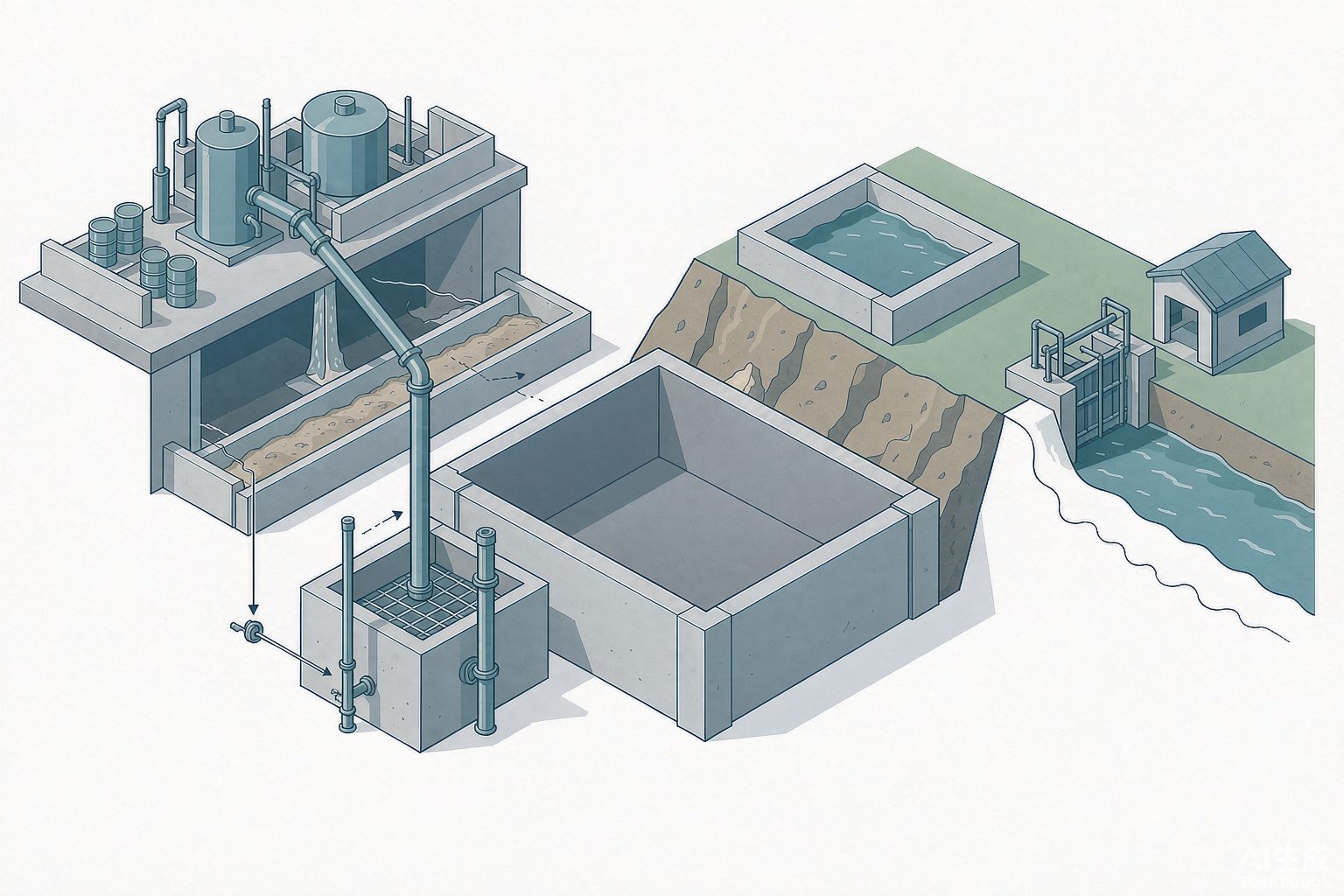
The Ministry of Ecology and Environment's "Minister's Mailbox" states: under normal circumstances, to maintain sufficient emergency drainage buffer capacity, the emergency tank should be kept normally empty; under non-emergency conditions, when it is genuinely necessary to occupy the emergency tank due to material leakage, substandard wastewater treatment facilities, etc., the emergency tank may temporarily be used as a buffer tank, the occupied volume shall not exceed 1/3, and it must be emptied promptly, and it shall be capable of emergency emptying within 30 minutes in the event of an accident. The "Classification Method for Enterprise Sudden Environmental Incident Risk" (HJ 941—2018) breaks the emergency wastewater collection measures into three requirements that must be met simultaneously: set up emergency drainage collection facilities in accordance with design specifications and design their capacity; ensure that leaks and firefighting water can be smoothly collected under emergency conditions while maintaining sufficient buffer capacity in daily operation; and transport the collected wastewater to the plant's wastewater treatment facilities for treatment through contracted units or self-built pipelines.
Section 6.6 of GB/T 50483—2019 provides more detailed engineering provisions: the tank should preferably be underground; when emergency wastewater must be transferred, the power supply for the transfer pumps and their standby pumps shall be determined as a Grade I load, and dual power sources shall be provided if this cannot be met; the clause explanation further states that the fuel reserve for diesel engines or generator sets should be sufficient for continuous operation of the units for 6 h, otherwise the transfer pumps may fail to operate due to power loss when a large amount of firefighting wastewater is generated. Article 6.6.4 requires that switching valves be installed outside the cofferdam; Article 6.6.5 requires that uncontaminated rainwater in the process unit area and tank farm area be switched to the clean rainwater system via switching valves, and the switching valves shall be located in a safe area, shall be operated at ground level, and should preferably be remotely controlled; Article 6.6.6 requires that the drainage capacity of the emergency wastewater collection system be checked against the emergency drainage flow rate (material leakage flow rate, firefighting water flow rate, rainwater flow rate).
Real enforcement cases confirm this. The following five cases all come from publicly available administrative penalty notices and orders for correction, and clearly show how the "tank" issue is caught on the regulatory side.
| Subject and Document | Facts of the Issue | Handling Result |
|---|---|---|
| A pharmaceutical company in Sichuan (De Huan Fa Penalty [2025] No. 9, 2025-11-18) | The EIA required a total emergency pool capacity of 590 m³ (buried type 1×50 m³, above-ground type 2×270 m³, with the buried type relying on gravity flow, and the construction of a plant-wide initial rainwater collection and accident wastewater cutoff system); after the 2025 年 3 月 engineering renovation, the actual capacity was only 430.65 m³ (44.5 + 386.15), and all were converted to emergency pump conveyance, while the original cutoff devices were dismantled and not reinstalled | Fine of 109,000 元 (pursuant to Article 81, Paragraph 4 of the Sichuan Provincial Regulations on Environmental Protection, 5 万–50 万 bracket) |
| An industrial and trading company in Guigang, Guangxi (Gui Huan Ze Gai Zi [2022] No. 3083) | The accident emergency pool actually constructed was only 240.6 m³, falling short of the 406 m³ required by the EIA | Ordered to rectify immediately, pursuant to Article 15 and Article 23, Paragraph 1 of the Regulations on the Administration of Environmental Protection of Construction Projects |
| A hospital in Bozhou, Anhui | Failed to construct an accident emergency pool as required by the environmental impact assessment document | Fine of 15,600 元 (pursuant to Article 38 of the Measures for the Administration of Emergency Response to Sudden Environmental Incidents) |
| A mining company in Chifeng, Inner Mongolia (2022-07-29 public notice) | A blockage in the tailings pipeline caused damage to the circulation pump; after the mineral processing wastewater was discharged into the accident pool, because the accident pool capacity was insufficient and effective measures were not taken in a timely manner, part of the production wastewater flowed out of the plant through the plant's flood discharge ditch and entered the Laoha River | Pursuant to Article 93, Paragraph 1, Item (2) of the Water Pollution Prevention and Control Law, 2 万–10 万 bracket |
| A company in Anning, Kunming, Yunnan | The 2080.5 m³ rainwater collection pool was also used as a production wastewater circulation pool, with obvious leakage outside the pool; the separately constructed 20 m³ and 24 m³ initial rainwater collection pools could not meet the needs of the entire plant | Rectified as required (this circumstance was not penalized under the opinion of mitigated exemption from punishment, but the violations were listed item by item) |
The first case is most worth reading word by word, because in a single sentence it hits three points at once: capacity shrank by 27% (430.65 ÷ 590 = 73.0%), gravity flow was changed to pumping, and the cutoff valves were removed and not reinstalled. Taken individually, none of these three matters is major, but together they mean that whether this pool can receive water under accident conditions depends on whether a pump has power; and no one is responsible anymore for opening or closing the pipe next to it.
VI. Four Real Ledgers: The Calculated and the Built
Substituting the line items from the several real projects above into the formula reveals something interesting: the proposed volume is almost always a little larger than the calculated one.
| Item | V1 | V2 | V3 | V4 | V5 | V Total | Proposed |
|---|---|---|---|---|---|---|---|
| A Project in Lanxi, Zhejiang | 0.5 | 378 | 25 | — | 17.8 | 371.3 | 400 m³ |
| A New Materials Project in Shaoguan, Guangdong | 5 | 486 | 5 | 0 | 162.53 | 648.53 | 710 m³ |
| A Coking Desulfurization Waste Liquid Project in Shanxi | 0 | 972 | 0 | 0 | 18.06 | 990.06 | Designed as per 990.06 |
| A Project in Xuancheng, Anhui | 0 | 36 | 0 | 12.92 | 181.2 | 230.12 | Greater than 230.12 m³ |
All units are m³. For the Lanxi case, V3 = 25 m³ was verified by self-calculation: the rainwater pipes around the plant are approximately 200 m, with pipe diameter taken as 400 mm, 200 × π × 0.2² ≈ 25.13 m³, which is consistent with the 25 m³ given. The V Total of all four cases can be directly recalculated from the itemized values in the original text.
In the Lanxi case, a margin of 7.7% was reserved, while in the Guangdong case, 9.5% was reserved. This "saying a bit more" of 5%–10% is not waste, but an industry habit of aligning two things: what is calculated by formula is "sufficient," while what is examined at acceptance is "having a margin." The Deboer case above is exactly the opposite—the environmental impact assessment allowed 590 m³, but only 430.65 m³ actually remained, 159.35 m³ less, so both "sufficient" and "having a margin" were gone at the same time.
VII. Xiangshui: After All Three Lines of Defense Were Breached
At about 48 on 2019 年 3 月 21 日 14, a particularly major explosion accident occurred at Jiangsu Tianjiayi Chemical Co., Ltd., located in the Ecological Chemical Industrial Park of Xiangshui County, Yancheng City, Jiangsu Province, causing 78 deaths, 76 serious injuries, and direct economic losses of 19.86 亿 yuan. The investigation team of the State Council found that the direct cause of the accident was spontaneous combustion caused by continuous heat accumulation and temperature rise of nitration waste illegally stored for a long time in the old solid waste warehouse, and the combustion triggered the explosion—this was an industrial safety responsibility accident, but its environmental emergency response process happened to be an extreme stress test of the three-level prevention and control system.
After the accident, the ecological and environmental authorities immediately built dams to block the Xinmin River, Xinfeng River, and Xinnong River, and isolated the explosion core area with cofferdams; about 1.8 万 m³ of highly acidic, high-organic wastewater in the large pit in the core area was fully extracted, neutralized on site by adding alkaline solution, and then transported via pipeline to the regulating tank of Jiangsu Yulong Chemical Wastewater Treatment Plant for temporary storage, and then treated by Chenjiagang Water Treatment Co., Ltd.; the Xinmin River was basically uncontaminated, and after treatment by an activated carbon dam, the sluice was opened to release water, with water quality basically stable within the Class IV surface water standard.
| Water Body (monitoring inside the gate, 2019-03-29) | Aniline Compounds | Ammonia Nitrogen | Dichloromethane | COD |
|---|---|---|---|---|
| Xinfeng River (heavily polluted) | Exceeds standard by 98.4 times | Exceeds standard by 90.5 times | Exceeds standard by 19 times | Exceeds standard by 7.9 times |
| Xinnong River (lightly polluted) | — | Exceeds standard by 0.6 times | — | Exceeds standard by 1.8 times |
The purpose of this table is not to show "how alarming the exceedance multiples are," but to indicate the magnitude of the water volume involved in the incident. An enterprise's own emergency pool, whether calculated at 400 m³ or 2300 m³, corresponds to the scenario of "one tank farm, one process unit failing"; whereas a contaminated river channel and a 1.8 万 m³ explosion crater already correspond to the emergency space of an entire industrial park. This is precisely why the technical guideline of 2024 年 calls for "making full use of the ponds, river channels, ditches, and surrounding water systems within the park"—when an incident exceeds the design scenario, what contains it is no longer a pool, but pumps, pipelines, and temporarily constructed dams.
This leads to the third criterion: What the accident pool can contain is the water within the design conditions; beyond the design conditions, what contains it is administrative capacity and engineering mobilization capacity. And the design conditions themselves are defined by the formula in Chapter 1—every qualifier in the formula is quietly delineating "which water counts as mine to contain, and which water does not."
VIII. Source Tracing: From "Containing" to "Catching"
Beyond "containing after an incident," there is another line: "catching before an incident." The lever for this is not the pool, but the water quality fingerprint.
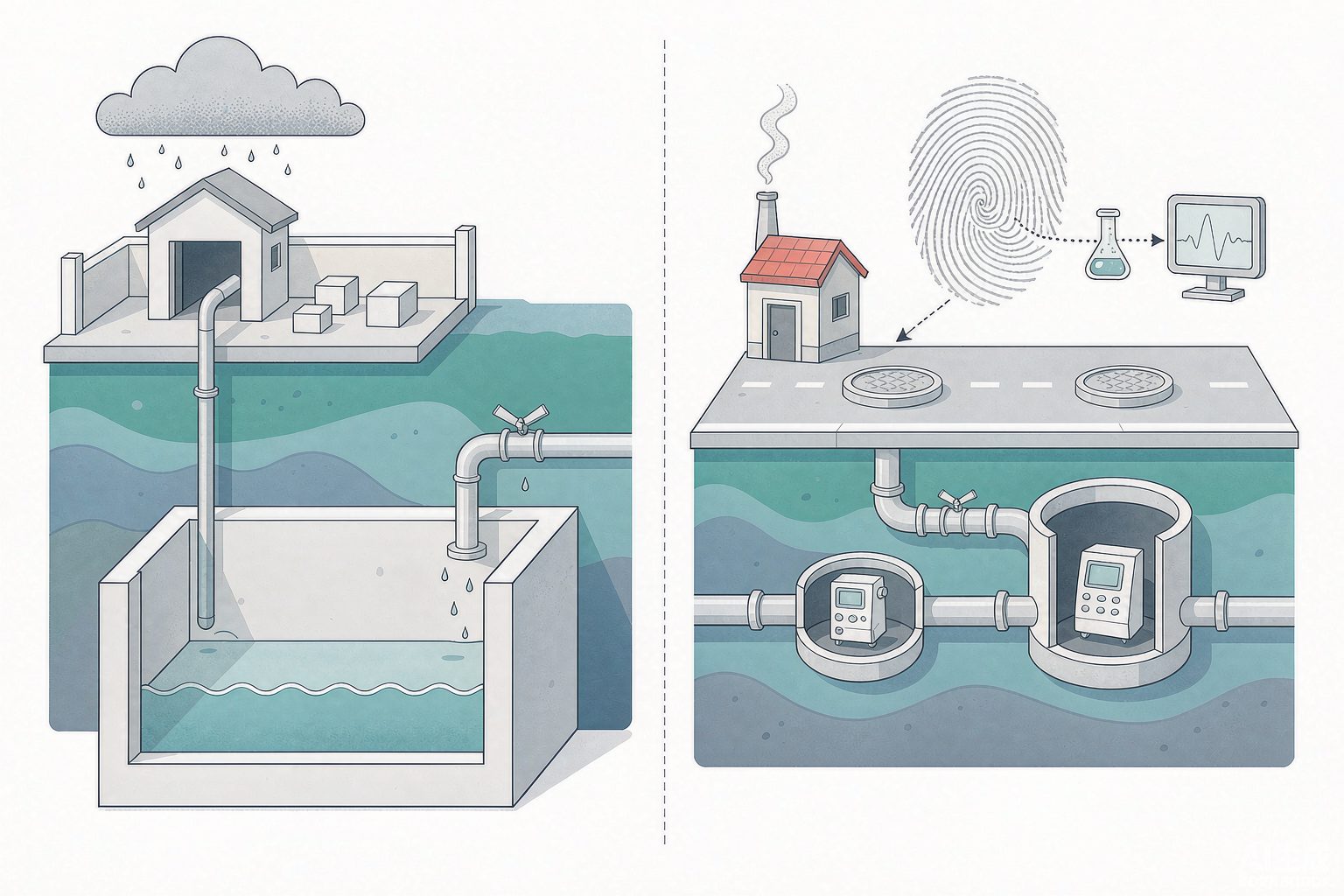
Ningbo Petrochemical Economic and Technological Development Zone 2022 年 introduced water quality fingerprint pollution source tracing technology and comprehensive acute toxicity monitoring technology for water quality, establishing an enterprise discharge list database, an enterprise toxicity database, and a water quality fingerprint database: full-process toxicity testing was carried out for 60 high-risk enterprises, obtaining more than 650 toxicity data entries; water quality fingerprint libraries were established for 10 key enterprises, with cumulative spectral data collected exceeding 3000 万. The park implemented online monitoring at 128 discharge outlets of 88 major wastewater discharge enterprises, and set up biological toxicity monitoring points at the inlet of the industrial wastewater treatment plant, forming a two-level early warning system of "outlet—wastewater plant"; when the toxicity of incoming water exceeds the set threshold, the online tracing instrument calls the fingerprint library for comparison, typically locking onto the exceeding enterprise within 10–15 minutes, after which the enterprise's discharge valve can be remotely controlled to close, forming a closed loop of "threshold trigger—intelligent tracing—valve interlock control." As of early 2026 年, the system had accumulated approximately 6 万 valid monitoring data entries, with more than 30 high-toxicity warnings issued, all achieving precise source tracing. This case was selected as a typical case of industrial park water environment management by the Ministry of Ecology and Environment in 2024 年.
In terms of technology sources, the water quality fingerprint early warning and tracing technology was independently developed by the team at the School of Environment, Tsinghua University, and has been applied in water source areas, surface water, industrial parks, wastewater treatment plants, and municipal pipe networks in multiple locations. The Lanshan Ecological Environment Branch of Rizhao, Shandong, also adopted means such as three-dimensional fluorescence spectroscopy to establish a dynamically updated "water quality fingerprint" information database with one file per enterprise for water-related enterprises in the chemical industrial park.
| Comparison Item | Accident Emergency Pool (Contain) | Water Quality Fingerprint Tracing (Catch) |
|---|---|---|
| Installation Location | Within the enterprise plant area | Outfall, pipe network, inlet of wastewater treatment plant |
| Action Timing | After the accident occurs | At the moment abnormal discharge is occurring |
| Technical Means | Cofferdams, pipelines, pool capacity, pumps and valves | Water quality fingerprints such as three-dimensional fluorescence, biological acute toxicity |
| Core Physical Quantity | Volume (m³) | Time (locking time, early warning lead time) |
| Output Result | Wastewater does not leave the boundary | Responsible party identifiable and traceable |
The two are complementary ends: the accident pool manages "where the water goes after an incident," while tracing manages "where the water comes from before an incident." One is in the plant, a volume; the other is on the pipe network, a valve.
IX. Conclusion: Two Numbers
Condense the entire article into two numbers: one is the volume of the pool, the other is the opening of the valve.
In the volume formula, V1, V2, and k are from the outset not determined by the water treatment discipline; V4 depends on whether production stops or not, and the only things that can truly be turned are V3 and the catchment area F—and these two knobs point to the same thing: let as little water as possible need to enter the pool. Therefore, the question "how large should the accident pool be built" often has its best answer not in the pool itself, but in the upstream cofferdam, ring ditch, and pipe network layout drawings.
As for the valve: GB/T 50483—2019 requires a switching valve outside the cofferdam, requires the switching valve to be located in a safe area with ground-level operation, and preferably remote control. These words are not long, but the Debor case shows that they can be violated simultaneously—after the retrofit, pumping replaced gravity flow, and the isolation device was removed and not reinstalled. The volume of the accident pool can be accepted by a formula, but the state of the valve can only be confirmed by a meeting or an inspection. What is most easily lost has always been the latter.
References
- "Environmental Protection Engineering Design Standard for Chemical Construction Projects" GB/T 50483—2019, Section 6.6 "Water Pollution Prevention and Control under Accident Conditions" and clause explanations 6.6.1~6.6.6 (6.6.3 Item 1 lists three items: leakage volume, firefighting wastewater volume, and rainfall; the clause explanations specify requirements for underground type, dual power sources for Class I loads, and continuous operation of diesel engines for 6 h).
- "Code for Design of Environmental Protection of Chemical Construction Projects" GB 50483—2009, Articles 6.6.1~6.6.3 ("Chemical construction projects shall be provided with emergency accident pools"; emergency accident pool capacity = maximum calculated emergency accident wastewater volume − net available capacity within the containment dike − accident wastewater pipeline capacity).
- "Technical Guidelines for Environmental Risk Assessment of Construction Projects" HJ 169—2018 (Construction projects shall be provided with accident wastewater collection and emergency storage facilities, preferably using non-powered gravity flow; "unit—plant—industrial park" three-level prevention and control).
- "Method for Risk Classification of Enterprise Sudden Environmental Incidents" HJ 941—2018 (three requirements that accident wastewater collection measures must simultaneously satisfy).
- "Notice on Strengthening Environmental Impact Assessment Management and Preventing Environmental Risks" Huanfa [2005] No. 152 (after the Songhua River incident, requiring planning EIA and project EIA to include environmental risk prevention and comprehensive emergency response plans for sudden incidents).
- "Notice on Further Strengthening Environmental Impact Assessment Management and Preventing Environmental Risks" Huanfa [2012] No. 77 (where emergency accident pools are not provided as required by environmental risk prevention measures, the "three simultaneities" acceptance shall not be conducted).
- General Office of the Ministry of Ecology and Environment, "Notice on Issuing the Technical Guidelines for the Construction of the Three-Level Prevention and Control System for Environmental Emergencies of Sudden Water Pollution Incidents in Chemical Industrial Parks and the Implementation of 'One Park, One Policy, One Map' (Trial)" Huanban Yingji Han [2024] No. 274, 2024-08-01.
- Ministry of Ecology and Environment, "Notice on Announcing the List of Pilot Parks (First Batch) for the Construction of the Three-Level Prevention and Control System for Environmental Emergencies of Sudden Water Pollution Incidents in Chemical Industrial Parks and the Implementation of 'One Park, One Policy, One Map'", 2024-01 (first batch of 17 pilot parks; chemical industrial parks recognized by provincial people's governments nationwide have reached more than 600; "trading space for time").
- "Technical Guidelines for the Construction of the Environmental Risk Prevention and Control System for Accident Wastewater in Chemical Industrial Parks" (local standard of the Shanxi Provincial Department of Ecology and Environment, 2024-02) (park-level V = k[(V1+V2−V3)+V4+V5], k should be taken as 1.2~1.5; the number of compartments in the emergency accident pool should not be less than 2).
- "Technical Requirements for the Prevention and Control of Water Body Pollution under Accident Conditions" Q/SY 1190—2013; "Technical Requirements for Water Body Environmental Risk Prevention and Control of Petrochemical Enterprises" Q/SH 0729—2018 (the volume of the accident pool occupied under non-accident conditions shall not exceed 1/3, and it must have the capacity for emergency emptying within 30 minutes).
- "Analysis and Discussion on the Design of Accident Pools in Ethylene Oxide Storage Tank Areas", "Shandong Chemical Industry" (when the mass concentration of ethylene oxide aqueous solution is about 4%, it basically loses its explosion capability, corresponding to a dilution factor of about 24 times; Q/SH 0774—2021 requires that the effective volume of the dedicated dilution accident pool shall not be less than 25 times the maximum leakage volume of the medium).
- "Technical Code for Fire Protection Water Supply and Hydrant Systems" GB 50974—2014 (design flow of indoor and outdoor hydrants, fire duration; Class A and B workshops 3 h).
- "Code for Fire Protection Design of Buildings" GB 50016—2014 (2018 年 edition); "Code for Fire Protection Design of Petrochemical Enterprises" GB 50160.
- "Code for Design of Petrochemical Wastewater Treatment" GB 50747—2012, Article 3.1.1 (the storage volume of polluted rainwater should be calculated as V=Fh/1000, with h taken as 15~30 mm); "Code for Design of Chemical Industrial Wastewater Treatment and Reuse" GB 50684—2011 (rainfall depth 10~30 mm).
- Reply from the Ministry of Ecology and Environment "Minister's Mailbox": on the construction method and volume calculation of emergency accident pools (emergency accident pools should preferably be underground; whether they can be used concurrently is currently not explicitly stipulated).
- Reply from the Ministry of Ecology and Environment "Minister's Mailbox": emergency accident pools should normally be kept empty; where occupation is truly necessary under non-accident conditions, it shall not exceed 1/3 of the volume, and there must be the capacity for emergency emptying within 30 minutes.
- Reply from the Department of Ecology and Environment of Guangdong Province: whether it is explicitly stipulated that an emergency pool must be provided when preparing an emergency plan, and according to what standard the emergency pool should be calculated (GB 50483—2009 stipulates that chemical construction projects shall be provided with emergency accident pools).
- Zhanjiang Municipal Emergency Management Bureau, "Common Problems and Countermeasures of Emergency Accident Pools and Rainwater Collection Pools", 2020-01-07 (list of problems such as diversion of accident pools to other uses, overflow pipes in pools connected to the rainwater system, and lag in manual control of rain-sewage switching devices).
- "Investigation Report on the Particularly Major Explosion Accident of Jiangsu Xiangshui Tianjiayi Chemical Co., Ltd. '3·21'" (approved by the State Council, 2019-11) and notifications from the Ministry of Ecology and Environment and China News Service 2019-03-29 to 04-01 (about 1.8 万 m³ of wastewater in the large pit in the core area; aniline compounds, ammonia nitrogen, dichloromethane, and COD in the Xinfeng River sluice exceeded standards by 98.4, 90.5, 19, and 7.9 times respectively; ammonia nitrogen and COD in the Xinnong River exceeded standards by 0.6 and 1.8 times respectively; damming and blocking of three rivers, activated carbon damming, alkali neutralization, and pipeline transport for temporary storage).
- Ningbo Petrochemical Economic and Technological Development Zone "Typical Case of Digital and Intelligent Early Warning and Precise Traceability of Toxic and Harmful Pollutants" (selected as a typical case of water environment management in industrial parks by the Ministry of Ecology and Environment in 2024 年; 60 high-risk enterprises with more than 650 toxicity data, water quality fingerprint libraries of 10 key enterprises with more than 3000 ten thousand spectrum data, 88 enterprises with 128 discharge outlets, locking within 10~15 minutes, and all more than 30 high-toxicity warnings precisely traced).
- Lanshan District People's Government of Rizhao City, "Lanshan Ecological Environment Branch Establishes a 'Water Quality Fingerprint' Information Database for Key Water-Related Enterprises in the Chemical Industrial Park", 2026-05 (three-dimensional fluorescence spectroscopy, one enterprise one file dynamic updating).
- Deyang Municipal Ecology and Environment Bureau, "Public Announcement of Administrative Penalty Information on Sichuan Deboer Pharmaceutical Co., Ltd." De Huan Fa [2025] No. 9, 2025-11-18.
- Guigang Municipal Ecology and Environment Bureau, "Decision on Ordering Correction of Illegal Acts" Gui Huan Ze Gai Zi [2022] No. 3083, 2022-07-04; administrative penalty announcement of Chifeng Municipal Ecology and Environment Bureau of Inner Mongolia (Ningcheng County Hongda Mining Co., Ltd., 2022-07-29); administrative penalty decision of Anning Branch of Kunming Municipal Ecology and Environment Bureau Kun An Sheng Huan Fa Zi [2021] No. 83.
- "Accident Wastewater Risk Prevention Measures" chapters of environmental impact report forms/reports for relevant construction projects in Lanxi City of Zhejiang Province, Shaoguan City of Guangdong Province, Jinzhong City of Shanxi Province, Xuancheng City of Anhui Province, and Zouping City of Shandong Province (sub-item value selection of V1~V5 and calculation of V total).
The data in this article are all cited from public national standards, industry specifications, government disclosure documents, and authoritative media reports; the volume sub-items and exceedance multiples involving specific enterprises can all be recalculated from the original texts. The accompanying figures are process schematic illustrations and do not correspond to the general layout of any specific plant. For similar engineering parameters in the case center, please refer to the design documents and the currently effective standard texts.
您提供的内容似乎不完整,缺少需要翻译的中文文本。请提供待翻译的中文内容,我将根据术语表为您翻译成地道的英文。