



 Publicly available data from multiple industries nationwide (integrated circuit
 Pilot to engineering scale (single plant at tens of thousands of tons/day; ultra
Electronic-Grade Ultrapure Water: One "18.2" Hides Four Prerequisites, and Two Impurities It Can Never Measure
Resistivity reaching 18.2 MΩ·cm—many people think this is the report card of ultrapure water. In fact, it only keeps one account—the ion account.
Ultrapure water is often regarded as "water purer than pure water," as if it were merely a progression in concentration. It is not. It is a different water type: tap water, softened water, and pure water are all assessed by "removal rate" and "residual concentration," whereas ultrapure water is assessed by a set of online indicators with mutually different dimensions—resistivity (MΩ·cm), Total Organic Carbon TOC (μg/L), particles (count/mL), bacteria (CFU/mL), total silicon (μg/L), metal ions (μg/L or even ppt), Dissolved Oxygen (μg/L). Each keeps its own account, and none can substitute for another; and the one with the highest profile among them, "18.2," happens to be the account with the least information content among these accounts. This article breaks down several key conventions of electronic-grade ultrapure water: why "18.2" must carry a qualifier, why "resistivity compliant" and "boron and silicon compliant" are two different things, and why the same "water recovery rate" can differ by a factor of two between two plants.
I. First, lay out the five accounts: don't conflate them into one phrase "water quality compliant"
Before discussing any numbers, one thing must be accepted first: the six categories of ultrapure water indicators are different in dimension, different in mechanism, and different in detection method, and none can represent the whole. A water quality sheet reading "resistivity 18.2 MΩ·cm, TOC 8 ppb" says nothing about any of particles, bacteria, boron, or silicon.
| Indicator | Typical Dimension | What It Covers | What It Does Not Cover |
|---|---|---|---|
| Resistivity | MΩ·cm (compensated to 25℃) | Total ionizable ions in water | Neutral molecules (boric acid, monosilicic acid), organics, particles, bacteria |
| Total Organic Carbon (TOC) | μg/L (i.e., ppb) | Total carbon content of organics | Inorganic ions, particulate matter, which specific organic compound it is |
| Particles | counts/mL (by particle size bin) | Particle count and size distribution | Dissolved substances, microbial activity |
| Bacteria | CFU/mL or counts/mL | Culturable viable bacteria | Endotoxins, biofilms, non-culturable bacteria |
| Total Silica | μg/L (ppb level for advanced processes) | Total dissolved and colloidal silica | Metal ions, organics |
| Metal Ions | μg/L to ppt | Trace concentration of each individual metal | Anions, organics, particles |
Once this table is thoroughly understood, the conclusions in the following sections follow naturally: resistivity is the "ion account," TOC is the "molecule account," particles are the "particle account," and silica and boron each have their own separate account. Using one account to declare everything compliant is the most common specification error in ultrapure water.
II. Resistivity 18.2: Four Omitted Premises
Removing all ions from water does not make resistivity rise indefinitely. The reason is simple—water itself ionizes into H⁺ and OH⁻. At 25℃, the theoretical limit of pure water resistivity is 18.248 MΩ·cm, commonly referred to in engineering as 18.2 (some sources write 18.25).
This number is extremely sensitive to temperature: for the same batch of ultrapure water, it is 18.2 MΩ·cm at 25℃, rises to 84.2 MΩ·cm at 0℃, and is only 1.3 MΩ·cm at 100℃; near 25℃, for every 1℃ rise in water temperature, resistivity drops by approximately 0.84 MΩ·cm. Therefore, the industry stipulates that resistivity must always be compensated to 25℃ before reporting.
Thus "18.2" conceals at least four orally omitted premises:
Premise One · Temperature basis.A reading without compensation noted is called "apparent resistivity," which naturally drifts with water temperature; two meters at the same sampling point can differ by a few tenths of a megohm, and this has nothing to do with water quality.
Premise Two · Online or offline.Once ultrapure water leaves a closed pipeline and contacts air, it dissolves CO₂, and the ionized HCO₃⁻ causes resistivity to drop rapidly. Therefore, the number 18.2 is only meaningful with online continuous monitoring; taking a cup of water to a laboratory for measurement will naturally yield low data.
Premise Three · Flow velocity.Electrode-type resistivity probes require a certain flow velocity to give stable readings; at too low a flow velocity, readings will be falsely high. Field experience: readings become unreliable when flow velocity is below approximately 0.1 m/s.
Premise Four · In-situ calibration.After several months of continuous use, the electrode constant of graphite electrode probes will drift, with field data showing drift up to 5%~10%. In other words, between "the meter shows 18.2" and "the water is truly 18.2," there still lies a periodically calibrated probe.
III. GB/T 11446.1—2013: The 1997 Version Had Five Grades, the 2013 Version Changed to Four
The domestic electronics industry reference standard is "Electronic Grade Water" GB/T 11446.1—2013. It replaced the 1997 version and compressed the original five grades (EW-I to EW-V) into four grades (EW-I to EW-IV), while adding items such as nickel, nitrate, phosphate, and sulfate. EW-I is the highest grade, corresponding to processes most sensitive to impurities, such as large-scale integrated circuits.
| Item | EW-I | EW-II | EW-III | EW-IV |
|---|---|---|---|---|
| Resistivity (25℃) / (MΩ·cm) | ≥18 (not less than 17 for 5%) | ≥15 (not less than 13 for 5%) | ≥12 | ≥0.5 |
| Total Silicon / (μg/L) | ≤2 | ≤10 | ≤50 | ≤1000 |
| Total Organic Carbon TOC / (μg/L) | ≤20 | ≤50 | ≤100 | ≤1000 |
| Bacteria / (count/mL) | ≤0.01 | ≤0.1 | ≤10 | ≤100 |
| Particle Size (≥0.1μm) / (count/mL) | ≤10 | ≤50 | ≤100 | — |
| Sodium / (μg/L) | ≤0.5 | ≤2 | ≤5 | ≤1000 |
| Copper / (μg/L) | ≤0.2 | ≤1 | ≤2 | ≤500 |
| Chlorine / (μg/L) | ≤0.5 | ≤1 | ≤10 | ≤1000 |
One wording in the table is most easily misread: the resistivity of EW-I is written as "≥18 (not less than 17 for 5%)". It means that falling below the nominal value is permitted during periods not exceeding 5% of the total monitoring time, but at no time may it fall below 17 MΩ·cm given in parentheses. This is a "permitted fluctuation window" specification, not an average value that can be taken at will.
IV. Boron and Silicon That Resistivity Cannot Measure: Not a Single Word About These Two Accounts
This section is the core of the entire article. Resistivity is a "total quantity" indicator—it only accounts for the total conductance contributed by all ionized ions in the water, and does not guarantee that every impurity is low to the ppt level. Unfortunately, there are two impurities that are almost non-ionized at neutral pH, and thus contribute essentially zero to conductivity, making resistivity "blind" to them.
Boron exists in water mainly in the molecular form of boric acid B(OH)₃, with a pKa of about 9.23. At neutral pH (about 6.5~7.5), more than 99% exists as undissociated molecules and does not contribute to conductivity. Silicon is dominated by monosilicic acid H₂SiO₃, with a pKa₁ of about 9.84, also weakly ionized—this also explains why a saying repeatedly appears in the industry: "Ultrapure water that shows compliant resistivity may still have boron in the product water at the ppb level."
What is more troublesome is that these two substances happen to evade every major mechanism of conventional processes: RO membranes rely on charge repulsion and size sieving, and charge repulsion fails against neutral boric acid molecules; EDI relies on electric-field-driven ion migration and has almost no removal capacity for neutral molecules; mixed-bed ion exchange has very low exchange efficiency for boric acid, and boron is the first anion to break through during mixed-bed operation—once breakthrough occurs, the previously adsorbed boron will also be displaced by other anions, causing the boron concentration in the product water to rise rather than fall.
| Unit | Boron Removal | Silica Removal | Remarks |
|---|---|---|---|
| Primary RO (neutral pH) | Approx. 30%~50% (other sources give 40%~70%) | Approx. 80%~95% | Boric acid does not dissociate at neutral pH, resulting in low rejection |
| RO with pH adjusted > 10 | Can reach above 90% | >99% | Under alkaline conditions, boron converts to B(OH)₄⁻ and silica to HSiO₃⁻, which can be rejected once "ionized" |
| HERO process | Significantly improved | Significantly improved | Cation resin softening is used first to remove hardness, then operation at elevated pH avoids scaling on the concentrate side |
| EDI | Relatively weak | Approx. 90%~95% | The upper limit of EDI effluent resistivity is approx. 18 MΩ·cm |
| Polishing mixed bed | Brings silica down to sub-ppb as a final safeguard | Can reach below 0.02 mg/L | The mixed bed can stabilize at 18.2 MΩ·cm, but requires chemical regeneration |
| Boron-selective resin | Effluent can be stably <1 ppt | — | NMDG functional group, regenerable (2%~4% HCl), service life 3~5 年 |
This yields a criterion that can be directly applied in O&M: do not judge whether a mixed bed has failed based solely on product water resistivity. In the later stage of mixed bed operation, the boron concentration in the product water may already far exceed the specification while resistivity remains high. If the end use has stringent boron requirements, the correct approach is to install an online boron analyzer on the mixed bed product water (some sources give its range as approx. 15 ppt~20 ppb, with a requirement that the sample water resistivity be above 15 MΩ·cm), and to adjust the volume ratio of cation to anion resin in the mixed bed from 1:1 to 2:1 or 3:2 to enhance boron removal.
The boron requirements for different process nodes differ enormously, a point often obscured by the practice of "uniformly assessing against 18.2":
| Process Node | Device Type | Ultrapure Water Boron Limit |
|---|---|---|
| 28 nm | Planar HKMG | 50~100 ppt |
| 7 nm | FinFET | 5~20 ppt |
| 2 nm | GAA Gate-All-Around | 100 ppq~5 ppt |
| 1.4 nm | Future Nodes | Below 1 ppt (Emerging Target) |
V. Process Chain and Three System Architectures: That Final 0.2 Can Only Rely on Mixed Bed
A typical ultrapure water main line is: pretreatment (multi-media filtration + activated carbon + softening/precision filtration) → primary RO → secondary RO (or high-efficiency RO with pH adjustment) → EDI → polishing mixed bed → 185 nm UV oxidation + 254 nm UV sterilization → degassing membrane → terminal ultrafiltration (approximately 0.01~0.22 μm), then returned to each point of use via SUS316L/PVDF circulation piping; the circulation flow rate is typically required to be greater than 1.5 m/s to inhibit microbial growth.
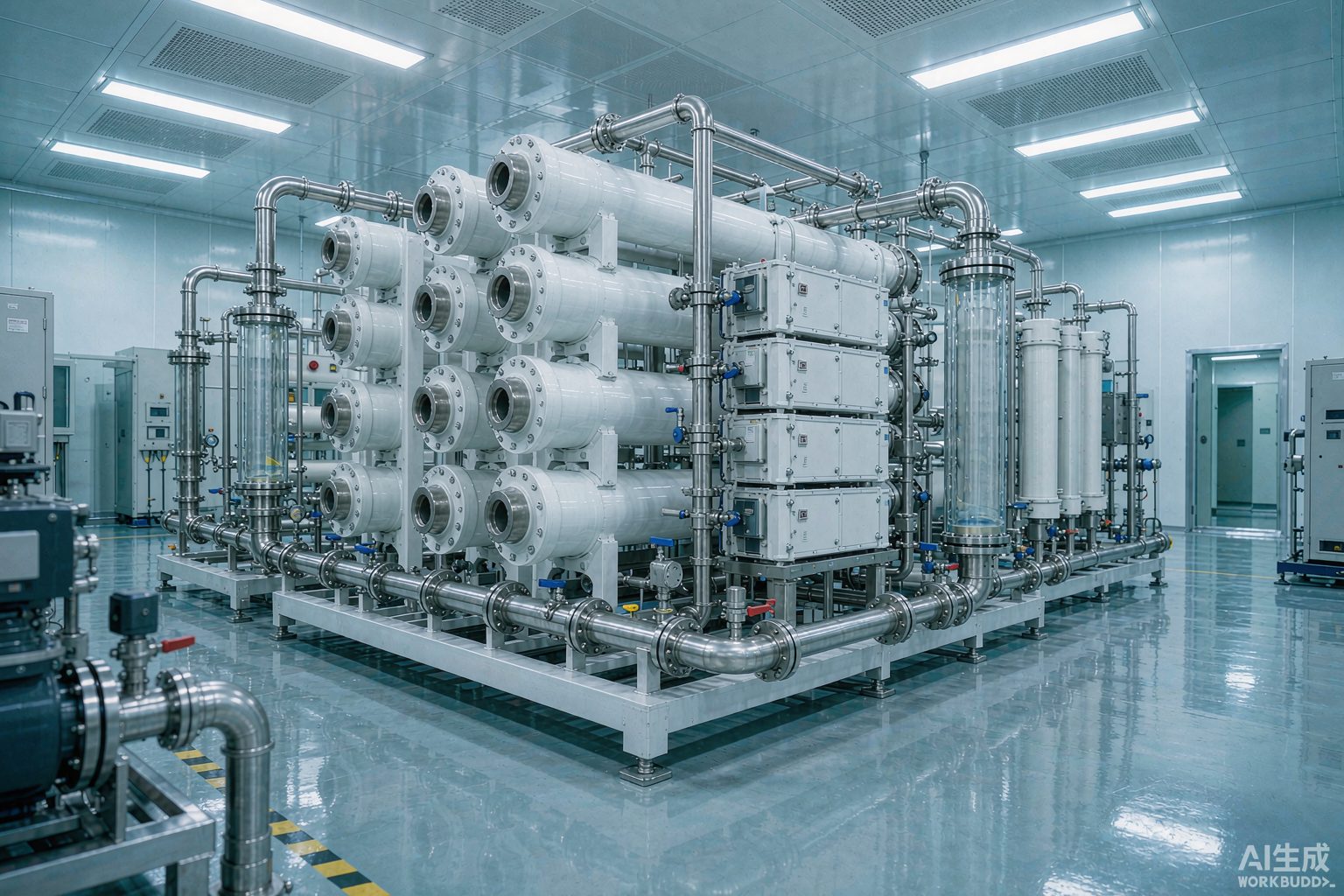
System architecture is usually selected from three options: RO+DI, RO+EDI, and a hybrid combining both. Their differences are not just in price:
| Dimension | RO+DI (Mixed Bed) | RO+EDI | Hybrid RO+EDI+DI |
|---|---|---|---|
| Relative Investment | Lowest (Baseline) | Approx. +20% | Approx. +35%~50% |
| Relative Operating Cost | High (approx. +30%, chemical regeneration) | Baseline | Slightly higher (approx. +10%) |
| Silica Removal | Intermittent, strong | Continuous, approx. 90%~95% | EDI as primary + mixed bed as backup, strongest |
| Upper Limit of Effluent Resistivity | Can be stabilized at 18.2 MΩ·cm | Approx. 18 MΩ·cm | Can reach 18.2 MΩ·cm |
| Regeneration Cost (Reference) | Resin regeneration approx. 0.20 USD/m³ | Approx. 0.05 USD/m³ | Between the two |
| Typical Application | Old plants, small plants, non-critical processes | Plants of 14 nm and above with stable influent | Plants of 3 nm and below with fluctuating influent |
The most critical row in the table is "Upper Limit of Effluent Resistivity": EDI effluent generally can only reach about 18 MΩ·cm; to reliably reach 18.2, the polishing mixed bed downstream is needed to make up the difference. Therefore, in that process chain, the polishing mixed bed is not an "optional polishing stage," but the stage that supplies the final 0.2 MΩ·cm.
VI. Recovery Rate: One "Recovery Rate," Four Denominators
This is where "definitions" are most evident in this topic—the same term can refer to four different things in the reports of two companies. First, let's lay out the public figures:
| Entity | Public Figure | Basis Note |
|---|---|---|
| TSMC | 2022 年 85.7%, 2023 年 90.3%, 2024 年 88.1% | "Water recovery rate" per the company's sustainability report basis |
| TSMC · Arizona, USA fab | Currently about 65% → initial 85% → target above 90% | Before and after commissioning of the under-construction reclaimed water plant (IRWP) |
| UMC | Company-wide process water recovery rate 84.3%; wastewater at new fabs sorted into up to 27 streams | "Process water" basis; separately reports that reclaimed water accounts for 97.6% of water intake at 2024 年 Fab 12i |
| ASE (assembly and testing) | Kaohsiung plant about 3 万 tons/day, about 75% recovered; Zhongli about 7000 tons/day | Plant-level recovery rate, not a wafer fab basis |
| SMIC | Ultrapure water recovery rate about 65%~72%; also an "internal reuse rate 98.5%" | The two figures have different denominators and cannot be cited interchangeably (see below) |
| Samsung Electronics DS / SK Hynix | Industry estimates about 40% / 2024 年 47% | Samsung does not disclose its recovery rate separately; figure is an estimate |
Breaking down these several "recovery rates" in the table, at least four sets of denominators can be distinguished:
① Water recovery rate = Recovered water volume ÷ Water use (intake) volume. The 88% in TSMC's report falls into this category, measuring "the proportion of water circulated back within the site relative to intake water."
② Reclaimed water substitution rate = Purchased reclaimed water volume ÷ Total plant water consumption. UMC's Fab 12i "reclaimed water covering 97.6% of intake water" is this category—it measures not how much it recovered itself, but how much reclaimed water was purchased externally. This is a different matter from category ①: one is self-produced and self-used, the other is externally purchased substitution.
③ Internal reuse rate. SMIC's widely cited "reuse rate 98.5%" falls into this category—it counts the proportion of the number of times water is reused internally to total water use, with the denominator including high-flow circulation links such as cooling water and washing water, which is naturally near saturation; whereas the same company's "ultrapure water recovery rate 65%~72%" is the figure comparable to ①. Comparing 98.5% side by side with TSMC's 88% is equivalent to subtracting two numbers with different denominators.
④ Water consumption per unit product. One order of magnitude given in public information is: producing one 300 mm silicon wafer requires approximately 2200~3000 gallons of ultrapure water (about 8.3~11.4 m³/wafer, according to the Semiconductor Industry Association); another common statement is "manufacturing one 8-inch wafer consumes about 7 metric tons of water in the front-end process." The two are not contradictory—the wafer sizes differ (8-inch vs. 12-inch) and the process stages counted differ (front-end process vs. full line), but if sizes and stages are not distinguished before direct comparison, a completely wrong unit water consumption will be obtained.
VII. When water is purified, wastewater becomes harder: Ultrapure water concentrate and GB 39731—2020
The ultrapure water system has an easily overlooked byproduct: RO concentrate. The salts in the raw water do not disappear; they are merely concentrated into this stream (TDS can reach several times to more than ten times that of the raw water). The realistic practice in electronics industry wastewater treatment is to mix the ultrapure water station concentrate with production wastewater and discharge them together into the sewer, and require that both before and after mixing the discharge limits be met.
The standard against which electronics industry wastewater discharge is benchmarked in China is "Discharge Standard of Water Pollutants for Electronics Industry" GB 39731—2020. Taking the discharge limits cited in a publicly available government environmental impact report form (Zhejiang Haining Pan-Semiconductor Industrial Park Project) as an example:
| Parameter | GB 39731—2020 Indirect Discharge | Downstream WWTP Effluent (GB 18918 Grade 1A) |
|---|---|---|
| pH | 6~9 | 6~9 |
| SS / (mg/L) | 400 | 10 |
| CODCr / (mg/L) | 500 | 50 |
| Ammonia Nitrogen / (mg/L) | 45 | 5 (8) |
| Total Nitrogen / (mg/L) | 70 | 15 |
| Total Phosphorus / (mg/L) | 8 | 1 |
| Fluoride / (mg/L) | 20 | — |
| Total Copper / (mg/L) | 2 | 0.5 |
There is one footnote that must be included in the table: the sewer discharge limit for total copper applies, per the standard, only to electronics end-product manufacturing enterprises with electroplating or electroless plating processes—not all electronics enterprises are subject to this parameter. In addition, GB 39731—2020 introduces an often-overlooked comprehensive toxicity control parameter: characterized by the "lowest no-observed-effect dilution factor" for acute toxicity to zebrafish embryos, with a reference value of ≤6, and requires centralized wastewater treatment facilities to monitor at least once per year starting from 2024 年 1 月 1 日 and report to the competent ecological and environmental authority. This is consistent with the direction of the revised draft for the pharmaceutical industry, which shifts toward biological toxicity indicators.
VIII. Photovoltaics and Lithium Batteries: One Tier Lower, but Not the Same Tier
Semiconductors are not the only users of ultrapure water. The photovoltaic and lithium battery industries also use large amounts of ultrapure water, but their requirements are one tier lower, and each has its own emphasis. Lumping their indicators together with those of semiconductors will cause misjudgments at both ends.
| User | Resistivity | TOC | Other |
|---|---|---|---|
| Semiconductors (advanced processes) | ≥18.2 MΩ·cm | ≤1~5 ppb (even lower at advanced nodes) | Boron and silicon down to ppt level; ≥50 nm particles <1 counts/L |
| Photovoltaic cells | ≥15 MΩ·cm | <20 ppb | ≥0.2 μm particles <100 counts/mL |
| Lithium batteries (cleaning/electrolyte filling) | ≥18.2 MΩ·cm | ≤10 ppb | ≥0.2 μm particles with nearly zero residue; strict control of silicon, iron, and heavy metals |
It is worth noting that: photovoltaics requires "one grade lower" (≥15), while the core processes of lithium batteries require "the same grade" (≥18.2). This precisely shows that the grade of ultrapure water is not ranked by industry, but by how close this process is to the "product surface"—the closer it is, the more the 18.2 grade must be used.
IX. Engineering Truths
1. "18.2" is an entry ticket, not a report card. It only proves that the ion ledger is clean. To prove the entire water system is qualified, TOC, particles, bacteria, boron, and silica must each be individually reported with data—this is the biggest difference between ultrapure water and all other water types.
2. Do not use resistivity to judge mixed bed failure. Boron is the first anion to break through in a mixed bed, and when it breaks through, resistivity is often still high. For systems with boron requirements, an online boron analyzer is not a luxury configuration—it is a mandatory configuration.
3. Alarm thresholds must have margin. Public technical literature gives the empirical practice for electronics wastewater as setting "50%~70% of the limit" as the design target, leaving room for shock loads and analytical deviations; the same applies to online instruments on the ultrapure water side—setting alarms only at the limit red line means letting fluctuations and detection deviations eat up your margin.
4. Stream segregation is the invisible main thread of an ultrapure water system. "New plant wastewater segregated into at most 27 categories" is not management showmanship, but the implementation of the principle that "the cleaner the rinse water, the less it should enter dirty water pipes"—the finer the segregation, the less work the central treatment station has to do, the higher the overall recovery rate, and the lower the yield risk.
5. The flow velocity in circulation piping is a hard constraint. The piping circulation flow velocity requirement is greater than 1.5 m/s, and the material is SUS316L or PVDF; there are only two purposes: prevent microorganisms from growing into biofilms in low-velocity dead zones, and prevent the piping material itself from releasing metals or organics into the water. In an ultrapure water system, "the piping itself is also water treatment equipment."
6. When the recovery rate cannot be improved, it is often not because operations are not working hard, but because the denominators are not aligned. Before reporting numbers externally, first clarify whether it is "in-station circulation ÷ water intake," "purchased reclaimed water ÷ plant-wide water use," or "internal reuse rate." With different denominators, the same plant can report four numbers: 40%, 65%, 88%, 98.5%.
References
- GB/T 11446.1—2013 "Electronic Grade Water" (under the jurisdiction of the Ministry of Industry and Information Technology, implemented on 2014 年; replaces GB/T 11446.1—1997). Multiple public sources cite its EW-I to EW-IV grading and main indicators (including the change from five levels to four levels in the 1997 version).
- Qiukanghong Technology, "Electronic Grade Ultrapure Water Quality Standards" and "What Are the National Standards for Industrial Pure Water Quality: A Full Interpretation of GB/T 11446 and GB/T 6682", citing the indicator tables for each level of GB/T 11446.1—2013 (including the note "5% time not less than").
- Ruisijie, "Electronic Grade Water (GB/T 11446.1—2013)" indicator table, including EW-I particle classification by size range (0.05~0.1 μm 500 particles/L, etc.).
- Chem17, "Methods for Expressing Water Purity": theoretical limit of pure water resistivity 18.248 MΩ·cm (25℃), 0℃ 84.2 MΩ·cm, 100℃ 1.3 MΩ·cm, and near 25℃, a decrease of 0.84 MΩ·cm for every 1℃ increase.
- China Membrane Industry Association, "How to Maintain Optimal Water Quality: All About Pure Water and Ultrapure Water" (2017-10-09): resistivity temperature characteristics and unit conversions (1 ppm=1 mg/L, 1 ppb=1 μg/L, 1 ppt=1 ng/L).
- Changhai Environmental Protection, "Ultrapure Water Equipment Output Resistivity Below Standard? 90% Is These 3 Instrument Reading Problems": four field pitfalls of resistivity (temperature compensation, flow rate <0.1 m/s causing falsely high readings, probe constant drift of 5%~10% over 6~12 months, pressure fluctuation interference), and the judgment criteria of EDI effluent ≥15 and post-polishing mixed bed ≥18.0 MΩ·cm. Commercial material, not peer-reviewed.
- Shanghai Chuangyang, "Methods for Boron Ion Removal in Ultrapure Water Systems": boric acid ionization constant approximately 5.8×10⁻¹⁰, predominantly borate species at pH>11, single-stage RO boron removal at neutral pH only 30%~50%, adjustable to above 90% at pH 10 and above, HERO process principles, boron breakthrough first in mixed bed, online boron meter range approximately 15 ppt~20 ppb. Commercial material.
- SnowPure, "Boron Control in Ultrapure Water for Advanced Semiconductor Nodes": boron limits of 28 nm 50~100 ppt, 7 nm 5~20 ppt, 2 nm 100 ppq~5 ppt, and the citation of "SEMI F63". Commercial technical brief, for directional reference.
- Water Engineer, "Ultrapure water by Electrodeionisation": RO silica removal approximately 80%, RO boron removal typically approximately 40%, mixed bed product water silica below 0.02 mg/L, EDI principles and ionization removal mechanisms for silica and boron. Commercial material.
- Toutiao account, "18.2 MΩ Is Not the Endpoint: Two 'Resistivity-Undetectable' Killers in Ultrapure Water—Boron and Silica": boron pKa 9.23, silica pKa₁ 9.84, single-stage RO boron removal at neutral pH 40%~70%, >95% after pH adjustment, boron-selective resin effluent <1 ppt, mixed bed resin ratio 1:1→2:1 or 3:2, anion breakthrough mechanism. Self-media, for directional reference.
- Sohu, "How Does Trace Boron Exceeding Standards in Ultrapure Water Affect GaN Device Threshold Voltage?": boric acid pKa≈9.2, undissociated at neutral pH, and the "blind spot" argument that conventional ultrapure water machines only monitor resistivity and TOC. Commercial material.
- Zhongsheng Environment, "Pure Water Preparation in Chip Fabs: A Complete Guide to Ultrapure Water Equipment Processes, Water Quality Standards and System Solutions": two-stage RO+EDI silica removal >99.9%, TOC removal, 185 nm/254 nm dual-wavelength UV, TOC degradation efficiency approximately 30%~50%, piping SUS316L/PVDF, circulation flow rate >1.5 m/s, and the 100 m³/d system investment range. Commercial material, not peer-reviewed.
- Zhongsheng Environment, "Solar Photovoltaic Ultrapure Water Treatment Equipment Selection and 18.2 MΩ·cm Compliance Process Configuration": EDI product water resistivity 16~18 MΩ·cm, silica removal >99%, TOC removal >90%; polishing mixed bed stable at 18.2 MΩ·cm; 185 nm UV TOC degradation efficiency >70%. Commercial material.
- HydropureWater, "Semiconductor UPW Plant Design: 2026 SEMI F63 Standards": CAPEX, OPEX, energy consumption (0.8~1.2 kWh/m³) and silica removal data for three architectures—RO+DI / RO+EDI / hybrid; EDI regeneration approximately 0.05 USD/m³ versus resin approximately 0.20 USD/m³; at the 5 nm node, a 1 ppb TOC increase corresponds to 0.5%~1% yield loss. English commercial technical brief, for directional reference.
- HydropureWater, "Wafer Cleaning Wastewater Treatment Process: 2026 Engineering & Compliance Guide": GB 39731—2020 and SEMI E12/E61 reuse-side indicators, CaF₂ sludge yield approximately 2.2 kg dry sludge/kg fluoride removed, design target set at 50%~70% of the limit. English commercial technical brief.
- Semiconductor Engineering, "How Semiconductor Fabs Use Water": UMC company-wide process water recycling rate 84.3%, new fab wastewater segregated into up to 27 streams, 2024 年 Fab 12i reclaimed water accounts for 97.6% of that fab's water intake, 2025/2030 reclaimed water and desalinated water targets 18%/32%; ASE Kaohsiung approximately 3 万 tons/day with approximately 75% recycled, Zhongli approximately 7000 tons/day, 2023 年 water intake 2147 万 tons. Industry media report.
- TSMC ESG, "TSMC S.T.S.P. Reclaimed Water Plant Commences Operation": Southern Taiwan Science Park Reclaimed Water Plant commenced operation on 2022 年 9 月, water supply 1 万 tons/day by year-end, 2026 年 up to 3.6 万 tons/day; Hsinchu Science Park reclaimed water plant planned to supply 1 万 tons/day on 2025 年, 2030 年 Taiwan region fabs' reclaimed water substitution rate target above 60%. Corporate public report.
- Asia Economic Daily, "Samsung and SK Hynix at 40%… Recycled Water Emerges as New Competitive Edge" (2026-07): TSMC 2022/2023/2024 water recycling rates 85.7%/90.3%/88.1%; Samsung DS does not separately disclose its recycling rate, industry estimates approximately 40%; SK Hynix 2024 年 47% (a slight improvement over 2023 年 44%). Media report.
- The Business Journals, "TSMC Arizona's Lacey Suastegui on the company's industrial water reclamation plant vision" (2025-09-23): Arizona fab current water recycling rate 65%, IRWP initial 85%, target 90%; according to the U.S. Semiconductor Industry Association, one 300 mm wafer requires 2200~3000 gallons of ultrapure water; daily production approximately 1.8 万 tons, 65% supported by reclaimed water. Media report.
- Construction Review Online, "The 15-acre TSMC Arizona Industrial Water Recycling Facility": IRWP 15 acres, commissioning in 2028 年, initial 85%, target above 90%, near-zero discharge, adapted to Phoenix's higher calcium and magnesium water quality. Media report.
- People's Daily Online Beijing Channel, "Beijing Economic-Technological Development Area Annual Water Savings Equivalent to 8 Kunming Lakes" (2020-05-10): SMIC water recycling treatment system total investment over 2300 ten thousand yuan, 2019 年 water consumption over 717 万 tons, tap water saved over 666 万 tons, recycled over 423 万 tons, internal reuse rate 98.5% (company self-reported figures). Government media.
- Haining Municipal People's Government, "Environmental Impact Report Form for the Phase I Tiantong Block Wastewater Treatment, Discharge and Dedicated Warehouse Construction Technical Renovation Project of Haining (China) Pan-Semiconductor Industrial Park (Submission Draft)": citing GB 39731—2020 indirect discharge limits (pH 6~9, SS 400, COD 500, ammonia nitrogen 45, Total Nitrogen 70, Total Phosphorus 8, fluoride 20, total copper 2) and the comprehensive toxicity zebrafish embryo acute toxicity control item (≤6, at least once per year starting from 2024-01-01). Government public document.
- Shengfulai Environmental Protection, "'Electronic Industry Water Pollutant Discharge Standard' (GB 39731—2020)" and Zhongsheng Environment, "A Complete Guide to Electronic Factory Wastewater Effluent Standards": commercial interpretations of the scope of application and direct/indirect discharge limits of GB 39731—2020 (there are discrepancies with the indirect discharge values listed in government public documents, which have been noted in the fact-check box of this draft). Commercial material.
- "18.2 MΩ·cm Compliance Process" and Baijiahao, "Applications and Water Quality Standards in the Ultrapure Water Industry" (2026-06): photovoltaic requirements of resistivity ≥15 MΩ·cm, TOC <20 ppb, particles <0.2 μm; lithium battery core processes ≥18.2 MΩ·cm, TOC ≤10 ppb, auxiliary processes 10~15 MΩ·cm. Commercial/self-media material, for directional reference.
- Baidu Aicaigou, "Water Resource Consumption in Monocrystalline Silicon Production": monocrystalline silicon production cooling systems account for over 60% of water consumption, wafer cleaning consumes 20~30 t per ton of silicon material (citing International Energy Agency statements on the water footprint of the photovoltaic industry chain). Commercial aggregated material, for directional reference.
Note: The standard clauses, process parameters and case data cited in this article all come from public documents, government public information and public technical materials; commercial sources have all been marked as "not peer-reviewed, for directional reference". Among them: the grading and indicators of GB/T 11446.1—2013 differ across multiple secondary transcriptions (especially EW-I's TOC, bacteria and total silica), and the discharge limits of GB 39731—2020 differ considerably between commercial materials and government public documents; both are recommended to be verified against the official standard texts once before publication; the "SEMI F63 boron limit" differs by approximately 1000 times between the two sources, which has been noted in the fact-check box of the main text; when citing, be sure to check the version and units against the original text.
您提供的内容似乎不完整,缺少需要翻译的中文文本。请提供待翻译的中文内容,我将根据术语表为您翻译成地道的英文。