



 Nationwide (coal gasification, textile, ammonia, coking, leachate)
 Pilot to full-scale (100s–10,000s m³/d)
Partial Nitritation–Anammox (PN/A) for High-Ammonia Industrial Wastewater: Mechanisms, Real Case Studies, and Key Parameters
Industrial Water Treatment Technology Series (one article per day, based on real data from the published literature) · 2026-08-11
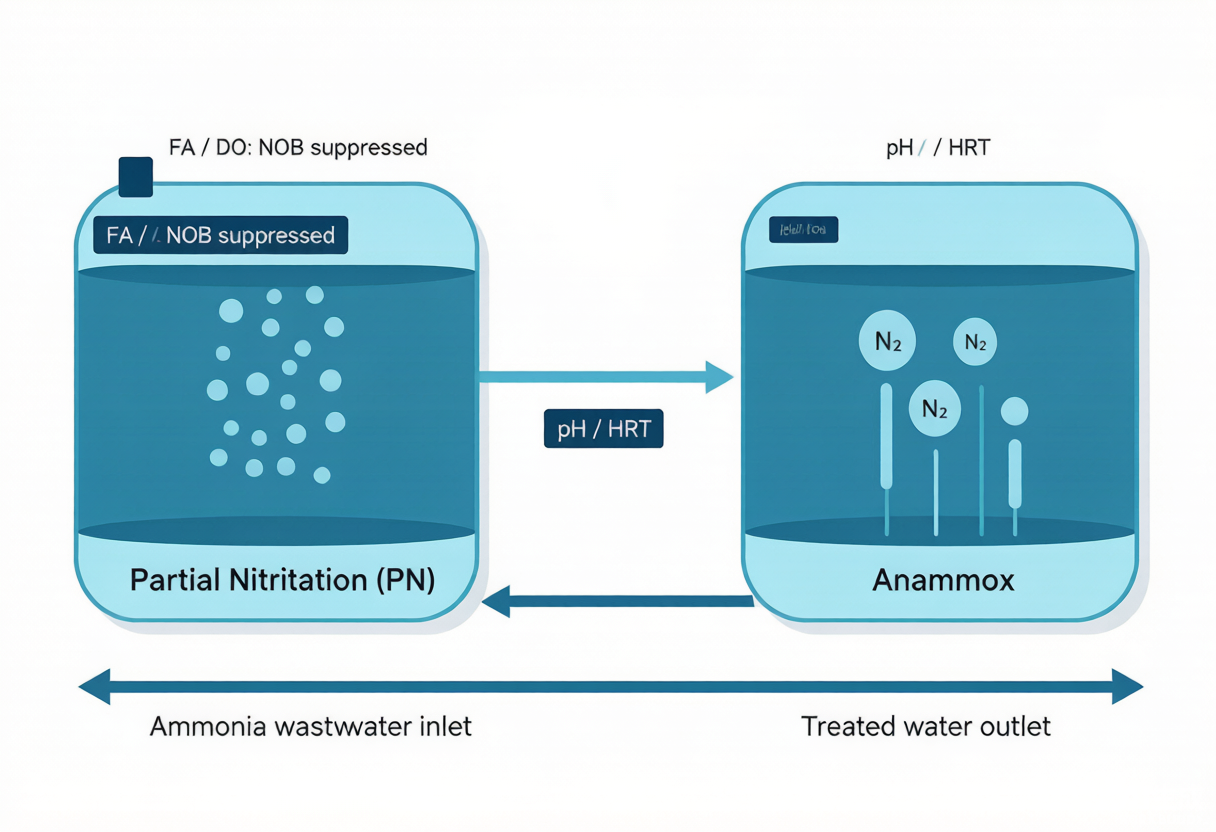
1. Why high ammonia nitrogen and a low C/N ratio are the Achilles' heel of conventional nitrogen removal
Conventional full nitrification–denitrification must first oxidize all ammonia to nitrate (consuming large amounts of oxygen) and then reduce the nitrate back to nitrogen gas with organic matter (consuming large amounts of carbon). When influent ammonia nitrogen reaches 1000–3000 mg/L while COD/TN is very low (for example, synthetic-ammonia shift condensate with COD of only 50–200 mg/L, see the IFAS pilot below), the cost and sludge production of external methanol/sodium acetate dosing become unsustainable, and total nitrogen often exceeds the limit because of insufficient carbon. The anammox route rewrites the reaction as "ammonia + nitrite → nitrogen gas," theoretically requiring no external carbon at all and only the small amount of oxygen needed to oxidize about half of the ammonia — a natural fit for high-ammonia, low-carbon wastewater.
High-ammonia, low-carbon wastewater is far from niche: coal gasification and synthetic-ammonia shift condensate, coking wastewater, landfill/incineration leachate, anaerobic sludge digestion liquor, livestock wastewater, and printing-and-dyeing liquid-ammonia mercerization absorption liquor all commonly contain hundreds to thousands of mg/L of ammonia nitrogen with very little degradable COD. Conventional denitrification requires roughly 3–5 kg of methanol-equivalent external carbon per kg of total nitrogen removed (a commonly cited experience range). For this kind of wastewater, that means an unbearable per-ton chemical cost and accompanying sludge production — and total nitrogen will inevitably exceed the limit when carbon runs short. This is precisely PN/A's home turf.
2. The anammox mechanism (Strous 1998 stoichiometry)
Anammox is carried out by obligately anaerobic autotrophic bacteria of the phylum Planctomycetota (e.g., Candidatus Brocadia, Kuenenia). Its core stoichiometry (Strous et al., 1998, from chemostat experiments) is:
NH₄⁺ + 1.32 NO₂⁻ + 0.066 HCO₃⁻ + 0.13 H⁺ → 1.02 N₂ + 0.26 NO₃⁻ + 0.066 CH₂O₀.₅N₀.₁₅ + 2.03 H₂O
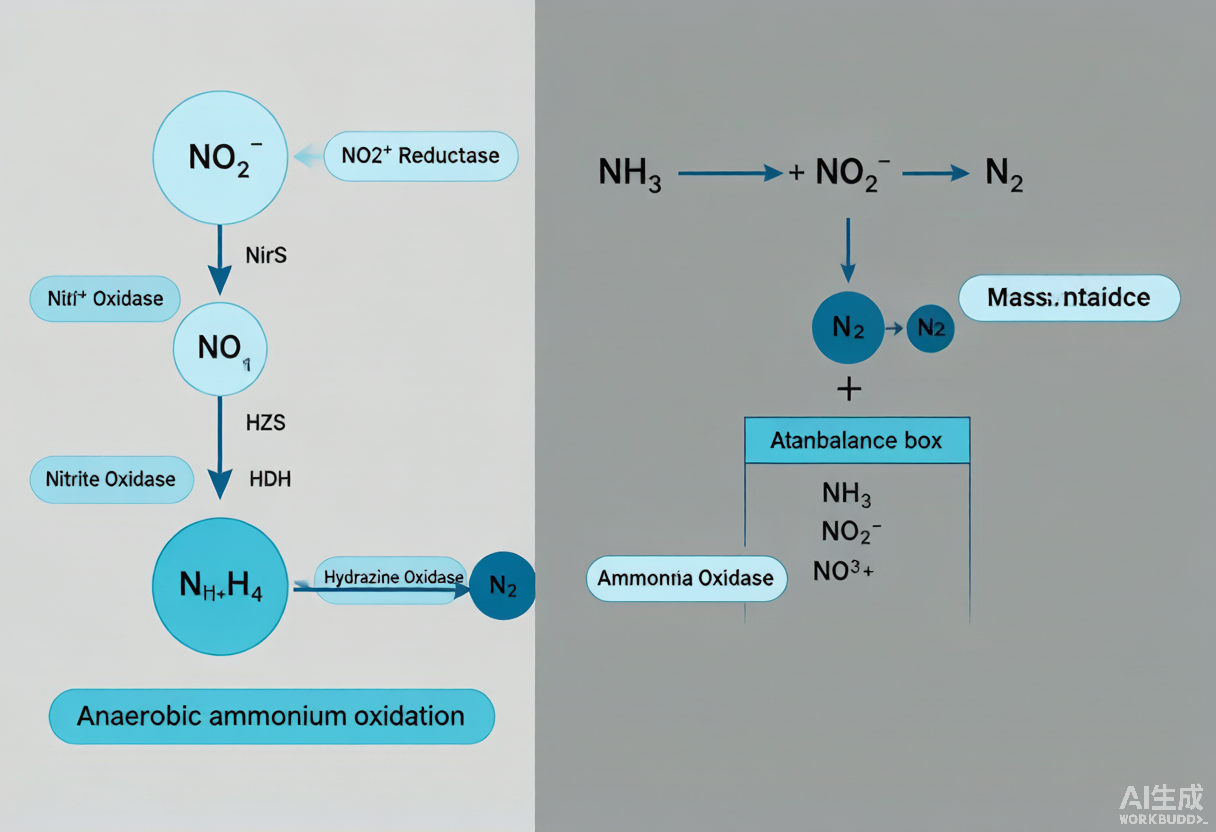
That is, each mole of ammonia requires about 1.32 moles of nitrite (a nitrogen-based ratio of about 1.32:1); about 89% of the nitrogen is converted to N₂, with only about 11% forming nitrate as a by-product. The energy-yielding reaction (NH₄⁺ + NO₂⁻ → N₂ + 2H₂O) has a standard Gibbs free energy ΔG°′ ≈ −357 kJ/mol (ecoenvbio review, consistent with multiple sources) — thermodynamically highly favorable. The enzymatic process proceeds in three steps: nitrite reductase (NirS) reduces NO₂⁻ to NO → hydrazine synthase (HZS) combines NO with NH₄⁺ to form hydrazine (N₂H₄) → hydrazine dehydrogenase (HDH) oxidizes N₂H₄ to N₂.
The discovery of anammox bacteria rewrote the textbook on biological nitrogen removal: in the 1990s, Mulder, van de Graaf, Jetten and colleagues observed them unexpectedly in a denitrification pilot (1995), and they were recognized by their unique intracellular "anammoxosome," ladderane membrane lipids, and red appearance. They are chemoautotrophic, using CO₂ as their sole carbon source, so instead of competing with heterotrophic denitrification for organic matter, they actually spare carbon for other uses. The trade-off is extremely slow growth and high sensitivity to environmental disturbance (temperature, DO, nitrite accumulation) — which makes the start-up and steady-state control of PN/A far more demanding than the conventional activated sludge process.
The weakness of anammox bacteria is extremely slow growth and sensitivity to oxygen and nitrite: specific growth rate of about 0.072 d⁻¹ (32°C), giving a theoretical doubling time of about 10–11 days (MSBR start-up study, Sciencedirect 2006; corroborated by the measured 9-day doubling in a textile wastewater case); and a sludge yield of only 0.088 g dry sludge/g N. It tolerates trace oxygen (<0.5% air saturation) but is irreversibly inhibited once DO >18% air saturation (Strous 1997, Egli 2001); nitrite is more toxic than ammonia, and the optimum pH is 6.7–8.3.
From an engineering standpoint, the 1.32 nitrite/ammonia stoichiometry means the PN stage must hold the "oxidation fraction" precisely at about half: under-oxidation leaves the anammox tank short of electron acceptors with residual ammonia; over-oxidation produces nitrate, wasting aeration and crowding out the anaerobic stage. One high-nitrogen wastewater study held the effluent NO₂⁻/NH₄⁺ ratio stably at about 1.25 to match anammox, while the textile case used zeolite adsorption–desorption to keep the ratio at 1.2 — showing that upstream ratio control is the key to PN/A success, and also explaining why the single-stage CANON process, though compact, is hard to scale up (its DO window is too narrow, and the two bacterial groups compete within the same reactor).
3. Partial nitritation (PN): holding NOB back at the starting line
Anammox needs nitrite rather than nitrate, so the upstream stage only has to oxidize about 50% of the ammonia to nitrite (partial nitritation) while preventing nitrite-oxidizing bacteria (NOB) from further oxidizing nitrite to nitrate. There are four main levers for suppressing NOB:
The engineering approach to partial nitritation traces back to the SHARON process (Hellinga et al., 1998), which uses high temperature (35°C) plus a short sludge age to selectively wash out NOB. For high-ammonia wastewater, the more common path is the FA-inhibition route described above — the higher the influent ammonia and the more alkaline the pH, the higher the free ammonia concentration and the sooner NOB are suppressed. It must be stressed that the FA window is "narrow and dangerous": if FA is too low, NOB rebound and nitrite accumulation is insufficient; if FA is too high, it in turn inhibits AOB and the anammox bacteria themselves. In practice, therefore, plants use a combination of oxygen limitation (DO) + temperature/sludge age + FA, with real-time feedback from the online nitrite-to-ammonia ratio, rather than relying rigidly on a single parameter.
4. Real case-study data
The cases below cover four typical high-ammonia, low-carbon industrial wastewaters — coal gasification, textile, synthetic ammonia, and coking — with data drawn from published peer-reviewed journals, conference papers, or dissertations (commercial content sites flagged separately). They show that PN/A has been engineering-verified on three dimensions — total nitrogen removal (85%–93%), operating cost (60%+ lower than AO), and carbon reduction (about 35%) — but start-up time (46–120 days) and vulnerability to high-salinity/high-ammonia shock remain the barriers to deployment.
1) Coal gasification wastewater (Water & Wastewater Engineering 2025, PKU core/CSCD, high credibility)
2) Textile liquid-ammonia mercerization high-ammonia wastewater (dowater 2025 / napstic dissertation)
3) IFAS-SPN/A pilot with integrated biofilm and activated sludge (Environmental Engineering 2026, peer-reviewed)
4) Coking wastewater O1/A/O2 process (napstic conference paper)
5) MBR+Anammox chemical park project (wateretechs.com commercial content site, values [to be verified])
Viewed across the five cases, influent ammonia nitrogen spans nearly two orders of magnitude, from 80 mg/L (coking) to 3811 mg/L (textile), yet PN/A delivers a viable nitrogen-removal path in every case — evidence that the process's adaptability to high-ammonia wastewater has been confirmed across multiple industries. The differences lie mainly in the start-up strategy (seeding mature sludge vs self-cultivation) and the back-end nitrate polishing method, not in the underlying principle.
5. Process-route comparison table
| Route | External carbon | Aeration/energy | Sludge yield | Applicable influent | Main drawbacks |
|---|---|---|---|---|---|
| Conventional nitrification–denitrification (AO/A²O) | Required (methanol/sodium acetate) | High (full nitrification) | High | Medium-to-low ammonia, moderate C/N | Carbon cost and sludge production surge at high ammonia/low C/N; TN easily exceeds limits |
| Partial nitritation–denitrification | Required (halved) | Medium (25% aeration saved) | Medium | Medium-to-high ammonia | Still relies on carbon; short-path stability affected by temperature/DO |
| Partial nitritation–anammox (PN/A) | Not required | Low (only ~half the ammonia oxidized) | Low (≈0.088 g/g) | High ammonia, low C/N | Slow start-up (weeks to months), sensitive to temperature/salinity/inhibition, needs PN stability control |
| Full autotrophic nitrogen removal (CANON/single-stage) | Not required | Low | Low | High ammonia, low C/N, small footprint | Narrow DO window in single-stage, intense microbial competition, difficult to scale up |
For selection, a rough criterion applies: when influent total nitrogen >200–300 mg/L and C/N (as BOD₅/TN or COD/TN) <3–4, PN/A's low-carbon advantage begins to show; the higher the ammonia and the scarcer the carbon, the more decisive the advantage. If water quality fluctuates widely or contains large amounts of recalcitrant organics or inhibitory salts, an equalization tank plus dilution should come first, or physicochemical/anaerobic pretreatment (e.g., UASB) should reduce COD before PN/A to keep heterotrophs from competing with AnAOB for living space.
6. Key-parameter operating checklist (for design and commissioning)
Designers should be reminded that the parameters above are mostly pilot- or lab-scale optimum values; when scaling up, HRT and loading must carry ample safety margin. Anammox bacteria have long generation times, and once deactivated by a shock, recovery is measured in "weeks" rather than "days." An equalization tank and dilution/recirculation buffer must therefore be installed upstream to "shave the peaks" of water-quality fluctuation before the biological stage — the IFAS pilot likewise states explicitly that "stable influent quality is a prerequisite for efficient nitrogen removal, and adding an equalization tank can effectively reduce fluctuation impacts."
7. Inhibition risks and by-products (must be taken seriously)
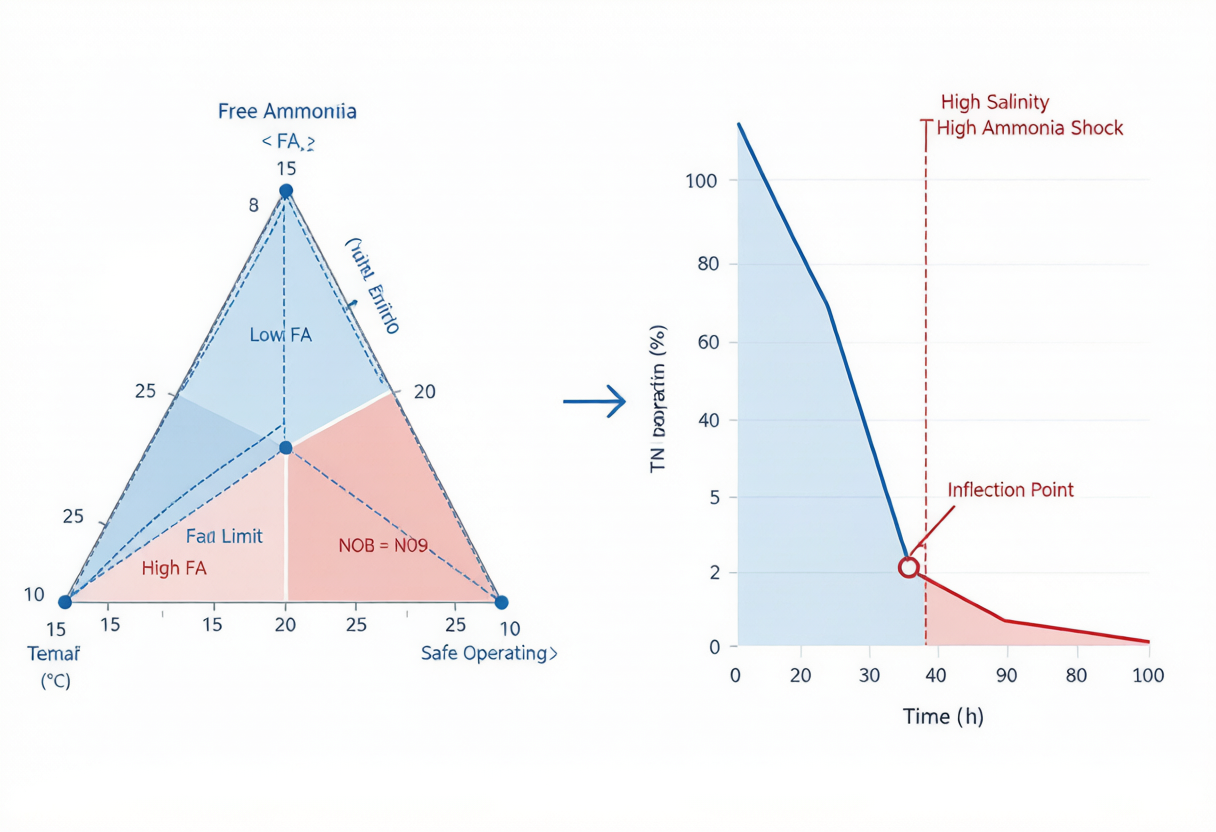
PN/A is not a "install it and relax" process. Besides the high-salinity/high-ammonia shock described above (the case shows TN dropping from 90% to 16%), there are three commonly underestimated risks that should be written into design specifications:
8. Figure index (already embedded in the text)
1. Cover overview (Figure 0): two-stage PN/A process overview, with FA/DO/pH/HRT control points marked;
2. Mechanism figure (Figure 1): three-step enzymatic anammox pathway + PN/A mass balance (ammonia + nitrite → N₂↑ + minor NO₃⁻);
3. Data/risk figure (Figure 2): FA–temperature–NOB inhibition window + cliff-like drop in TN removal under high-salinity/high-ammonia shock (90%→16%).
9. AI preliminary review report
| Check item | Conclusion |
|---|---|
| Word count (narrative only) | About 1845 characters (excluding tables/references/various data boxes/fact-check boxes/figure suggestions; about 4400 Chinese characters in full), meeting the ~2000-character target |
| Format | Uses the series CSS template (720px, blue h2 left border, orange .data, .flag/.check fact-check boxes); complete structure with cover/mechanism/data/compliance figures |
| Sensitive words / compliance risk | Low. Content is published-literature mechanism and data plus peer-reviewed journal citations, with no political/commercial sensitivity; contains 1 commercial-site [to be verified] and 3 fact-check boxes (stoichiometry revision, high-salinity inhibition, low temperature/by-products), requiring manual review before publication |
| Factual and logical consistency | 3 fact-check boxes established: ① the Strous 1998 vs Lotti 2014 stoichiometry discrepancy (1.32 vs 1.146); ② the contradictory contexts of high-salinity tolerance (30 g/L) and high-salinity/high-ammonia shock (90%→16%); ③ low-temperature activity decline + nitrate/N₂O by-product risks. The FA formula is attributed to Anthonisen 1976 |
| Platform adaptation differences | Series superscripts removed, 3 figures embedded in the text; before publication, only final editorial confirmation of the 3 [to be verified] flags and the boundary wording of the fact-check boxes is needed |
- Strous M, et al. Missing lithotroph identified as novel planctomycete. Appl. Environ. Microbiol., 1999; Strous et al. (1998) anammox stoichiometry NH₄⁺ + 1.32 NO₂⁻ + … → 1.02 N₂ + 0.26 NO₃⁻ + … (chemostat experiments)
- Lotti T, et al. (2014). Revised stoichiometry: NH₄⁺ + 1.146 NO₂⁻ + … → 0.986 N₂ + 0.161 NO₃⁻ + … (kinetic experiments and elemental analysis)
- Anthonisen A C, et al. (1976). Classic expression for free ammonia (FA) inhibition of nitrifying/nitritating bacteria [NH₃] = [TAN]/(1+10^(pKa−pH))
- Shao Guangyi, Peng Jianqiang, Zhou Zhongxu, et al. Treatment performance of coal gasification wastewater based on anammox and analysis of carbon reduction and economic benefits [J]. Water & Wastewater Engineering, 2025, 51(6): 58-65. (NH₃-N removal 92.49%, TN >85%, NRR 0.435, cost 2.842 vs 8.018 yuan/m³, carbon −34.72%; PKU core/CSCD)
- "Study on the application of the anammox process in the treatment of textile liquid-ammonia mercerization high-ammonia wastewater" [dissertation]. napstic 0620230900329420. (FA 2–30 mg/L, NAR 93%, ARR 0.942, ARE 93%/TNRE 89%, NO₂⁻/NH₄⁺=1.2; reposted by dowater 2025-08-28)
- "Pilot study on enhancing partial nitritation–anammox nitrogen removal of high-ammonia industrial wastewater in an integrated fixed-film activated sludge system" [J]. Environmental Engineering, 2026, doi:10.13205/j.hjgc.202605002. (influent NH₄⁺-N 2300 mg/L, TN 90.21%, NRR 0.64, AnAOB abundance 35.3%)
- O1/A/O2 partial nitritation–anammox–full nitrification treating coking wastewater [conference paper]. napstic 0720120800168595. (35°C, 115 d start-up, TN 75%, effluent NH₄⁺ <5)
- Partial nitritation–anammox treatment of high-nitrogen wastewater [dissertation]. napstic 0620090400296884. (DO 0.5–1.0, NO₂⁻/NH₄⁺=1.25, HRT 20–25 h holds TN >80%)
- Partial nitritation–anammox treatment of high-ammonia, high-salinity wastewater [dissertation]. napstic 0620180500020369. (at 1600 mg/L NH₄⁺ + 19000 mg/L salinity, TN inhibition 90%→16%)
- Anammox process treatment of high-salinity nitrogenous wastewater. dowater 2010-03-02. (ammonia removal 79%–98.7% at 15–30 g/L salinity)
- Start-up of the Anammox process in a membrane bioreactor. J. Hazard. Mater. / Sciencedirect, 2006 (MSBR; removal rate 710 mg/L·d, μ=0.072 d⁻¹@32°C, yield 0.088 g/g)
- Anaerobic Ammonium Oxidation … (ecoenvbio review). ΔG°′≈−357 kJ/mol, three-step enzymatic mechanism, Strous/Lotti stoichiometry comparison table
- wateretechs.com. MBR+anammox high-ammonia wastewater treatment (Shandong chemical park 500 m³/d, TN 92.7%, 3.8 yuan/t) [commercial content site, values [to be verified]]
Next preview: anammox vs partial nitritation–denitrification — the energy/carbon/investment trade-offs (or the scale-up challenges of single-stage CANON autotrophic nitrogen removal).