


 Nationwide (dyeing, pharma, petrochem, coking, leachate)
 Pilot to full-scale (10s–10,000s m³/d)
Electro-Fenton: On-Demand Hydrogen Peroxide Generation at the Cathode — an Advanced Oxidation Tool for Recalcitrant Industrial Wastewater
Conventional Fenton relies on purchased hydrogen peroxide plus ferrous dosing, with three pain points: H₂O₂ storage and transport risk, high chemical cost, and large iron-sludge volumes. Electro-Fenton merges "oxidant production" and the "Fenton reaction" into a single electrolytic cell: the cathode reduces dissolved oxygen to H₂O₂ in situ, and Fe³⁺ is reduced back to Fe²⁺ at the cathode for recycling. Using the real ledger of published peer-reviewed literature, this article lays out the mechanism, parameters, electrodes, and multi-industry case studies in one go.
1. Principle: cathodic H₂O₂ production + iron cycling — the Fenton reaction driven by electrolysis
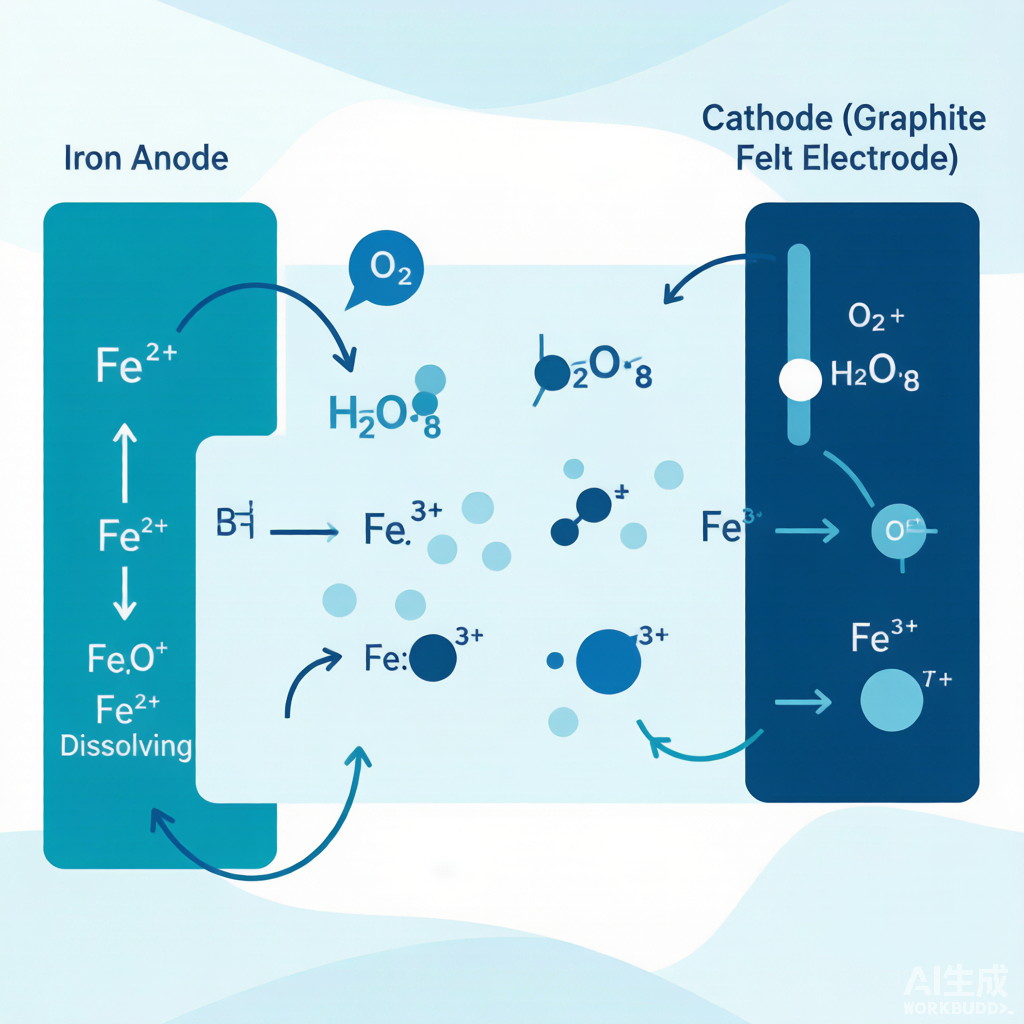
The core of electro-Fenton is three coupled reactions running in a closed loop inside the electrolytic cell (the mechanism is long-standing scientific consensus, with consistent equations given in the Bohrium and lvxunhk technical reviews):
- Cathodic H₂O₂ production (2e⁻ oxygen reduction): O₂ + 2H⁺ + 2e⁻ → H₂O₂. Air/oxygen is fed to the cathode, reducing dissolved oxygen to hydrogen peroxide under acidic conditions — this is precisely the key to EF replacing purchased H₂O₂.
- The main Fenton reaction: Fe²⁺ + H₂O₂ → Fe³⁺ + ·OH + OH⁻. The ·OH produced (standard redox potential 2.80 V vs NHE) is non-selective and strongly oxidizing, attacking the vast majority of organics.
- Iron ion regeneration (the key to the closed loop): Fe³⁺ + e⁻ → Fe²⁺. The Fe³⁺ oxidized during the reaction is reduced back to Fe²⁺ at the cathode, so the catalyst is recycled and iron sludge is markedly reduced.
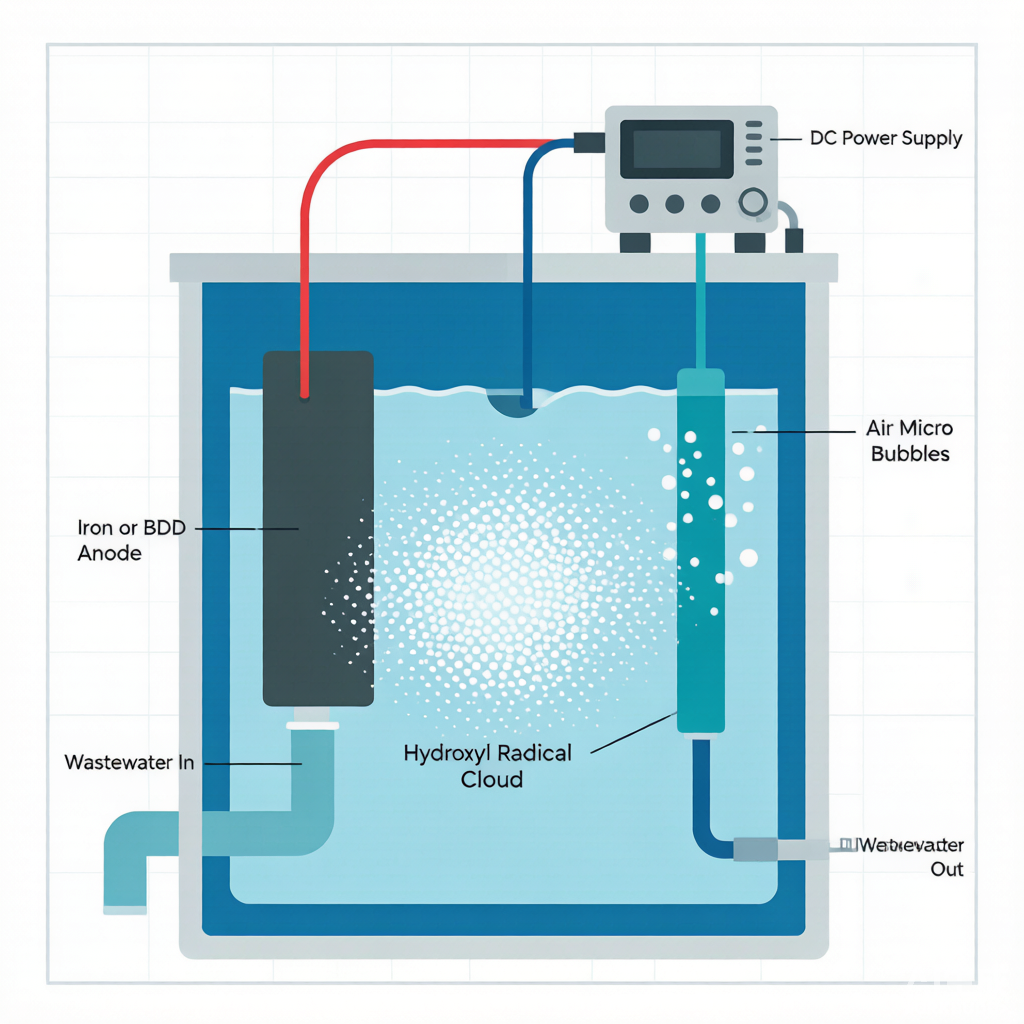
The anode is mostly an iron plate (dissolving to replenish Fe²⁺) or an inert electrode such as BDD (boron-doped diamond) or DSA (conductive but not iron-dissolving). The whole system is "driven on demand" by electric current — a self-sustaining degradation loop.
2. Three core parameters: pH, current density, and Fe²⁺ dosage (the basics for selection)
EF is a "condition-sensitive" process; these three parameters determine whether radical yield and iron cycling run smoothly.
① pH ≈ 3 (the optimum window for the Fenton reaction, about 2.5–4)
Decades of research show EF performs best under acidic conditions, especially at pH≈3. Experiments in the Chinese Research Academy of Environmental Sciences' "Electro-Fenton Process Optimization White Paper (2026)" show COD removal peaking at 89% at pH 2.8–3.2; beyond that the efficiency drops by more than 40% — the root cause being that as pH rises, Fe³⁺ hydrolyzes to Fe(OH)₃ precipitate, "locking" the catalyst in the solid phase so it cannot cycle. For chlorinated organics (Cl⁻ >2000 mg/L), pH should be lowered to 2.5–2.8 and H₂O₂ dosage increased by 15%–20%.
② Current density (CD): typically 5–30 mA/cm²; too high only adds energy consumption and electrode wear
Most studies control CD at 5–30 mA/cm² (lvxunhk technical review). But higher CD is not always better: too high a CD aggravates polarization, increases side reactions (self-reduction of H₂O₂, hydrogen evolution), and accelerates electrode wear. Commercial operating experience notes that CD above 100 mA/cm² markedly accelerates electrode wear, so 50–80 mA/cm² is preferred. A study using a stainless-steel anode to degrade benzyl chloride achieved good removal in 40 min at pH 3, CD=3 mA/cm² (Hanspub; low current because the iron anode dissolves iron slowly).
③ Fe²⁺ dosage: 0.1–1.0 mmol/L
The catalyst dosage of Fe²⁺ supplied externally or by anodic iron dissolution is on the order of 0.1–1.0 mmol/L (lvxunhk). Excess Fe²⁺ competes with ·OH and produces more iron sludge; insufficient Fe²⁺ limits radical production. A landfill-leachate concentrate study achieved 61% COD removal at Fe²⁺=1 mmol/L, CD=25 mA/cm², pH 3.0 (napstic dissertation).
3. Cathode materials and reactors: GDE is the decisive factor in H₂O₂ production
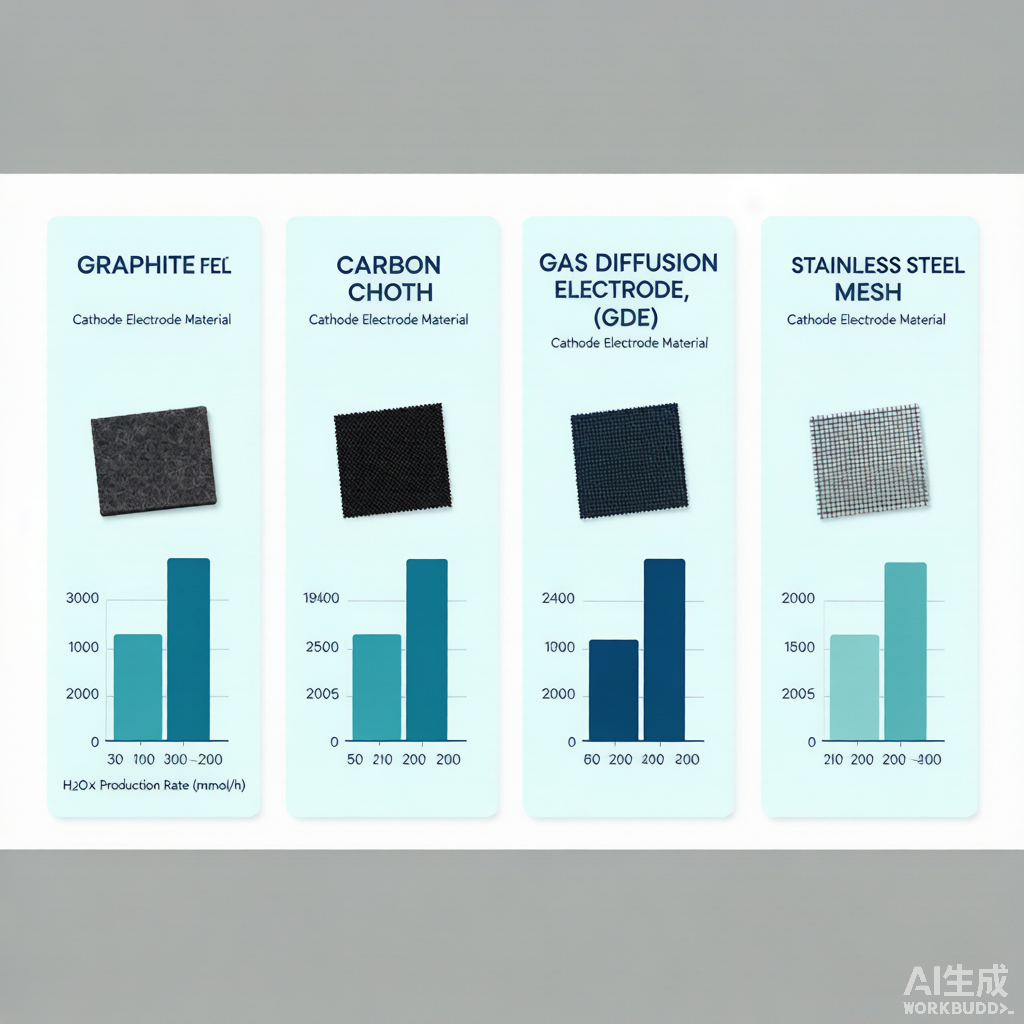
The ceiling of EF efficiency is set by the "cathodic 2e⁻ oxygen-reduction H₂O₂ production rate." Dissolved oxygen solubility in water is only about 8 mg/L, so mass transfer is the rate-limiting step — which is exactly the value of the gas diffusion electrode (GDE): it builds the gas–liquid–solid three-phase interface inside the electrode itself, using oxygen directly from air and eliminating or reducing aeration. Recent peer-reviewed literature reports striking data:
| Cathode / electrode system | H₂O₂ production rate / yield | Current efficiency | Energy efficiency / stability | Source |
|---|---|---|---|---|
| Self-breathing GDE (CNT/carbon nitride/PTFE-graphite felt, 2024) | 45.83 mg·L⁻¹·cm⁻²·h⁻¹ | — | Phenol 92% / bisphenol A 95% (60 min) | ScienceDirect 2024 |
| CB/PTFE GDE (nitrobenzene groundwater) | 312.3 mg·L⁻¹·h⁻¹ | 84.2% (average) | 15.4 kWh·kg⁻¹ H₂O₂; maintained 94.6% over 810 min continuous | Tsinghua University dissertation |
| CB-PTFE active GDE (sulfamethazine) | 32.09 mg·h⁻¹·cm⁻² | 80.18% | No mechanical aeration required | Sci. Total Environ. 2020 |
| 3D GDE (amoxicillin) | 398 mg/L (150 min) | 70% | 9.7 kWh·kg⁻¹; maintained 385 mg/L after 10 cycles | J. Environ. Chem. Eng. 2022 |
| CB/PTFE GDE (decentralized H₂O₂) | ~202 mg·h⁻¹·cm⁻² | >80% (5–400 mA/cm²) | <10 kWh/kg H₂O₂ (42 days); cost ~0.88 $/kg | Front. Environ. Sci. Eng. 2021 |
4. Process comparison: EF vs conventional Fenton vs ozone/H₂O₂-type AOPs
| Dimension | Electro-Fenton (EF) | Conventional chemical Fenton | Ozone / O₃-H₂O₂ |
|---|---|---|---|
| H₂O₂ source | Cathodic in-situ generation (no storage/transport) | Purchased dosing (storage/transport risk) | On-site ozone generation + external H₂O₂ |
| Iron / catalyst | Anodic iron dissolution or external dosing, Fe²⁺ electrochemically regenerated | External FeSO₄, not recycled | No iron needed (homogeneous catalysis optional) |
| Iron sludge volume | Low (commercially cited ~1/5) | High | Low (no iron sludge) |
| Optimum pH | 2.5–4 | 2.5–4 (Fenton range) | Ozone 6–9 / O₃-H₂O₂ slightly alkaline (process-dependent) |
| Energy profile | Uses electricity but saves chemicals; commercial data cite 1/3–1/2 the energy of conventional Fenton | Chemical cost dominant | Ozone generation energy-intensive (about 8–12 kWh/kg O₃ for an oxygen source) |
| Typical COD removal | 80–95% (water-quality and condition dependent) | 60–90% | 50–90% depending on pollutant and catalyst |
| Application positioning | Pretreatment / advanced treatment of recalcitrant wastewater | Pretreatment of recalcitrant wastewater | Advanced treatment of recalcitrant wastewater |
5. Five pitfalls engineering must watch closely
1. pH control is the first lifeline
When pH deviates from 2.5–4, Fe³⁺ hydrolyzes to Fe(OH)₃ precipitate, iron cycling stalls, and efficiency drops off a cliff. Online pH/ORP feedback plus gradient acid dosing is recommended, with accuracy up to ±0.1.
2. Mass transfer sets the ceiling on H₂O₂ production — prioritize GDE
Dissolved oxygen solubility is only ~8 mg/L, so submerged cathodes easily "starve for oxygen." The GDE moves the oxygen source inside the electrode, which is key to improving efficiency and cutting cost. The peer-reviewed GDE studies above achieve H₂O₂ production of several hundred mg/(L·h) with current efficiency >80%.
3. Energy consumption and current efficiency must be reckoned per "kg COD"
A landfill-leachate concentrate study measured: at 10 V and 60 min, current efficiency fell from 50% to 30% and energy consumption rose from 5.6 to 9.7 kWh/kgCOD — the longer the reaction time, the lower the efficiency and the higher the energy. Decentralized GDE H₂O₂ production can be pushed below <10 kWh/kg H₂O₂, an important fulcrum of economic viability.
4. Cl⁻/Br⁻-containing wastewater carries by-product risk
High-salinity, halogen-containing wastewater may generate active chlorine / bromate and other by-products at the anode (analogous to the bromate risk of ozone oxidation of bromide-containing wastewater). Chlorinated organics require lowering pH and increasing H₂O₂ dosage; halogenated by-products should be tested before discharge.
5. Iron sludge, though reduced, must still be properly disposed of, and electrodes need maintenance
EF iron sludge is about 1/5 of conventional Fenton but is still iron-bearing sludge; the cathode active layer can detach and the anode can passivate, requiring periodic inspection (oxalic acid cleaning, etc.). Commercial data cite electrode lifetimes of 2–3 years.
6. One-line selection advice
Suitable for: recalcitrant organic wastewater with complex composition, high toxicity, and poor biodegradability (low B/C) — printing and dyeing, pharmaceutical, petrochemical, coking, landfill leachate, etc. — as pretreatment before biological treatment (raising B/C from 0.1 to 0.4–0.7) or as an advanced-treatment upgrading unit.
Not suitable for: simply high-volume, low-concentration, readily biodegradable wastewater — for that, direct biological treatment is more economical. Reserve EF for the "hard bones" that need ring cleavage, improved biodegradability, or strict compliance, and prioritize a GDE cathode plus online pH control.
References (real sources)
- Phan Q H H, Dinh N T, Tran T T, et al. Fe²⁺, Fe³⁺, Co²⁺ as highly efficient cocatalysts in the homogeneous electro-Fenton process for enhanced treatment of real pharmaceutical wastewater. Journal of Water Process Engineering, 2022, 46:102635 (doi:10.1016/j.jwpe.2022.102635).
- Wang Y, Chen J, Gao J, et al. Selective electrochemical H₂O₂ generation on the graphene aerogel for efficient electro-Fenton degradation of ciprofloxacin. ScienceDirect, 2021 (volume/issue/doi to be supplemented).
- Treatment of olefin plant spent caustic wastewater using electro-Fenton technique. Ain Shams Engineering Journal, 2017 (ScienceDirect, pii/S1110062117301204).
- Study on treatment of landfill leachate concentrate by cathodic electro-Fenton and energy-consumption assessment. napstic dissertation (0620170300406975).
- Real dyeing wastewater treated by electro-Fenton using drinking-water treatment sludge as catalyst. RSC Advances, 2021 (doi:10.1039/d1ra04049a).
- Parametric study of electro-Fenton treatment for real textile wastewater, disposal and cost analysis. J. Environ. Sci. Tech., 2019, 16:801.
- Chen Yufeng, Fang Yi, Cheng Wei, et al. Pilot study on treatment of industrial dyeing wastewater with electro-generated Fenton's reagent. Journal of Fujian Normal University (Natural Science Edition), 2005, 21(2):58-61.
- Enhancing H₂O₂ production with a self-breathing gas diffusion electrode (CNT/carbon nitride/PTFE on graphite felt). ScienceDirect, 2024 (pii/S1572665724002376).
- Tsinghua University dissertation: electro-generation of H₂O₂ with a carbon black/polytetrafluoroethylene (CB/PTFE) gas diffusion electrode and its degradation of nitrobenzene (newetds.lib.tsinghua.edu.cn, sysId 232774).
- Electro-Fenton and photoelectro-Fenton degradation of sulfamethazine using an active gas diffusion electrode without aeration. Science of The Total Environment, 2020 (doi to be supplemented).
- A three-dimensional gas diffusion electrode without external aeration for producing H₂O₂ and eliminating amoxicillin. Journal of Environmental Chemical Engineering, 2022 (doi:10.1016/j.jece.2022.107301).
- Liu C, et al. Technoeconomic feasibility of electrochemical H₂O₂ production with GDE for decentralized water treatment. Frontiers of Environmental Science & Engineering, 2021, 15:1.
- Electro-Fenton mechanism and parameter review (Bohrium Science Encyclopedia / lvxunhk electrochemical water treatment technical analysis), used for cross-checking reaction equations and parameter ranges.