


 Nationwide (coking, petrochem, dyeing, electroplating, paper, leachate)
 Pilot to full-scale (10s–1,000s m³/d)
Persulfate-Activated Advanced Oxidation (PS-AOP): Sulfate Radical SO₄·⁻ Tears Apart "Recalcitrant" Organics — One More Tool for Industrial Wastewater Advanced Treatment
Beyond Fenton, ozone, and electro-Fenton, there is still a "sulfate-radical blade" for the advanced treatment of recalcitrant industrial wastewater. Persulfate itself is quite "lazy" at room temperature; it must be "snapped" at its peroxide bond by heat, iron, cobalt, or UV to release the strongly oxidizing sulfate radical SO₄·⁻. Using publicly available peer-reviewed literature and real engineering accounts, this article explains the mechanism, the five activation routes, and the key parameters in one pass.
I. Principle: How Persulfate Becomes a Sulfate Radical
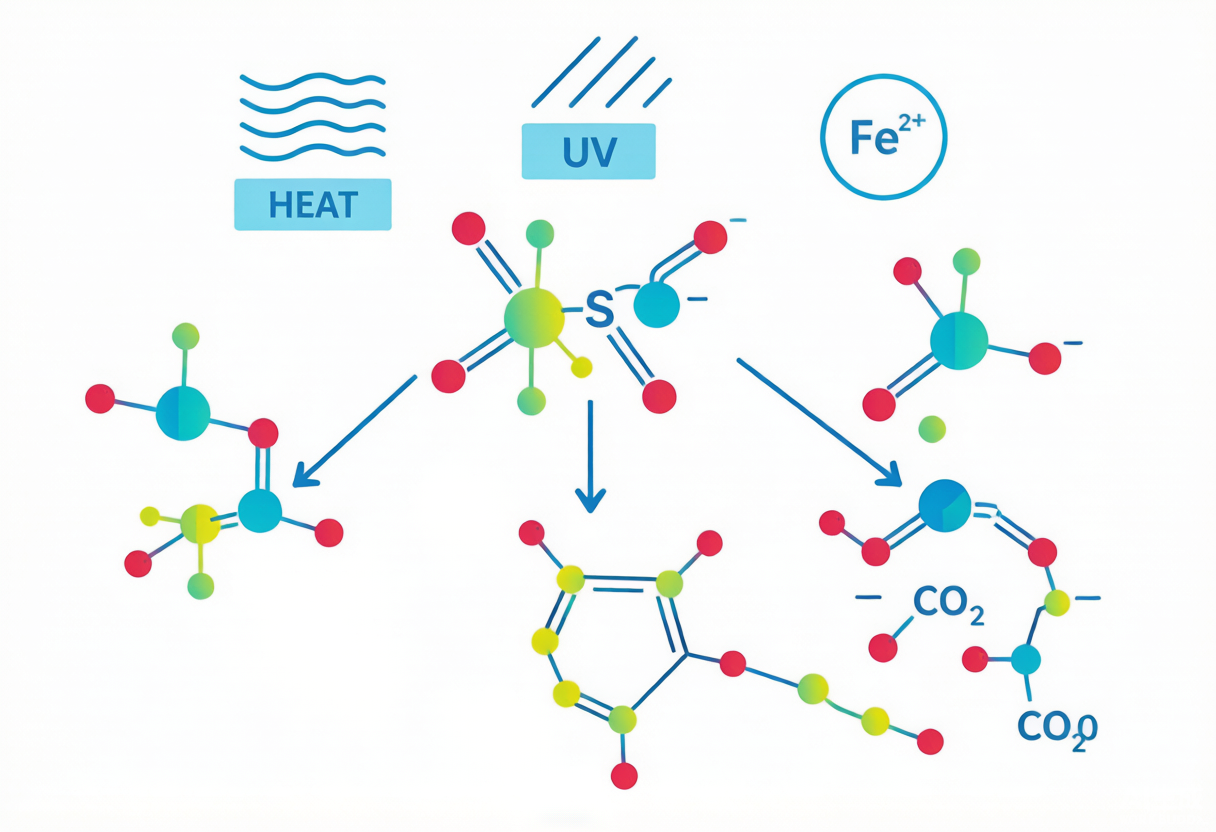
Persulfate has two precursor families: peroxydisulfate S₂O₈²⁻ (PDS, e.g. sodium persulfate Na₂S₂O₈, potassium persulfate K₂S₂O₈) and peroxymonosulfate HSO₅⁻ (PMS, trade name Oxone). PDS is cheaper, more stable, and easier to store and transport; PMS is more reactive with metals and has a lower activation energy, making it the workhorse of cobalt/iron-based activation research.
The core of activation is a single step — "snapping" the peroxide bond to release two radicals:
S₂O₈²⁻ + (heat / UV / transition metal) → 2 SO₄·⁻
The sulfate radical has a standard redox potential of E° = 2.5–3.1 V (vs NHE), higher than ·OH’s 1.8–2.7 V (Xia et al., Front Chem 2020 review; the PFOS degradation review also cites 2.5–3.1 eV). Its half-life is about 30–40 μs (Li et al., 2019, cited in Front Chem 2020), markedly longer than ·OH, meaning it has more mass-transfer time between formation and "colliding" with the pollutant.
The two also differ mechanistically: SO₄·⁻ attacks electron-rich, aromatic structures mainly via electron transfer, giving it greater selectivity, whereas ·OH operates mainly via H-abstraction and is almost indiscriminate. Consequently, SO₄·⁻ remains effective in buffer systems containing carbonate/phosphate, while ·OH is readily quenched by these background anions (Front Chem 2020).
Why would an industrial site reach for SO₄·⁻? Fenton relies on H₂O₂ and only works efficiently at pH 2–4; many industrial wastewaters (especially near-neutral, carbonate-buffered ones) are costly to acidify and generate large volumes of iron sludge. SO₄·⁻ is both stronger and effective over a wider pH, with greater "targeting" ability toward electron-rich structures such as benzene rings, azo bonds, and polycyclic aromatic hydrocarbons. This is the practical motive behind its use in advanced treatment of coking, printing-and-dyeing, and pharmaceutical tail water — not to replace Fenton, but to add another blade for operating windows where Fenton "cannot reach".
II. Five Mainstream Activation Routes + Real Case Data
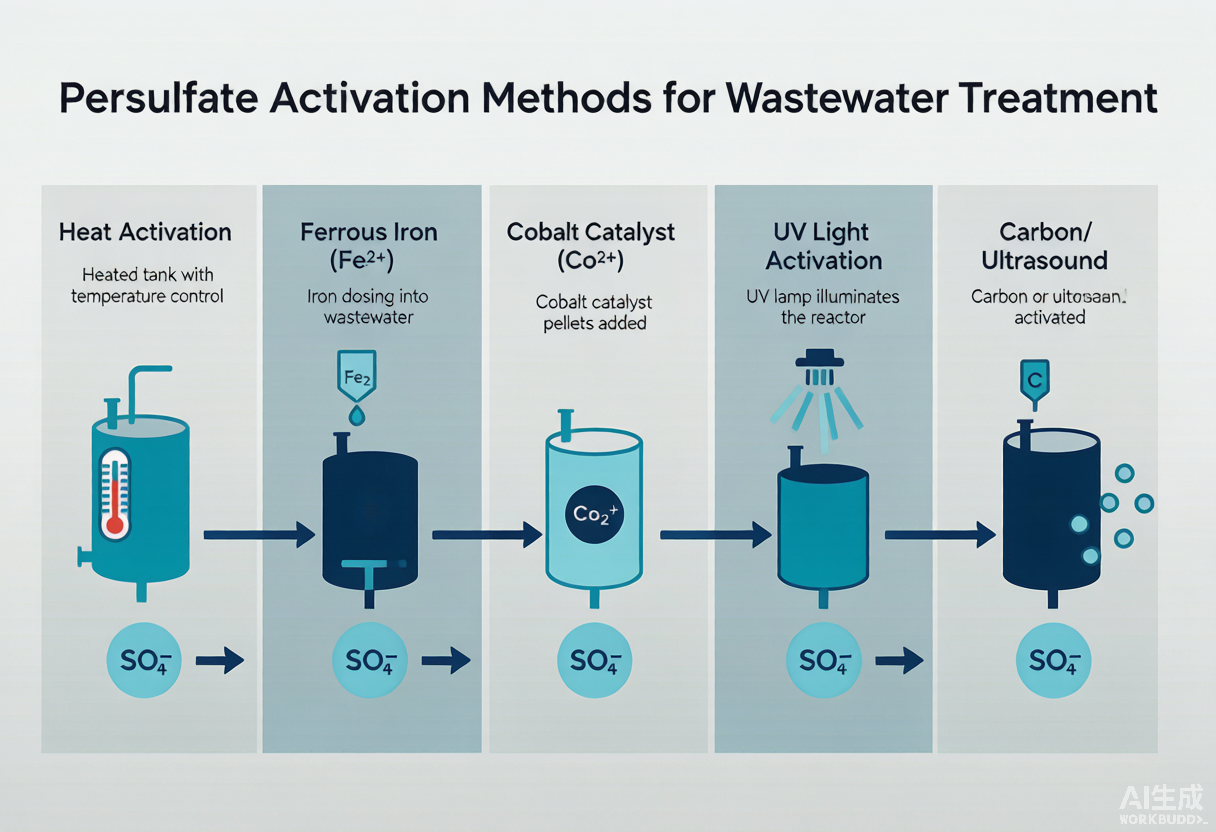
PDS or PMS? PDS (sodium/potassium persulfate) is cheap, stable, and easy to store and transport, suited to bulk dosing for heat or UV activation; PMS (peroxymonosulfate) is more reactive with metals (Fe, Co) and has a lower activation energy, making it the mainstream of metal-activation research and application. In practice, the precursor is chosen by activation route: metal catalysis favors PMS, while bulk oxidation by heat/UV can use PDS. The data for the five routes below all come from public literature and engineering measurements.
① Thermal activation (the most "straightforward" and the most energy-hungry)
S₂O₈²⁻ + heat → 2 SO₄·⁻. The activation energy varies with pH: 100–116 (acidic), 119–129 (neutral), 134–139 kJ/mol (alkaline) (House 1961; Matzek & Carter 2016). Below 30°C there is almost no activation (half-life of days to months); at 40–70°C the half-life drops to hours or even minutes, with 50–70°C the usual optimum window. Temperature is extremely sensitive: for prometryn (spiramycin), removal rose from 53.5% (60 min) at 40°C to 97% (60 min) at 50°C, 88% (20 min) at 60°C, and 100% (20 min) at 70°C (Wang et al., 2021, thermal activation review).
A representative recalcitrant industrial wastewater case: DDNP (dinitrodiazophenol) industrial wastewater treated by heat-activated persulfate (RSC Adv 2018, Wei et al., doi:10.1039/c8ra01995a). Under optimal conditions of 90°C, 75 min, PS 20 g/L, and pH≈2.0, the results were COD removal of 99.22%, color removal of 99.99%, and DDNP removal of 99.99%, with BOD₅/COD rising from 0 to 0.31 — a marked improvement in biodegradability.
② Fe²⁺ / zero-valent iron activation (the most common in engineering)
Fe²⁺ + S₂O₈²⁻ → SO₄·⁻ + Fe³⁺ + SO₄²⁻. Electroplating-additive production wastewater (Fe²⁺-activated sodium persulfate, effluent after two-stage Fenton at a Guangzhou plant; napstic dissertation): the rate constant is highest at pH 3 (k = 0.01228 min⁻¹); at n(Fe²⁺):n(PS) = 1.25, COD drops 30.3% in 30 min; at c(S₂O₈²⁻) = 9 mmol/L, COD drops 35.6% in 30 min (k = 0.01544 min⁻¹), consistent with first-order kinetics.
Papermaking secondary effluent (zero-valent iron ZVI / sodium persulfate, Guo Xin et al., South China University of Technology, 2013): at pH 3, ZVI 8 g/L, PS 4 g/L, 3 h reaction, CODCr degradation was 57.5% (initial pH 3) / 34.2% (unadjusted pH), with color removal of 83% / 89%. Coking tail water (solid catalyst / zero-valent iron activation, cqvip): zero-valent iron was the best activator; at COD:Na₂S₂O₈ = 1:6, COD degradation was 73% and color dropped to 17×, with preferential attack selectivity toward cyanide and thiocyanate.
③ Co²⁺ activation (highest efficiency, but with a toxicity cost)
Co²⁺ + HSO₅⁻ → Co³⁺ + SO₄·⁻ + OH⁻. In a comprehensive cost comparison across multiple metal ions, Anipsitakis & Dionysiou found Co²⁺ to be the optimal activator; Co/PMS outperforms Fenton across pH 3–9 (for 2,4-DCP and atrazine) with higher mineralization (Environ. Sci. Technol. 2003/2004, PubMed 14594393). ⚠️ However, cobalt carries toxicity and secondary-pollution risk and is environmentally restricted in engineering, so practice has largely shifted to heterogeneous cobalt/iron-based solid catalysts (e.g. Co(OH)F@MXenes, Fe-Co/SBA-15) to avoid metal leaching.
④ UV activation (chemical-free, but limited by light transmission)
UV-C irradiation of S₂O₈²⁻ or HSO₅⁻ can directly photolyze them into SO₄·⁻ (and can be combined with heat/ultrasound). Antipyrine wastewater treated by combined UV-C + heat + ultrasound activation (J. Hazard. Mater. 2016, Monteagudo et al., doi:10.1016/j.jhazmat.2015.12.001) achieved near-complete mineralization of intermediates that ·OH can hardly mineralize, at [S₂O₈²⁻] = 1200 mg/L, 50°C, pH 2.8, and about 120 min. (Specific UV activation quantum yield [to be supplemented])
⑤ Microwave / carbon materials / ultrasound-electro coupling (emerging directions)
Landfill leachate microwave activation (napstic dissertation): microwave alone achieved 68.28% COD removal (sodium persulfate) / 61.61% (peroxymonosulfate) in 20 min, better than the 64.48% / 58.85% of water-bath heating; microwave + Fe₃O₄ combined activation reached 92.87% COD removal (sodium persulfate) / 83.91% (peroxymonosulfate) at Fe₃O₄ 0.05 mol/L, PS 0.1 mol/L, 700 W, pH 5, 20 min. High-salinity petrochemical wastewater treated with ultrasound-electro coupled persulfate (peer-reviewed study, journal [to be supplemented]) achieved 82.31% COD removal (ultrasound-electro-persulfate) at pH 3, 300 W, 130 kHz, 10 V, PS 20 mM, versus 68.97% for electro activation alone, reaching a maximum of 91.2% at 333 K and 120 min.
| Activation route / wastewater | Optimal conditions | Removal performance | Source |
|---|---|---|---|
| Thermal activation / DDNP industrial wastewater | 90°C, 75 min, PS 20 g/L, pH≈2.0 | COD 99.22%, color 99.99%, BOD₅/COD 0→0.31 | RSC Adv 2018, Wei et al. |
| Fe²⁺ activation / electroplating-additive wastewater | pH3, n(Fe²⁺):n(PS)=1.25, PS 9 mmol/L, 30 min | COD −35.6% (optimal dose) | napstic dissertation |
| ZVI zero-valent iron / papermaking secondary effluent | pH3, ZVI 8 g/L, PS 4 g/L, 3 h | COD 57.5%, color 83% | Guo Xin et al., SCUT 2013 |
| Solid catalyst-ZVI / coking tail water | COD:Na₂S₂O₈=1:6 | COD 73%, color→17× | cqvip dissertation/journal |
| Microwave + Fe₃O₄ / landfill leachate | Fe₃O₄ 0.05 mol/L, PS 0.1 mol/L, 700 W, pH5, 20 min | COD 92.87% (sodium persulfate) | napstic dissertation |
| Ultrasound-electro coupling / high-salinity petrochemical wastewater | pH3, 300 W, 130 kHz, 10 V, PS 20 mM | COD 82.31% (91.2% at 333 K) | peer-reviewed study |
Viewed across the board, none of the five routes is a "universal solution": thermal activation is water-agnostic but energy-hungry; Fe²⁺ is cheap and compliant but requires pH and iron-sludge control; Co²⁺ is fastest but toxic; UV is chemical-free but limited by light transmission and turbidity; microwave/ultrasound-electro coupling is efficient but equipment-intensive. The essence of selection is balancing oxidant cost, activation energy, secondary pollution, and on-site conditions.
III. Key Parameter Essentials (all a matter of "too much is as bad as too little")
- pH: acidic conditions are best for the Fe²⁺ system (pH 2–3, highest rate); Co/PMS can extend to pH 3–9; heat/UV are relatively less pH-sensitive, but under alkaline conditions the mechanism has effectively shifted to ·OH. Carbonate/phosphate buffer systems quench SO₄·⁻, though more weakly than they quench ·OH.
- Dosage — "too much is as bad as too little": excess persulfate causes radical self-quenching (2 SO₄·⁻ → S₂O₈²⁻); excess Fe²⁺ is instead oxidized by SO₄·⁻ (Fe²⁺ + SO₄·⁻ → Fe³⁺ + SO₄²⁻). In PAH studies, Fe²⁺:Na₂S₂O₈ = 1:10 was optimal while 1:5 declined; for electroplating wastewater, c(S₂O₈²⁻) = 9 mmol/L was optimal and excess was inhibitory.
- Temperature: thermal activation is extremely temperature-sensitive; the rate constant rises more than 100-fold from 40 to 70°C, and below 30°C it is nearly ineffective — room-temperature wastewater relying on "thermal activation" must first be heated.
- Reaction time: typically tens of minutes to several hours (DDNP 75 min, papermaking 3 h, microwave 20 min, antipyrine 120 min), requiring residence-time design in conjunction with dosage.
- Anion quenching: Cl⁻, HCO₃⁻, CO₃²⁻, and humic acid compete for radicals; real wastewaters often require higher doses or preconditioning.
IV. Process Comparison: PS-AOP vs Fenton vs Ozone vs Electro-Fenton
| Process | Primary radical / oxidant | Optimum pH | Oxidant / reagent | Sludge / by-products | Suitable scenarios |
|---|---|---|---|---|---|
| PS-AOP (heat/Fe²⁺/UV) | SO₄·⁻ (plus ·OH) | 2–8 (wide) | persulfate PDS/PMS | sulfate accumulation; Fe²⁺ produces iron sludge; Co toxicity | deep oxidation of recalcitrant COD, improved biodegradability |
| Fenton | ·OH | 2–4 (narrow) | H₂O₂ + Fe²⁺ | large iron-sludge volume | recalcitrant wastewater at low pH |
| Ozone O₃ / catalytic | ·OH (indirect) | 6–9 | O₃ | bromate risk in bromide-containing water | decolorization, odor removal, partial COD |
| Electro-Fenton (EF) | ·OH (in-situ H₂O₂) | ≈3 | electric field + Fe anode | less iron sludge | low-to-medium concentration, in-situ reagent generation |
V. Engineering Reality Check: Don’t Let Lab Data Mislead You
VI. One-Line Selection Advice
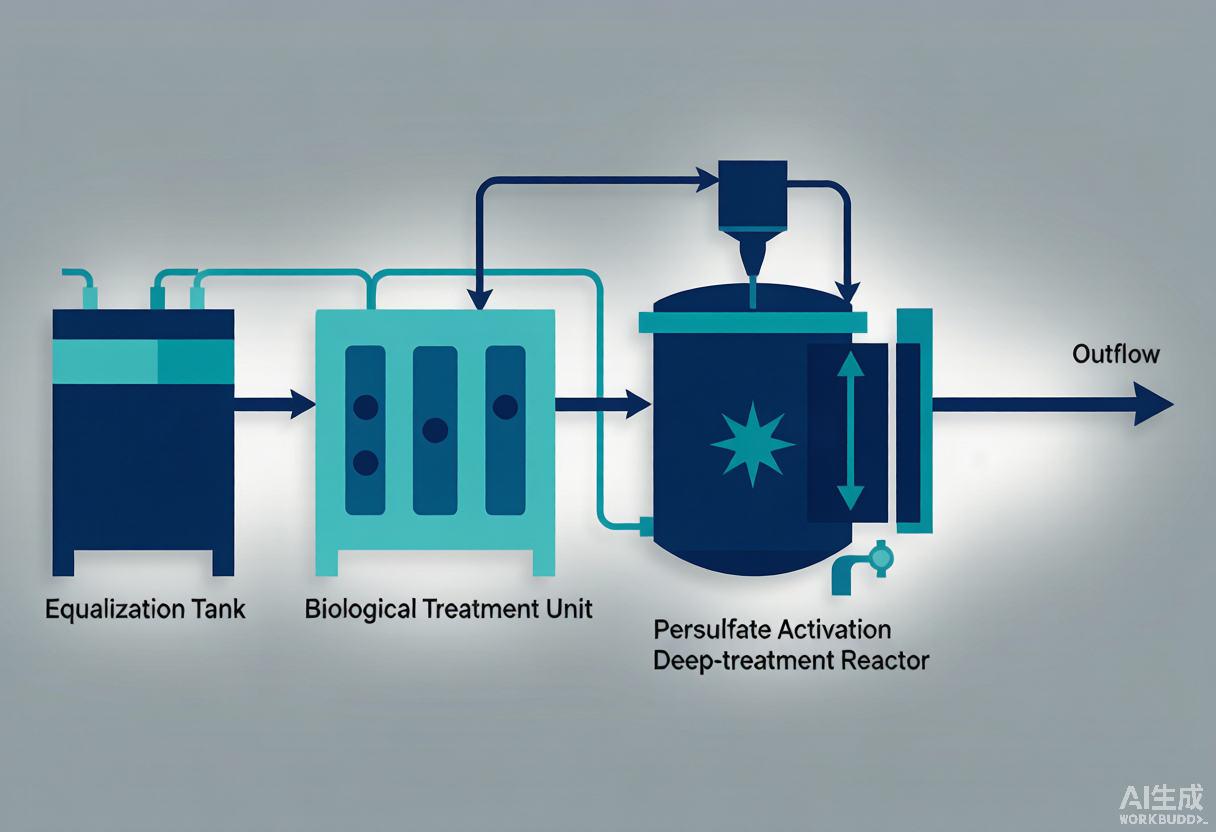
Suitable for: industrial wastewater that still fails standards after biological treatment (recalcitrant COD / toxicity / color), needs improved biodegradability (B/C), or requires deep removal of specific micropollutants (pharmaceuticals, pesticides, dyes); it is also widely used for in-situ chemical oxidation (ISCO) of groundwater. Public cases exist for coking, petrochemical, printing-and-dyeing, electroplating, papermaking, and landfill leachate.
Not suitable for: high-volume primary treatment that pursues the lowest cost alone; scenarios with restricted high-sulfate discharge and no dilution/segregation conditions; and high-temperature thermal activation where there is neither a heat source nor metal-recovery support.
References (real sources)
- Xia X, Zhu F, Li J, et al. A Review Study on Sulfate-Radical-Based Advanced Oxidation Processes for Domestic/Industrial Wastewater Treatment: Degradation, Efficiency, and Mechanism. Frontiers in Chemistry, 2020, 8:743 (doi:10.3389/fchem.2020.00743, PMC7729018).
- Matzek L W, Carter K E. Activated persulfate for organic chemical degradation: A review. Chemosphere, 2016, 151:178-188 (doi:10.1016/j.chemosphere.2016.02.055).
- Anipsitakis G P, Dionysiou D D. Degradation of organic contaminants in water with sulfate radicals generated by the conjunction of peroxymonosulfate with cobalt. Environmental Science & Technology, 2003, 37(20):4790-4795 (PubMed 14594393).
- Wei L, Chen W, Li Q, et al. Treatment of dinitrodiazophenol industrial wastewater in heat-activated persulfate system. RSC Advances, 2018, 8:20603-20611 (doi:10.1039/c8ra01995a).
- Monteagudo J M, Durán A, Latorre J, Expósito A J. Application of activated persulfate for removal of intermediates from antipyrine wastewater degradation refractory towards hydroxyl radical. Journal of Hazardous Materials, 2016, 306:77-86 (doi:10.1016/j.jhazmat.2015.12.001).
- Guo Xin, et al. Advanced oxidation technology based on sulfate radicals for advanced treatment of papermaking secondary effluent (CODCr 160 mg/L). South China University of Technology, 2013 (industrial water treatment category, file_no 201304048).
- Heterogeneous sulfate-radical advanced treatment of coking tail water (zero-valent iron as the best activator, COD:Na₂S₂O₈ = 1:6). cqvip dissertation/journal, id 6100253358.
- Advanced oxidation technology based on sulfate radicals for advanced treatment of electroplating-additive production wastewater (Fe²⁺/sodium persulfate). napstic dissertation, 0620170300261512.
- Microwave-activated sulfate radicals and their application (landfill leachate: microwave/water-bath/Fe₃O₄ combined activation comparison). napstic dissertation, 0620191200010589.
- Sonoelectro-activated persulfate for mineralization of high saline petrochemical wastewater: mechanisms and kinetics. Peer-reviewed study (pH 3, 300 W, 130 kHz, 10 V, PS 20 mM → COD 82.31%). Journal name [to be supplemented].
- Heat-activated persulfate for the degradation of micropollutants in water: a comprehensive review and future perspectives. Review, 2022 (identifies scale-up and energy consumption as the main bottlenecks). Journal name/volume/pages [to be supplemented].
- Research progress on degradation of environmental organic pollutants by activated peroxymonosulfate technology. Research of Environmental Sciences, 2021 (doi:10.13198/j.issn.1001-6929.2021.08.09).
- House D A. Kinetics and mechanism of persulfate reactions (source of activation energy 100–139 kJ/mol data). Chem Rev, 1962.