



 Nationwide (food, brewing, starch, pharma, MSG, paper)
 Pilot to full-scale (10s–10,000s m³/d)
UASB (Upflow Anaerobic Sludge Blanket): An "Oxygen-Free" Bed That Turns High-Strength Organic Wastewater into Biogas — Industrial Emission Reduction That Pays Back in Energy
Aerobic treatment (activated sludge, MBR) requires constant aeration and is electricity-intensive, whereas UASB relies on anaerobic bacteria in a "sealed vessel" to convert organics into biogas — consuming almost no oxygen, producing only 1/5–1/10 of the sludge of aerobic systems, and recovering methane as energy. Using Chinese technical specifications, classic textbooks, and peer-reviewed measurements from monosodium glutamate (MSG) and distillery stillage, this article lays out the mechanism, design parameters, engineering accounts, and how to choose among three generations of anaerobic reactors.
I. Principle: Bottom Water Distribution + Sludge Bed + Three-Phase Separator — Granular Sludge Is the Soul
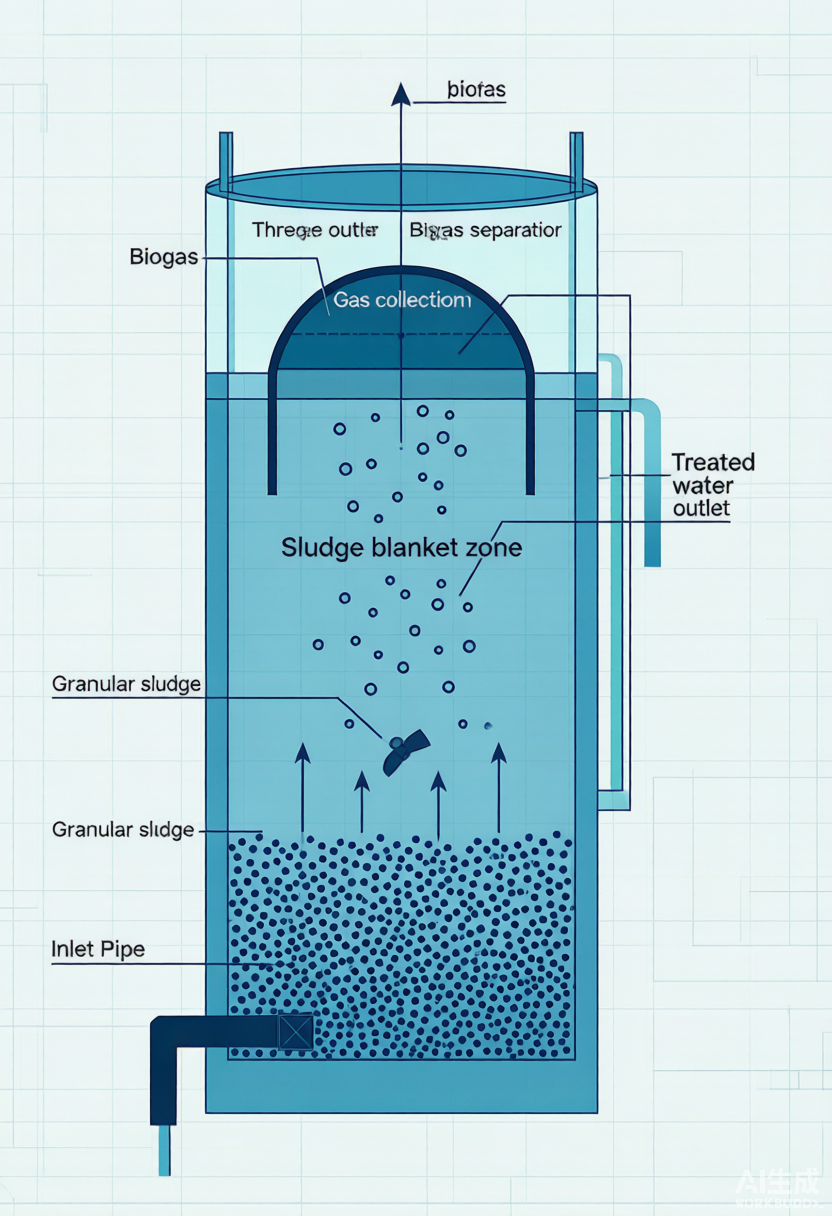
The UASB’s structure is extremely simple yet ingenious, comprising four parts from bottom to top: the bottom water-distribution system, the reaction zone (sludge bed + sludge blanket), the top three-phase separator (GLSS), and the gas collector. Wastewater enters uniformly from the bottom and flows upward through a dense granular sludge bed, where organics are progressively decomposed by hydrolytic — acidogenic — methanogenic consortia, ultimately producing biogas dominated by CH₄ (about 50%–70%) and CO₂. Rising bubbles carry the sludge-water mixture upward; at the top three-phase separator, gas is captured by the collector, sludge settles back to the bed under its own weight (granule settling velocity up to 18–100 m/h), and clarified water overflows from the effluent weir.
The entire reactor has no mechanical mixing and no aeration; mixing relies entirely on the upward water flow and biogas lift — the root reason its energy consumption is only 1/10 of aerobic treatment. What truly makes it "efficient" is the granular sludge layer: granulated methanogens lock slow-growing microorganisms (generation times of up to ten-plus days) inside the reactor, so the SRT (sludge retention time) far exceeds the HRT, sustaining high loading even at an HRT of only 6–24 h. If granulation fails, the UASB degenerates into an ordinary anaerobic tank.
II. Core Parameters: OLR, HRT, Upflow Velocity, Temperature, Alkalinity/VFA (the Selection Fundamentals)
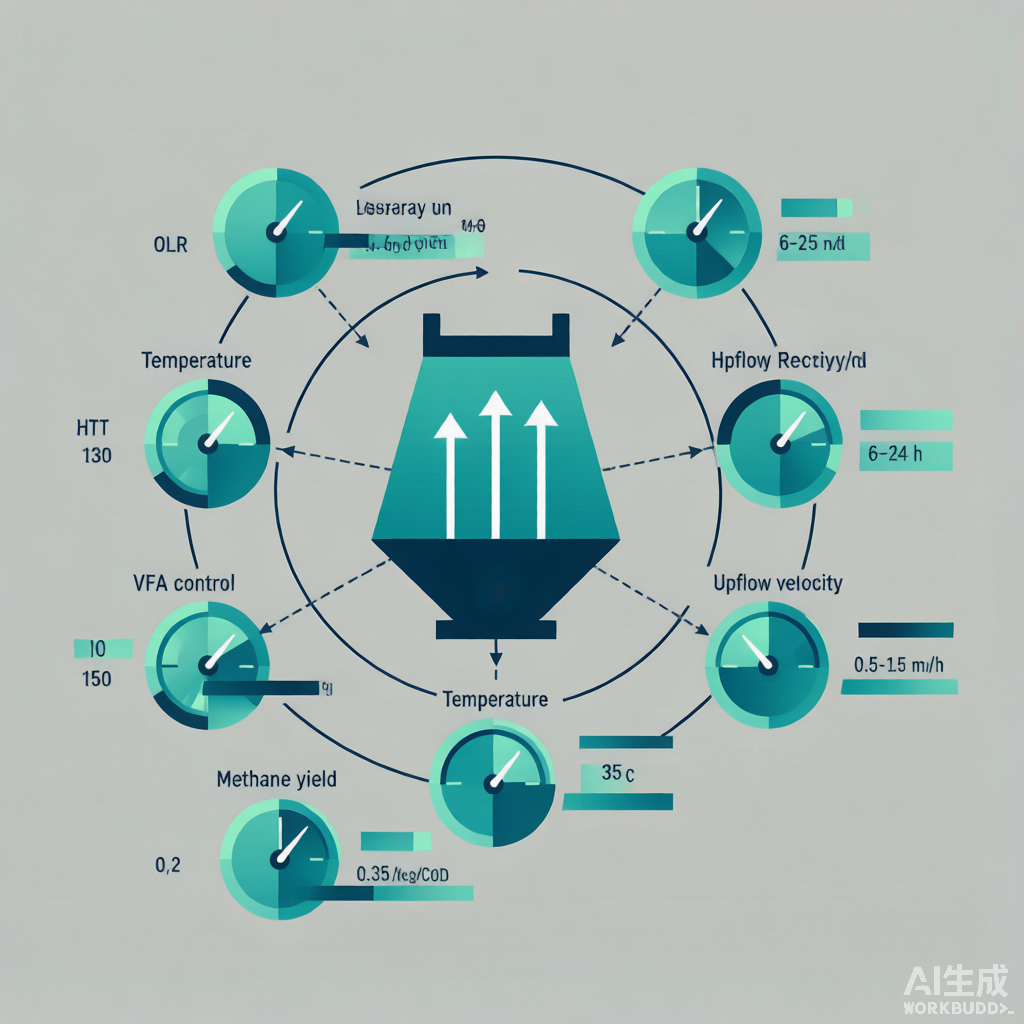
UASB design and operation rest on five "fundamentals." The ranges given by different sources are broadly consistent but stratified — specifications and textbooks are conservative and prudent, while engineering measurements and vendor figures are more aggressive. Selection should treat the specification as the floor and pilot testing as the ceiling.
① Volumetric loading rate OLR — "how much COD a unit tank volume can consume per day"
The Chinese group standard T/CNFPIA 4022—2025 gives a UASB design OLR of 4–7 kgCOD/(m³·d); the classic textbook Metcalf & Eddy Wastewater Engineering (5th ed.) breaks it down by wastewater type: food 5–10, dairy 6–10, brewing/alcohol 8–15, molasses 8–12, papermaking 4–8 (all mesophilic, mature granular sludge). Vendor data (china-mcc, [to be verified]) cite 3–10 for routine projects, up to 10–20 at 30°C water temperature. In engineering practice, distillery stillage achieved 13–22 kg/(m³·d) at 35±1°C (Sichuan Environment / CNKI journal), and MSG wastewater reached 18.9 kg/(m³·d) after acclimation (Environmental Science & Technology 2002), demonstrating that the loading ceiling is set by granular-sludge maturity and wastewater biodegradability, not the equipment itself.
② Hydraulic retention time HRT — "how long the water stays inside"
Specifications and textbooks generally adopt 6–24 h (T/CNFPIA: UASB 12–24 h; Metcalf & Eddy food 6–12 h, brewing 10–24 h, molasses 16–24 h). High-strength wastewater (COD>5000 mg/L) should take the upper end. Too short an HRT lets organics escape undecomposed; too long wastes tank volume — distillery stillage’s measured HRT of 15.6–22.3 h sits at the reasonable high end.
③ Upflow velocity — "don’t flush out the granular sludge"
Design upflow velocity is generally 0.5–1.5 m/h, and the three-phase separator zone should be ≤1.5 m/h. Too low a velocity lets sludge settle and compact; too high carries granules out of the bed and causes sludge loss — one of the easiest points to fail during UASB commissioning. High-SS wastewater (e.g. papermaking) can be raised to 1.2–1.8 m/h with strengthened pretreatment.
④ Temperature — mesophilic 35±2°C; each 5°C drop cuts the reaction rate by about 30%
Mesophilic (35±2°C) is the engineering mainstream; thermophilic (53–55°C, e.g. hot distillery stillage) can reach higher loading but sharply raises energy and stable-operation difficulty. Temperature fluctuation must be held within ±1°C/d, otherwise methanogens are easily inhibited. Multiple sources agree: every 5°C drop reduces the anaerobic reaction rate by about 30% (mining/tailings wastewater treatment manual, [to be verified]); winter operation requires insulation or heating.
⑤ Alkalinity and VFA — the anaerobic "blood pressure meter"
The methanogenic process generates alkalinity but acidification accumulates easily, so alkalinity must be maintained at 2000–3500 mg/L (as CaCO₃, mining wastewater data [to be verified]); in normal operation VFA (as acetic acid) should be <200 mg/L, the VFA/alkalinity ratio ≤0.3, and the propionic/acetic acid ratio <1.4. Once VFA spikes and pH falls below 6.8, that is a warning sign of acidification — reduce the load immediately.
III. Real Engineering Accounts (public literature + technical specifications + engineering cases)
| Wastewater type / condition | Key parameters | Removal and gas production | Source level |
|---|---|---|---|
| Monosodium glutamate (MSG) wastewater | granular sludge seeding, 1-month acclimation OLR 1.87→18.9 kgCOD/(m³·d); influent COD 4500–5000 mg/L; 38±1°C; design OLR 10–15 | COD removal about 80%, normal gas production, good load-shock resistance | peer-reviewed (Environmental Science & Technology 2002 / Acta Scientiae Circumstantiae) |
| Distillery stillage (mesophilic) | 35±1°C; OLR 13–22 kg/(m³·d); HRT 15.6–22.3 h | COD removal 83.9%–92.2%; biogas yield 5.1–8.7 L/(L·d); CH₄ 55%–72% | peer-reviewed (Sichuan Environment / CNKI) |
| Distillery stillage (thermophilic 53±1°C) | 1 month to cultivate granular sludge; sludge TS 65 g/L, SVI 14; HRT 18.4–24 h; OLR>20 g/(L·d); Umax(CH₄) 603.9 mL/(g·d) | CH₄ about 60%; COD removal about 91%; effluent COD 1400–2000 mg/L | peer-reviewed (Chengdu Institute of Biology, CAS, open access) |
| Pre-degassed UASB (MSG wastewater) | 35°C; most bed gas pre-removed to control sludge rise; HRT compressed to 2–3 h | COD removal 70%–80%; OLR up to 40 kg/(m³·d) | peer-reviewed (China Biogas / cqvip) |
| Food processing / brewing (specification ranges) | food OLR 5–10, brewing OLR 8–15, molasses 8–12; HRT 6–24 h | COD removal 65%–85% (brewing 70%–85%) | textbook/specification (Metcalf & Eddy 5th ed. / ATV-DVWK) |
| Meat processing wastewater (commercial site) | influent COD 2000–5000 mg/L; OLR 3–8; HRT 12–24 h; upflow velocity 0.7–0.9 m/h [to be verified] | COD reduced to 400–1000 mg/L (80%–90% removal) [to be verified] | commercial/aggregated source (wateretechs, to be verified) |
| Industrial desulfurization high-salinity wastewater (commercial site) | Cl⁻>10000 mg/L; OLR 5–15; HRT 12–48 h; pH 6.8–7.5 [to be verified] | COD removal 85%–95%, sulfate reduction >80%; energy 0.3–0.5 vs aerobic 1.2–1.8 kWh/tCOD [to be verified] | commercial/aggregated source (wateretechs, to be verified) |
IV. UASB vs EGSB vs IC: How to Choose Among Three Generations of Anaerobic Reactors
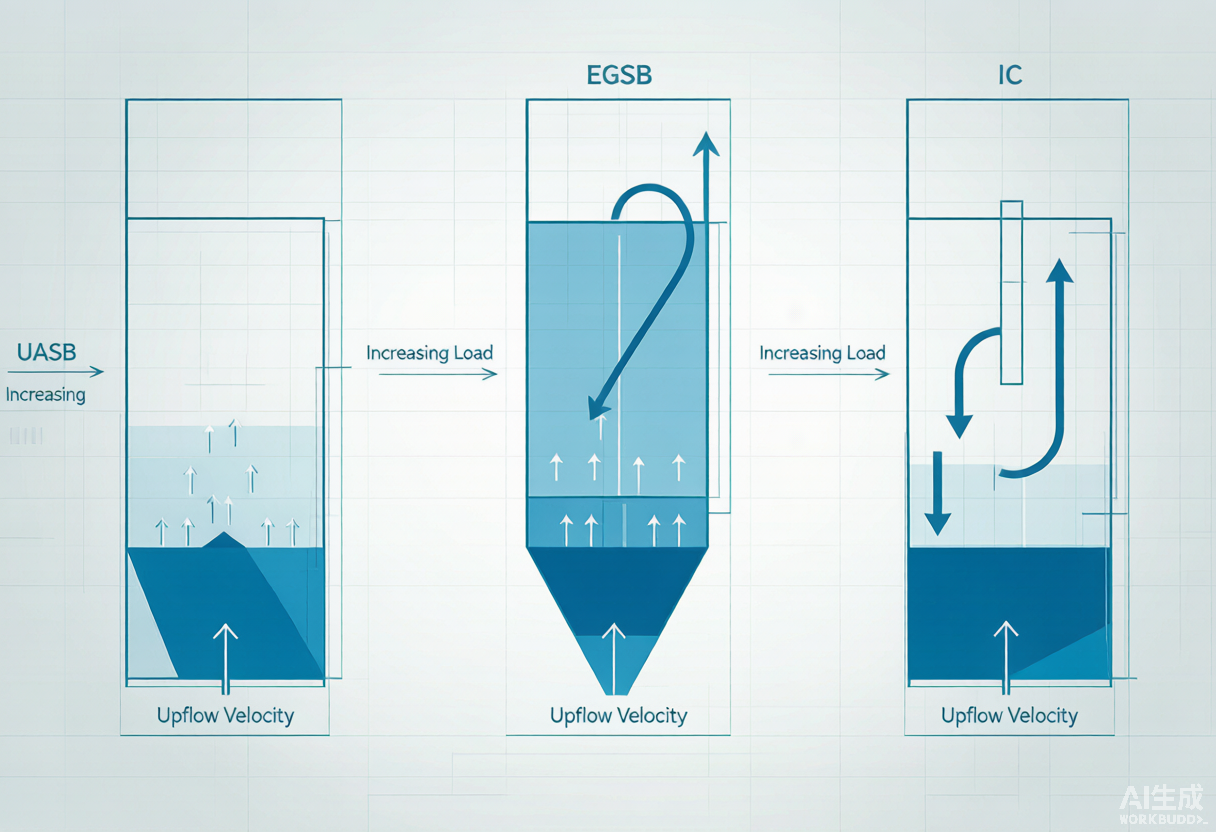
After the UASB, anaerobic reactors evolved along the axis of "higher loading, shorter HRT" into a third generation: EGSB (expanded granular sludge bed, which "inflates" the bed via effluent recycle for higher velocity) and IC (internal circulation, using biogas lift to achieve very high upflow velocity). The three are not substitutes; they are selected by water quality and loading:
| Parameter | UASB (2nd gen) | EGSB (3rd gen) | IC (internal circulation) | Source |
|---|---|---|---|---|
| Sludge concentration | 10–20 g/L | 20–40 g/L | Higher (internal circulation keeps it expanded) | T/CNFPIA 4022—2025 |
| Design OLR | 4–7 kgCOD/(m³·d) | 6–12 kgCOD/(m³·d) | Usually >15, up to 20–30 [to be verified] | Specification + commercial data |
| HRT | 12–24 h | 8–24 h | Shorter (internal circulation enhances mass transfer) | T/CNFPIA 4022—2025 |
| Upflow velocity | 0.5–1.5 m/h | Higher (recycle required) | Highest (biogas lift) | Textbook/specification |
| COD removal | 50%–75% (BOD 60%–80%) | 50%–75% (BOD 60%–80%) | Same order as UASB | T/CNFPIA 4022—2025 |
| Application | Medium-to-high strength, conventional loading | Low strength needing short HRT, easily expandable | Ultra-high strength, large volume, tight footprint | Synthesis |
Practical conclusion: UASB suffices for most food, brewing, and pharmaceutical wastewaters; choose EGSB for low-strength streams needing short HRT or easily-expandable systems; IC is more economical when COD exceeds 15000 mg/L with large flows and tight footprints (commercial data claim IC’s cost-effectiveness begins to show above COD>5000 mg/L, [to be verified]). Regardless of generation, three-phase-separator precision (inclined walls ≥45°, slot velocity ≤2 m/h) is the lifeline that prevents sludge loss.
V. Cultivating Granular Sludge: The Hardest Part of Start-up Is Not Design but "Growing the Sludge"
Seven-tenths of UASB success lies in start-up. The consensus is to seed with granular sludge (or mature anaerobic digested sludge, at about 20%–30% of reactor volume), which can shorten start-up from 2–3 months to 1–2 months; keep initial OLR at 1–2 kgCOD/(m³·d) and raise it in small weekly increments, never loading fully from day one. Maintaining 35±2°C, pH>6.8, and controlled VFA is the prerequisite for granulation. The MSG wastewater case jumped from 1.87 to 18.9 kg/(m³·d) in one month precisely because it was seeded with mature granular sludge, and the thermophilic distillery case likewise grew highly active granules (TS 65 g/L) within a month. Conversely, uneven water distribution, excessive upflow velocity, or uncontrolled VFA will stall granulation and cause heavy sludge loss.
VI. Four Pitfalls Engineering Must Watch
1. Temperature and VFA acidification
Methanogens are extremely sensitive to temperature and VFA. No insulation in winter or loading raised too quickly both cause acidification — pH dropping below 6.8 is the alarm. Countermeasures: insulate/heat the equalization tank, strictly control ±1°C/d, and treat VFA<200 mg/L and a VFA/alkalinity ratio ≤0.3 as the operating red line.
2. Upflow velocity flushing out granular sludge
At velocity >1.5 m/h or with uneven water distribution, granules are carried out of the bed and COD removal plummets. Countermeasures: size the three-phase separator per specification, strengthen pretreatment for high-SS wastewater (oil separation/sedimentation/DAF), and prevent clogging of distribution orifices and the separator.
3. Inhibition by toxic substances
UASB is sensitive to heavy metals (Cu>50 mg/L), sulfide (>200 mg/L), and ammonia nitrogen (>1500 mg/L) (encyclopedia/engineering manuals, [partly to be verified]); excessive oils and grease (animal/vegetable oil >1500 mg/L in meat/hot-pot wastewater) coat the sludge and inhibit activity. Such substances must be pretreated first (sulfide stripping, ammonia stripping, oil separation).
4. The "no desalination, no N/P removal" boundary
UASB only handles organic carbon — it does not desalinate, nor remove nitrogen or phosphorus. Effluent COD is still several hundred to several thousand mg/L, so aerobic treatment (A/O, SBR, MBR) or anammox must follow to meet standards; high-salinity systems must assess the risk of hydrogen sulfide from sulfate reduction (which is exactly why the desulfurization-wastewater case was set up).
VII. One-Line Selection Advice
Suitable for: high-strength biodegradable organic wastewater with B/C≥0.3 and COD 1500–20000 mg/L — food, brewing, starch, MSG, pharmaceutical, papermaking, etc. — especially when you want to "save aeration electricity, reduce sludge, and collect biogas along the way."
Not suitable for: low-strength wastewater (COD<1000 mg/L, where anaerobic substrate is insufficient and removal drops sharply), untreated high-salinity/high-toxicity streams, or scenarios requiring direct compliance with Class I discharge — in those cases, put UASB up front as "pioneer degradation + energy recovery" followed by aerobic/membrane processes, which is safer.
References (real sources)
- Environmental protection standard of the People’s Republic of China. HJ 2024—2012 Technical Specification for Upflow Anaerobic Sludge Blanket Wastewater Treatment Engineering. Specifies UASB design flow, equalization tank, HRT, upflow velocity, sludge seeding (20%–30%), and other requirements.
- China National Forest Products Industry Association. T/CNFPIA 4022—2025 Guidelines for Best Available Technologies for Pollution Prevention and Control in the Wood-Based Panel Industry. Provides parameter ranges for UASB (HRT 12–24 h, upflow velocity 0.5–1.0 m/h, sludge 10–20 g/L, OLR 4–7, COD removal 50%–75%) and EGSB (sludge 20–40 g/L, OLR 6–12).
- Metcalf & Eddy. Wastewater Engineering: Treatment and Resource Recovery, 5th ed. (as cited by the UASB reactor sizing calculator spans.co.in). Gives OLR/HRT/removal by wastewater type: food 5–10 / 6–12 h / 65–80%, brewing 8–15 / 10–24 h / 70–85%, molasses 8–12 / 16–24 h / 70–80%, papermaking 4–8 / 8–16 h / 50–70%; granular sludge particle size 0.5–3 mm, settling velocity 18–100 m/h; methane yield 0.35×(T+273)/273.
- Ding Zhonghao, Cai Lianlang, Li Lei, Sha Qian. Study on treatment of monosodium glutamate wastewater with an upflow anaerobic sludge blanket [J]. Environmental Science & Technology, 2002 (also cited in Acta Scientiae Circumstantiae). Granular sludge seeding; OLR rose from 1.87 to 18.9 kgCOD/(m³·d) in one month; influent COD 4500–5000 mg/L; about 80% removal; 38±1°C.
- Study on granular sludge formation and operating performance of a UASB treating distillery stillage [J]. Sichuan Environment / CNKI Environmental Science Herald. 35±1°C, OLR 13–22 kg/(m³·d), HRT 15.6–22.3 h, COD removal 83.9%–92.2%, biogas 5.1–8.7 L/(L·d), CH₄ 55%–72%.
- Chengdu Institute of Biology, Chinese Academy of Sciences. Study on thermophilic treatment of distillery stillage in a UASB reactor (open access, sciengine.com). 53±1°C; granular sludge cultivated in one month (TS 65 g/L, SVI 14, Umax(CH₄) 603.9 mL/(g·d)); HRT 18.4–24 h, OLR>20 g/(L·d), CH₄ about 60%, COD removal about 91%, effluent COD 1400–2000 mg/L.
- Pre-degassed UASB reactor for monosodium glutamate wastewater [J]. China Biogas / cqvip. 35°C, HRT 2–3 h, COD removal 70%–80%, OLR up to 40 kg/(m³·d).
- Lettinga G, van Velsen A F M, Hobma S W, de Zeeuw W, Klapwijk A. Use of the upflow sludge blanket (USB) reactor concept for biological wastewater treatment, especially for anaerobic treatment [J]. Biotechnology and Bioengineering, 1980, 22(4):699–734. (the original paper establishing the UASB)
- wateretechs.com series of engineering guides (UASB solutions for meat processing, tailings, desulfurization, and hot-pot-seasoning wastewater). Contains engineering figures for OLR/HRT/removal/energy; commercial/aggregated sources; the relevant figures in this article are marked [to be verified] and must be re-sourced before publication.
- china-mcc.com / hydropurewater.com / spans.co.in / b2bwiki.baidu.com. UASB equipment parameters, anaerobic CAPEX for biodiesel wastewater ($400–900/m³), sizing calculators, etc.; vendor/calculator/encyclopedia sources; relevant figures marked [to be verified].