



 Nationwide (pharma, coking, petrochem, paper, TCM)
 Pilot to full-scale (10s–10,000s m³/d)
MBBR (Moving Bed Biofilm Reactor): Carriers Drift in the Water, Microbes Cluster on Them — Compact and Stable Industrial Wastewater Upgrading
Conventional activated sludge relies on the secondary clarifier's return sludge to "hold onto" the microbes — when the load fluctuates or settling deteriorates, the effluent easily fails. MBBR lets microbes grow directly on plastic carriers tumbling with the flow; the carriers are retained by the outlet screen, so high biomass is maintained without sludge return and the footprint can shrink to roughly 1/2 that of a conventional process. Using Kaldnes' original technical literature, the CPCB/Spans design guidelines and real industrial cases from pharmaceutical, coking, petrochemical and TCM wastewater, this article explains the mechanism, the sizing parameters and the engineering ledger in one pass.
1. Principle: carriers drift in the water, microbes grow on the carriers
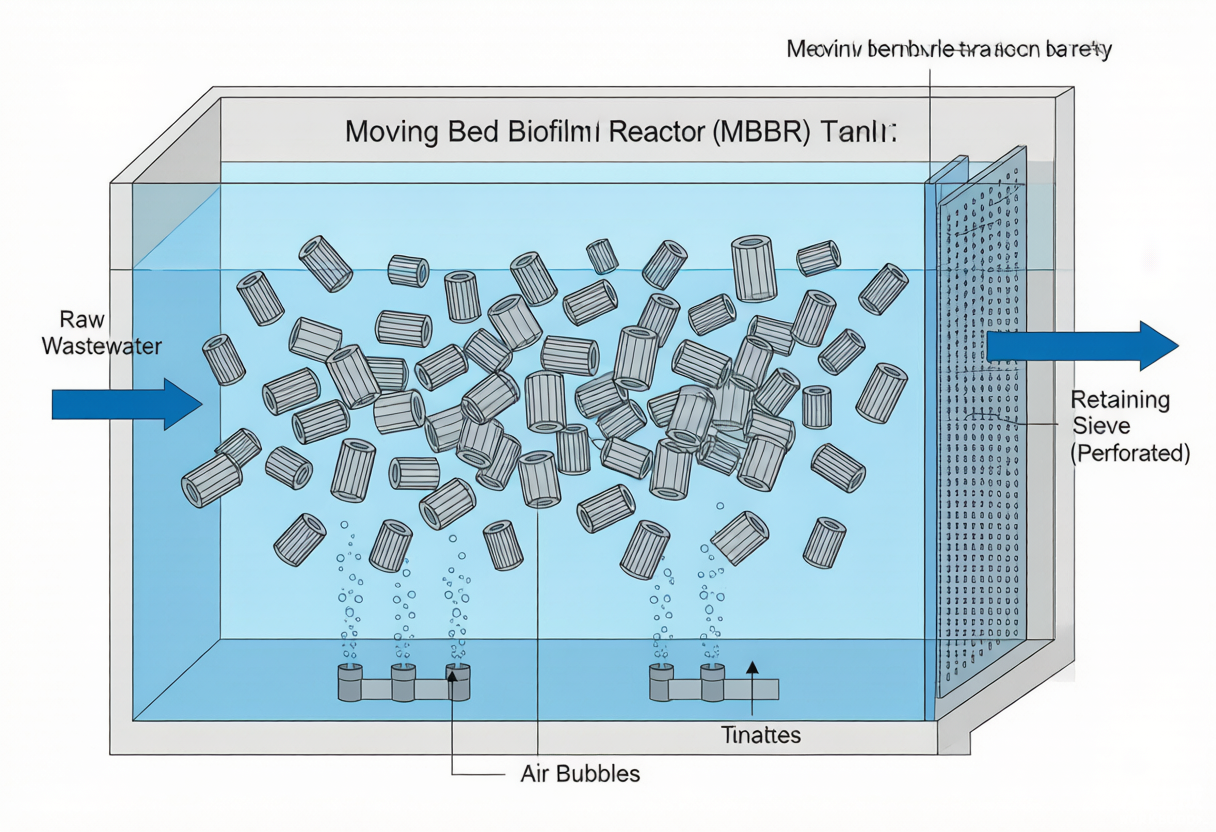
The MBBR flow path is intuitive: wastewater enters the tank, which is charged with a large quantity of plastic carriers, and bottom aeration both supplies oxygen and keeps the carriers tumbling. Microbes form a biofilm on the carrier surface, and substrates in the water — organic matter, ammonia nitrogen and the like — are degraded as they pass through the biofilm. Because the carriers continuously collide and rub against one another, an over-thick biofilm sloughs off naturally ("hydraulic shear"), and the small amount of detached sludge leaves with the effluent, so the biofilm thickness in the tank remains relatively stable.
A perforated screen/grid is installed at the tank outlet (K1 typically uses 5 mm openings, K2 uses 10 mm) to retain the carriers inside while letting only the treated water pass. Thanks to this structure, MBBR combines the advantages of the activated sludge process (suspended biomass in the tank) and the biofilm process (immobilized microbes, long sludge age, nitrifiers that are not easily washed out), and it clogs less readily than fixed-bed biofilm processes — the carriers keep moving instead of consolidating like contact-oxidation packing.
2. Three core parameters: filling fraction, surface loading and HRT (the sizing essentials)
The key to MBBR design is "how much biofilm surface area to give the microbes, and how long to let the water stay". The commonly used design parameters come from Ødegaard's original literature, the CPCB/Spans industrial ETP design guidelines and recent Chinese MBBR engineering practice:
① Carrier filling fraction — not the higher the better
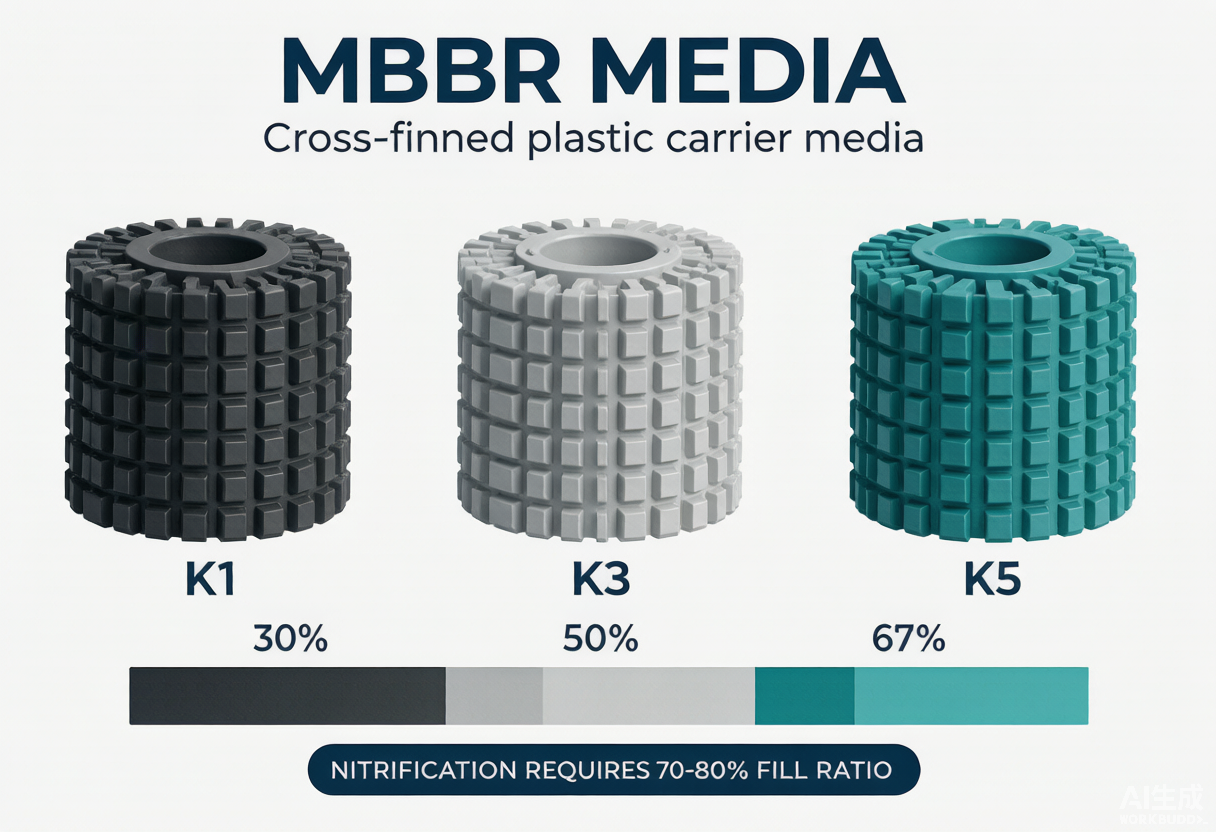
The filling fraction is the ratio of carrier volume to the effective reactor volume. Ødegaard's original literature recommends a standard filling fraction of 60%–70% (at 67%, K1 gives an effective specific surface area of about 335 m²/m³ in the reactor), but it should not exceed about 70% or carrier tumbling is impaired. The value, however, differs greatly by function: carbon oxidation (BOD/COD removal) typically uses 30%–50%, while nitrification uses 50%–67% because nitrifiers grow slowly and need more biomass. Di Trapani et al. (2008) even found that COD removal in coking wastewater was better at a 35% filling fraction than at 66%, whereas nitrification was more efficient at 66% — which shows that carbon oxidation and nitrification need separate filling fractions; one number cannot serve all purposes.
② Surface loading (SALR / OLR) — how "busy" the carriers get
SALR (Surface Area Loading Rate) is the loading borne per unit carrier surface area per day. The CPCB/Spans design guidelines give 5–15 g BOD/(m²·d) for the carbon-oxidation stage and 0.5–1.5 g NH₄-N/(m²·d) for the nitrification stage; converted to reactor volumetric loading, roughly 4–10 kg COD/(m³·d) for the carbon stage and about 0.2–0.5 kg NH₄-N/(m³·d) for the nitrification stage. An East China Jiaotong University team's Applied Chemical Industry study measured a carbon-oxidation surface loading of about 15.8 g COD/(m²·d) and an ammonia nitrogen surface loading of about 0.89 g NH₄-N/(m²·d) for a pharmaceutical wastewater MBBR, both within the recommended engineering range.
③ HRT, DO, pH and temperature — nitrification is the finicky one
HRT is typically 4–8 h for carbon oxidation and 6–12 h for nitrification; a DO of 2–3 mg/L is enough for carbon oxidation while 3–4 mg/L is preferable for nitrification; pH of 6.5–8.5 for carbon oxidation and 7.0–8.0 for nitrification; the process runs at 15–35℃, but nitrification is optimal at 20–28℃ and its rate drops markedly below 15℃. These ranges are similar to the activated sludge process, but MBBR is steadier under short-duration shocks thanks to the biofilm buffer.
3. The real engineering ledger (published literature and thesis data)
| Wastewater type / process | Key parameters | Removal performance | Source tier |
|---|---|---|---|
| Coking wastewater | Carrier filling fraction 50%, HRT 12–20 h; influent NH₄-N 60–90 mg/L, SCN⁻ 200–432 mg/L, COD about 2000 mg/L | COD removal up to 89%–90%, volatile phenol ~99%, SCN⁻ >94%, NH₄-N over 90% (effluent <10 mg/L, meeting GB 8978-1996 Grade I) | Thesis + Gu et al. 2014 (peer-reviewed) |
| Pharmaceutical wastewater / two-stage anoxic-aerobic MBBR | Total HRT 6.75–9 h, COD 800–1100 mg/L, NH₄-N 40–60 mg/L; COD volumetric loading 2.2 kg/(m³·d), surface loading 15.8 g COD/(m²·d) | Average COD removal 87%, NH₄-N removal 91.5%; ammonia nitrogen volumetric loading 0.13 kg/(m³·d) | Applied Chemical Industry 2017, 46(3) (Peking University Core / CSCD) |
| Pharmaceutical wastewater / two-stage MBBR (furan ammonium salt) | Carrier filling fraction 40%, total HRT 32 h; first-stage OLR 1.4–1.6 kgCOD/(m³·d) | COD removal 88.6%, TN removal 25.7%; the second stage converts 56.2% of NH₃-N to nitrate | Journal paper (indexed in CQVIP) |
| Antibiotic wastewater / A/O-MBBR | Carrier dosing ratio 30%, HRT 8 h, 20–25℃; influent COD 350–400 mg/L, NH₄-N 80 mg/L | COD removal 83.34%, NH₄-N removal 90.46%; 50 μg/L tetracycline reduced COD removal from 85.97% to 76.3% | Thesis (napstic.cn) |
| TCM wastewater / hydrolysis acidification + aerobic MBBR | Aerobic stage HRT 30 h, DO 6 mg/L, sludge return ratio 100%; influent COD about 1150 mg/L | With hydrolysis acidification: COD 93%, NH₄-N 70%, TN 45%, TP 38%; without hydrolysis: COD 87%, NH₄-N 58% | Thesis (napstic.cn) |
| Petrochemical / pharmaceutical park wastewater advanced treatment | MBBR combined process; petrochemical influent COD >1000 mg/L, pharmaceutical park COD 150–500 mg/L, color 256 | Petrochemical effluent COD <150 mg/L; pharmaceutical park effluent COD <150 mg/L, color 32; MBBR stage COD/NH₄-N removal rates 30.2%/35.4% | Thesis (napstic.cn) |
4. How to choose carriers: K1/K3/K5 — more expensive isn't always right
Common carriers on the market include Kaldnes K1, K3, K5 and BiofilmChip M. Selection should compare specific surface area, effective protected surface area, filling-fraction ceiling and price:
- K1: HDPE, φ10 mm × 7 mm, density about 0.95 g/cm³, specific surface area 500 m²/m³; standard filling fraction 67%, giving an effective specific surface area of about 335 m²/m³ in the reactor; relatively low cost and the most widely used — adequate for carbon oxidation and ordinary nitrification.
- K3: size φ25 mm × 10 mm, also about 500 m²/m³ specific surface area; less prone to clogging and suitable for wastewater containing fibers or small particles.
- K5 / BiofilmChip M: specific surface area 800–1200 m²/m³, suitable for nitrification or anammox pretreatment that needs very high biomass, but more expensive, with a maximum filling fraction usually of 55%–60% and stricter requirements on screen opening size.
Practical advice: start with K1/K3 for carbon oxidation and routine nitrification; upgrade to K5/BiofilmChip only when the effluent ammonia nitrogen limit is particularly strict or the tank volume is extremely constrained. Also, don't judge by "specific surface area" alone — the biofilm mainly grows on the carrier's inner surface, so the effective protected surface area is the real surface available for biofilm growth, and many engineering datasets use 335 m²/m³ (K1 at 67%) as the design basis.
5. Choosing between MBBR and conventional processes
MBBR, activated sludge, SBR and MBR do not replace one another; rather, they divide the work according to site, water quality and effluent requirements:
| Indicator | MBBR | Conventional activated sludge (CAS) | SBR | MBR | Source |
|---|---|---|---|---|---|
| Effluent quality | Good (requires downstream settling/filtration) | Average | Good | Best (SS near zero) | Design guidelines + engineering practice |
| Footprint | Compact (tank volume about 50%–70% of CAS) | Large | Medium to large | Compact | Spans / susbio |
| Sludge return | Not required | RAS required | Not required | Not required (membrane retention) | Design guidelines |
| Sludge yield | Lower (0.25–0.40 kg VSS/kg COD) [to be verified] | Higher | Medium | Lower | Commercial engineering data |
| Shock-load resistance | Strong (biofilm buffer) | Weak | Medium | Medium | Engineering practice |
| Operation & maintenance | Low (screen and aeration inspection) | Medium | Medium | High (membrane cleaning/replacement) | susbio |
| Energy consumption | Medium (aeration + mixing) | Medium | Medium | High | Design guidelines |
| Best-fit scenario | In-situ upgrading, industrial wastewater, large fluctuations | Large flows, low-cost discharge | Small batches, intermittent discharge | High-quality reuse | Combined |
6. Four pitfalls engineers must watch closely
1. Pretreatment must be in place
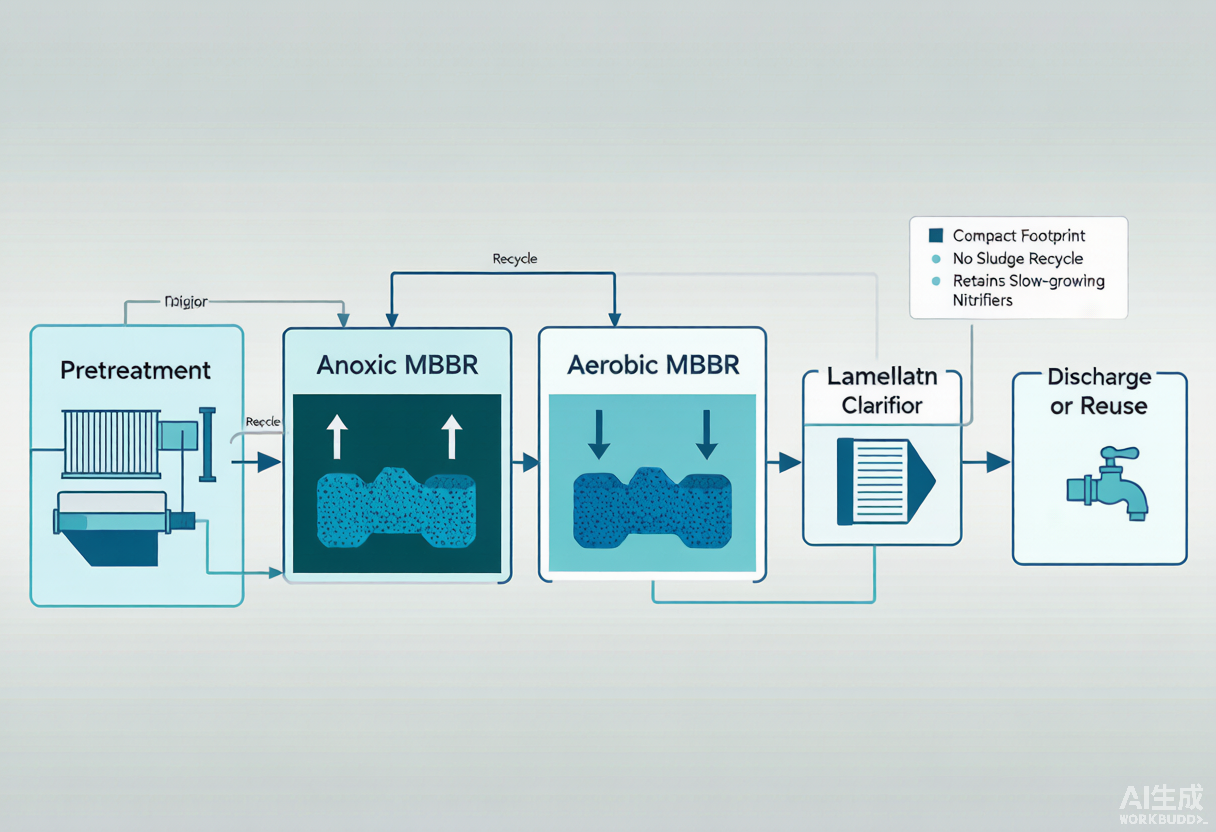
Fibers, hair, grease and high SS will coat the carriers, clog the screens and wear the diffusers. Common engineering requirements: install a 1–3 mm fine screen or rotary screen upstream; oily wastewater should first pass through DAF/oil separation to bring FOG below 20–50 mg/L before entering the MBBR; add a grit chamber when sand content is high.
2. Higher filling fraction is not always better
Exceeding 70% markedly weakens carrier tumbling, lowers mass-transfer efficiency, and raises the risk of screen clogging. Carbon oxidation at 30%–50% and nitrification at 50%–67% are the common engineering ranges; if deep nitrogen removal is also required, consider a two-stage MBBR (front anoxic carbon oxidation + rear aerobic nitrification) with different filling fractions for each stage.
3. MBBR itself does not "filter" — detached sludge must be handled
Aged biofilm that sloughs off leaves with the effluent as TSS, so a downstream secondary clarifier, clarifier, dissolved air flotation, MBR or filter must be provided. If this step is omitted, effluent SS will exceed the limit. At high filling fractions the amount of detached sludge increases, and the clarifier loading must be accounted for.
4. Temperature, toxicants and antibiotics can inhibit the biofilm
Below 15℃ the nitrification rate drops markedly; high concentrations of phenol, cyanide, antibiotics, heavy metals and the like inhibit microbial activity. The antibiotic wastewater study above shows that 50 μg/L tetracycline alone can lower the ammonia nitrogen removal rate from 89.14% to 69.45%; although SCN⁻ and volatile phenol in coking wastewater can be removed steadily, a start-up acclimation period is indispensable and the loading should be raised in stages.
7. One-line sizing advice
Suitable for: industrial wastewater where the footprint is tight, water quality and flow fluctuate widely, in-situ upgrading is needed, or the goal is to keep the existing tanks and only add carriers and aeration — typically pharmaceutical, coking, petrochemical, printing and dyeing, food processing and TCM extraction wastewater, at scales from tens to tens of thousands of m³/d.
Not suitable for: large flows with lenient discharge standards where the lowest initial investment and operating cost are wanted — in that case conventional activated sludge is often more economical; moreover, if pretreatment is inadequate or downstream clarification/filtration is not provided, MBBR cannot deliver stable effluent.
References (real sources)
- Ødegaard H, Rusten B, Westrum T. A new moving bed biofilm reactor—applications and results[J]. Water Science and Technology, 1994, 29(10–11):157–165. (one of the foundational MBBR papers)
- Ødegaard H. The moving bed biofilm reactor[C]//Water Environmental Engineering. 1999. Gives K1 carrier specifications: HDPE, density about 0.95 g/cm³, specific surface area 500 m²/m³; standard filling fraction 60%–70%, effective specific surface area of about 335 m²/m³.
- Leiknes Ø, Ødegaard H. The development of a biofilm membrane bioreactor[J]. Desalination, 2001, 132(1–3):263–271.
- Di Trapani D, Mannina G, Torregrossa M, et al. Comparison between fixed and moving bed biofilm reactors[J]. Water Science and Technology, 2008, 57(12):2013–2020. Points out that COD removal may be better at a 35% filling fraction than at 66%, while nitrification is better at 66%.
- Gu Q, Sun H, Zhang X, et al. Application of biofilm carriers in biological treatment of coking wastewater[J]. Bioresource Technology, 2014, 166:1–7. Coking wastewater filling fraction 20%–60%; COD 89%, phenol 99%, thiocyanate 99% (50% filling, HRT 20 h).
- Spans Envirotech. MBBR (Moving Bed Biofilm Reactor) Design Guidelines for Industrial ETP — Explained. Gives carbon-oxidation/nitrification design parameters: engineering ranges for filling fraction, surface loading, HRT, DO, pH, temperature and aeration intensity.
- Experimental study on two-stage anoxic-aerobic MBBR treatment of pharmaceutical wastewater[J]. Applied Chemical Industry, 2017, 46(3):490-492, 497. Total HRT 6.75–9 h; COD 87%, NH₄-N 91.5%; COD surface loading 15.8 g/(m²·d).
- Experimental study on MBBR treatment of pharmaceutical wastewater[J]. Journal indexed in CQVIP. Filling fraction 40%, HRT 32 h; COD 88.6%, TN 25.7%.
- Study on a biological moving-bed membrane bioreactor treating coking wastewater[D]. Thesis (napstic.cn abstract). Filling fraction 50%, HRT 12–20 h; COD up to 90%, volatile phenol ~99%, SCN⁻ >94%, effluent NH₄-N <10 mg/L; combined MBBR-MBR improves COD removal by 10.8% over MBBR alone.
- Experimental study on anaerobic/aerobic-MBBR treatment of antibiotic wastewater[D]. Thesis (napstic.cn abstract). 30% filling, HRT 8 h, 20–25℃; COD 83.34%, NH₄-N 90.46%; 50 μg/L tetracycline markedly lowers the removal rates.
- Study on the performance of a combined hydrolysis acidification–aerobic MBBR process treating TCM wastewater[D]. Thesis (napstic.cn abstract). HRT 30 h, DO 6 mg/L; with hydrolysis: COD 93%, NH₄-N 70%, TN 45%, TP 38%, meeting GB 21906-2008.
- Research and application of biological moving-bed reactors for advanced treatment of industrial wastewater[D]. Thesis (napstic.cn abstract). Petrochemical wastewater COD >1000→<150 mg/L; pharmaceutical park COD 150–500→<150 mg/L, color 256→32.
- Susbio. What is the MBBR Process in Sewage Treatment Plants? Gives a process comparison table of MBBR versus MBR, SBR and conventional activated sludge.