



Can Water Be Purified Without Chemical Dosing? Full Review of Real Experimental Data on Electrocoagulation
GAO WU TONG · Industrial Water Treatment Technology Series (Daily, Based on Real Data from Public Literature)
① Purify water without chemicals? Full review of real experimental data on electrocoagulation (main title of this article)
② Electrodes on, pollutants settle on their own: Electrocoagulation technology for industrial wastewater treatment with measured removal rates
③ From demulsification to heavy metal removal: Electrocoagulation (EC) process mechanisms and real case data
Introduction
Industrial wastewater has complex composition, and traditional chemical coagulation relies heavily on external chemical agents, resulting in large sludge volumes and high chemical costs. Electrocoagulation (EC) generates coagulants in situ by sacrificing anodes to release metal ions—essentially "producing its own flocculant" within the wastewater—combined with the air flotation effect of cathodic hydrogen evolution, achieving integrated demulsification, decolorization, and heavy metal removal. It features simple equipment, no external chemical dosing, and minimal secondary pollution, and has seen rapid adoption in recent years for printing and dyeing, oily, and heavy metal wastewater. Based on real experimental data from published literature, this article reviews the mechanisms, key parameters, and measured performance of electrocoagulation.
1. Reaction Mechanisms
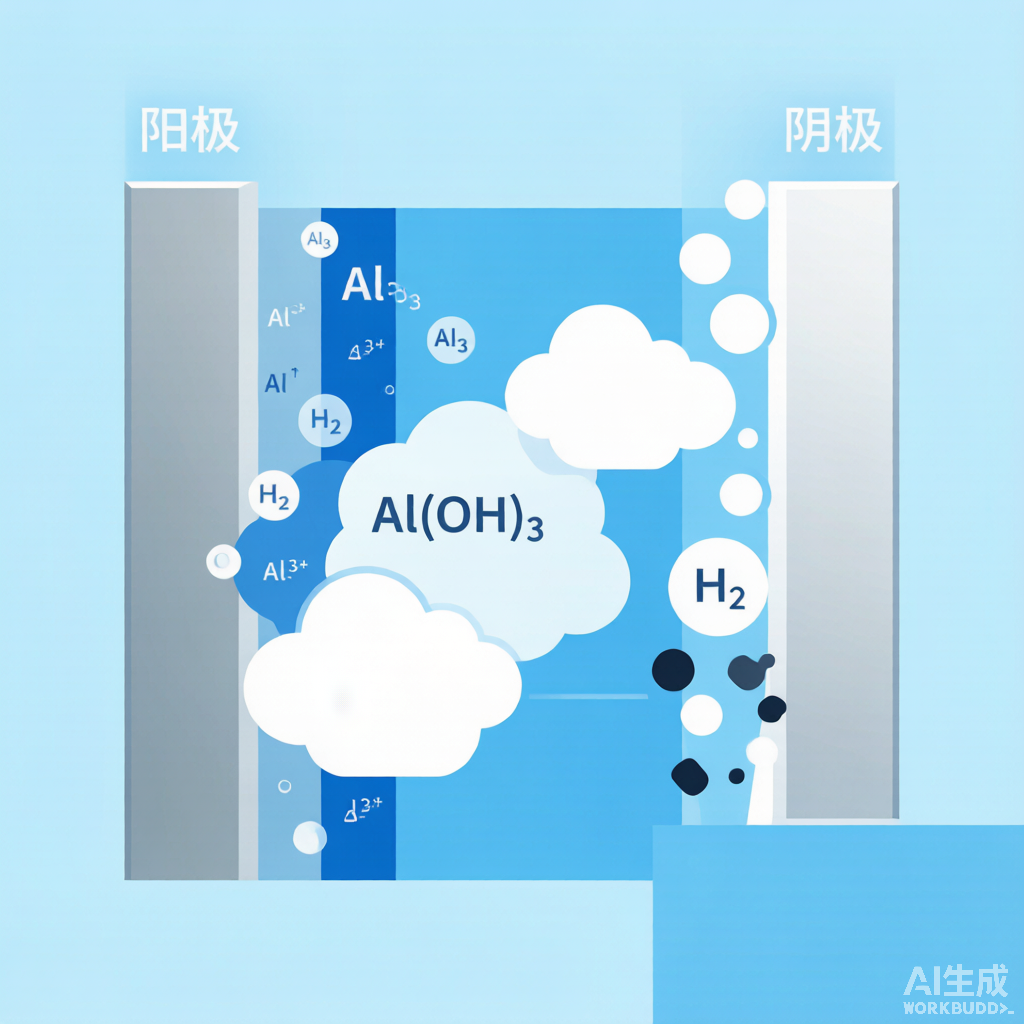
The core of electrocoagulation follows a three-step process: "electrolytic dissolution + in-situ flocculation + air flotation separation":
1. Anodic dissolution: Using aluminum or iron as sacrificial anodes, metals dissolve upon energization:
Al → Al³⁺ + 3e⁻ (aluminum anode)
Fe → Fe²⁺ + 2e⁻ (iron anode)
2. Hydrolysis and floc formation: The dissolved metal ions hydrolyze and polymerize in water, forming flocs such as Al(OH)₃ and Fe(OH)₂/Fe(OH)₃:
Al³⁺ + 3H₂O → Al(OH)₃↓ + 3H⁺
3. Cathodic hydrogen evolution and air flotation: At the cathode, 2H₂O + 2e⁻ → H₂↑ + 2OH⁻, and fine hydrogen bubbles carry flocs and oil droplets to the surface for separation.
Additionally, the anode region exhibits reducing capability, converting Cr⁶⁺ to Cr³⁺ prior to precipitation removal; flocs remove pollutants synergistically through charge neutralization, double-layer compression, sweep flocculation, and adsorptive coprecipitation mechanisms.
2. Key Process Parameters (with Real Data Ranges)
1. Electrode Material
Aluminum electrodes perform better for COD and color removal under acidic conditions; iron electrodes achieve better heavy metal removal under neutral/weakly alkaline conditions with lower operating costs.Real data: Kobya et al. treated metal cutting fluid wastewater with iron electrodes (pH 7, 60 A/m², 25 min), achieving COD removal of 92% and TOC of 82%, with operating costs of 0.497 $/m³—lower than the 0.768 $/m³ for aluminum electrodes.
2. Current Density
This determines flocculant production rate and bubble generation rate, making it the most sensitive parameter. Too low results in insufficient removal; too high increases energy consumption and promotes electrode passivation.Real data: In electroplating wastewater experiments, as current density with iron electrodes increased from 1 to 5 A/dm², Cu²⁺ removal rose from 54.93% to 97.74% (other conditions: electrode gap 2.5 cm, pH 6, 30 min).
3. Initial pH
This affects hydrolysis and precipitate morphology. For various heavy metal wastewater streams, removal rates peak at pH 8.5–9.0 ; electroplating wastewater achieves optimal Cr⁶⁺, Cu²⁺, Ni²⁺, and Zn²⁺ removal at pH 6–7 (all within the 94%–98% range).
4. Electrode Gap
Typically 1–2.5 cm; excessive gaps raise cell voltage and increase energy consumption. Literature shows optimized gaps for iron/aluminum electrodes predominantly concentrated at 1–2.5 cm.
5. Retention / Reaction Time
Longer is not always better. Chromium-containing electroplating wastewater peaks at 30 min, after which removal rates decline due to electrode passivation; for advanced treatment of multiple heavy metals, retention of 3–4 min achieves 99% or higher removal (at high current densities of 13.2–19.8 A/m²).
6. Conductivity
Excessively low conductivity increases energy consumption, which can be mitigated by adding small amounts of NaCl/Na₂SO₄; however, high salinity (e.g., 33 g/L NaCl) actually inhibits removal and requires trade-off considerations.
3. Real Case Data
1) Printing and Dyeing Wastewater
2) Oily/Emulsified Wastewater
3) Heavy Metal Wastewater
4. Comparison with Other Chemical Methods
| Process | External Chemicals Required | Typical Sludge Volume | Primary Applications | Energy Consumption Characteristics |
|---|---|---|---|---|
| Electrocoagulation | None required (in-situ generation) | Relatively low | Oily, dye, heavy metal, and high-salinity wastewater | Electricity-intensive but chemical-saving |
| Chemical Coagulation | PAC / PAM required | Moderate | Suspended Solids, colloids | Chemical-intensive |
| Chemical Precipitation | Precipitants required (e.g., sodium sulfide) | Relatively high | Heavy metals, hardness | Chemical-intensive |
| Fenton Oxidation | H₂O₂ + Fe²⁺ required | Low (iron sludge) | Refractory organic compounds | Chemicals + a certain proportion of electricity/oxidation |
V. Engineering Key Points and Limitations
Electrode Passivation: Under high current density or prolonged operation, a passivation film forms on the anode surface, reducing dissolution efficiency. Improvements include pulsed power supplies (delaying passivation, energy saving 50%+), and edge-insulated electrodes (Xinjiang Institute of Physics and Chemistry 2023: energy consumption reduced from 1.95 to 1.19 kWh/kg, COD removal 92.44% → 93.73%).
Energy Consumption and Cost: Energy consumption for electrocoagulation is typically in the range of 0.5–2 kWh/m³ (e.g., 0.5 kWh/m³ for restaurant wastewater; emulsified oil treatment varies with operating conditions); actual operating costs for textile wastewater are approximately 1.5 $/m³. Current density and residence time should be optimized based on water quality to reduce costs.
Applicability Boundaries: It offers advantages for high-conductivity, high-salinity wastewater (e.g., EC + O₃ combination for high-salinity printing and dyeing wastewater), but for extremely low-conductivity wastewater, salt supplementation is required, increasing operational complexity.
Conclusion
Electrocoagulation, characterized by "in-situ floc formation without chemical dosing," demonstrates considerable measured removal efficiencies in oily, printing and dyeing, and heavy metal wastewater (mostly within the 90%–99% range). Its success is highly dependent on the synergistic optimization of current density, pH, electrode material, and time window, and engineering applications must directly address passivation and energy consumption. Positioning it as the "green option" within the chemical treatment family, and combining it with coagulation, sedimentation, and Fenton processes, often achieves a better techno-economic balance.
Have you used electrocoagulation in your actual projects? Was the biggest pain point electrode passivation, energy consumption, or sludge? Feel free to share in the comments, or send me your measured data — in the next issue, we'll compare the gap between real engineering and laboratory data.
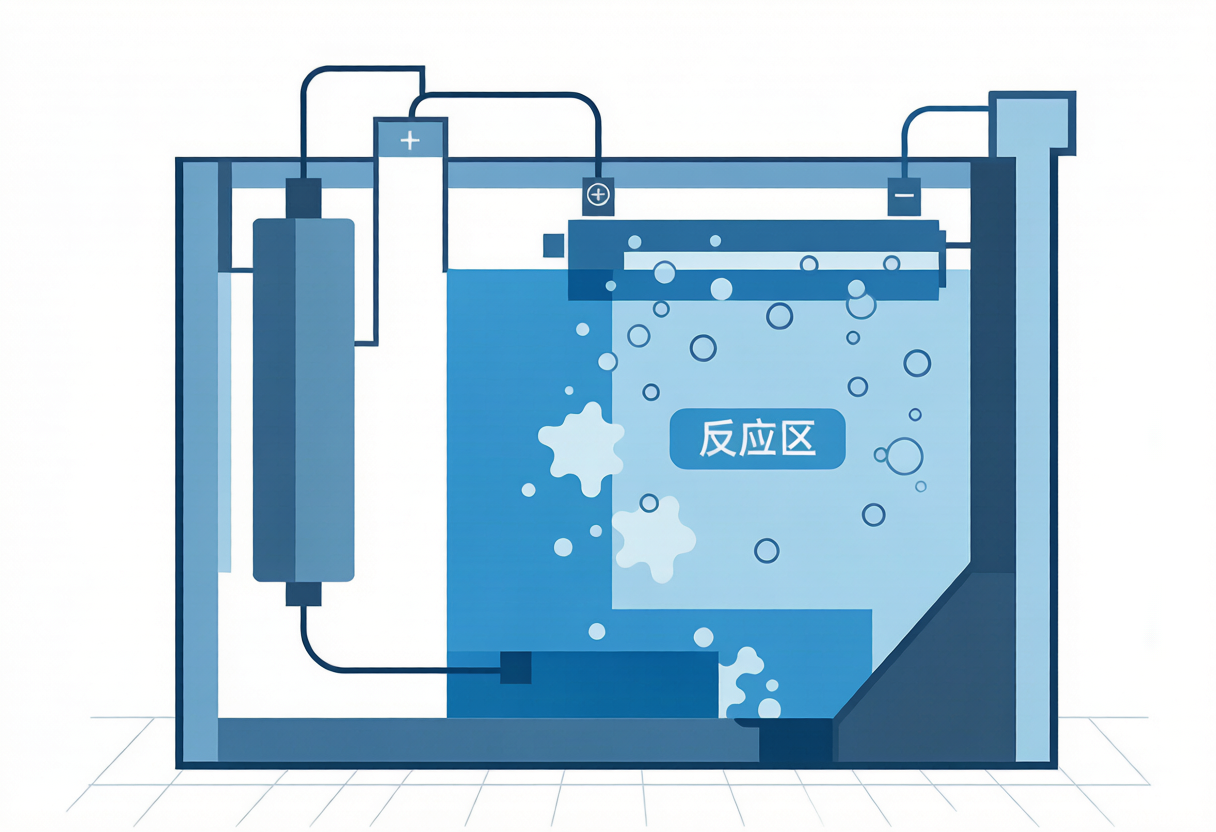
· Cover image (Fig. 0): Schematic cross-section of an electrocoagulation reactor (AI-generated)
· Fig. 1: Reaction mechanism schematic (AI-generated)
· Fig. 2: Comparison table of four chemical treatment methods (see table above)
· Fig. 3: Bar chart of representative actual removal rates (SVG, data as annotated in each case)
Note: The cover image and mechanism diagram are AI-generated schematics for illustrative purposes and do not substitute for engineering drawings.
- Wang Yue et al. Electrocoagulation degradation of printing and dyeing wastewater using blast furnace dust electrodes. Journal of Tianjin Polytechnic University, 2025, 44(6):48-63.
- Sırma Bener et al. Electrocoagulation process for the treatment of real textile wastewater. Process Safety and Environmental Protection, 2019, doi:10.1016/j.psep.2019.06.010.
- Experimental study on the treatment of emulsified oil wastewater by electrocoagulation (dissertation). napstic.
- Kobya M. et al. Treatment of metalworking fluid/emulsion wastewater by electrocoagulation (cited in dowater review).
- Study on the separation of chromium ions in solution by electrocoagulation. Leather Science and Engineering, 2022, doi:10.19677/j.issn.1004-7964.2022.03.005.
- Treatment of Acid Mine Drainage by Electrocoagulation and Response Surface Optimization. Metallurgy, 2023, YSYL202300297.
- Technology for removing heavy metals from electroplating wastewater by electrocoagulation. dowater, 2023.
- Study on factors influencing the removal of multiple heavy metals from wastewater by electrocoagulation. Environmental Science (hjkx.ac.cn).
- Xinjiang Institute of Physics and Chemistry. Electrocoagulation process based on novel edge-insulated electrodes for separating oil-in-water emulsions. 2023.
Note: All experimental data in this article are sourced from the aforementioned public literature/dissertation search results, without any fabrication or self-derived calculations; data from engineering reports are labeled with their source type. Manual final review is required before publication.