


 Across multiple industries nationwide (coking / coal chemical / semiconductor /
  Pilot-scale to full-scale implementation (from tens to tens of thousands of m³/d
Ammonia Nitrogen Stripping (Air Stripping): Converting NH₄⁺ to NH₃ and "Blowing" It Away with Air — A Powerful Pretreatment Tool for High-Ammonia Industrial Wastewater
Biological treatment is sensitive to high ammonia nitrogen—elevated free ammonia inhibits nitrifying bacteria. Air stripping takes a different route: under alkaline conditions, ammonium is "flipped" into free ammonia, which is then carried off directly by air or steam. Drawing on EPA technical manuals, IWA peer-reviewed data, and real-world engineering cost ledgers from coking, semiconductor, and landfill leachate projects, this article explains the three operating knobs—pH, temperature, and air-to-liquid ratio—along with engineering constraints in one go.
1. Principle: One Equilibrium + One Mass Transfer
Ammonia exists in two forms in water, governed by an acid-base equilibrium that shifts with pH:
NH₄⁺ + OH⁻ ⇌ NH₃ (free ammonia) + H₂O
Ammonium (NH₄⁺) is water-soluble and remains in the liquid phase; free ammonia (NH₃) is a gas and readily volatilizes. At ambient temperature, the acid dissociation constant pKa of NH₄⁺/NH₃ is approximately 9.25 (25℃), which means: for each unit rise in pH, the fraction of free ammonia increases exponentially. Practical conversions—at pH 11 , roughly 98% of ammonia exists as free ammonia; at pH 12 , approximately 99.8% (literature states "at pH 12 , over 95% exists in the strippable NH₃ form"). This is the fundamental reason why stripping requires alkali addition to raise the pH to 10.5–12 .
The second step is mass transfer: moving NH₃ from the liquid phase to the gas phase. This is accomplished by bringing wastewater into countercurrent contact with air (air stripping) or steam (steam stripping) in a packed tower—water is distributed at the top, air enters at the bottom, and NH₃ continuously diffuses into the gas stream and is carried away. The driving force is the difference between "the partial pressure of ammonia in the liquid phase versus that in the gas phase"; sustained high air flow rates keep the gas-phase ammonia concentration extremely low, so liquid-phase ammonia is continuously "extracted." Thus, the three major knobs for stripping efficiency are: pH (determines how much can be stripped), temperature (accelerates volatilization), and air-to-liquid ratio (determines how quickly it is carried away).
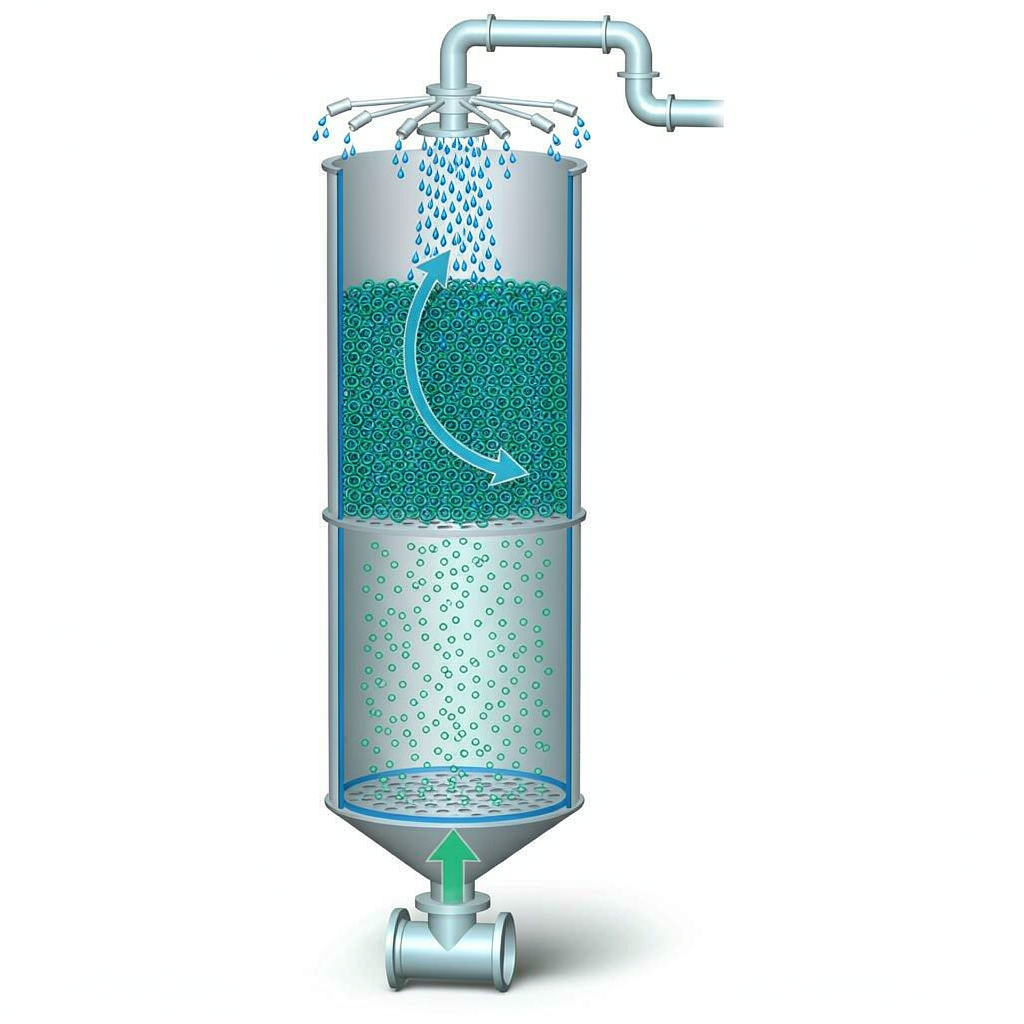
2. Three Knobs: Operating Windows (from EPA Manuals and IWA Peer Review)
Consolidating operating ranges from multiple engineering sources into an actionable window:
- pH: Operating range 10.5–12, with 11.0–11.5 commonly adopted in engineering practice. Raising pH above 11.5 only buys a few extra percentage points of removal, yet significantly increases alkali consumption and exacerbates packing scaling. Most full-load installations cap out at 11.0–11.5, leaving the final 5–10% to the downstream biological stage (EPA Air Stripping Technical Manual; IWA Publishing 2000; hydropurewater engineering review, 2025).
- Temperature: Temperature simultaneously raises both the free ammonia fraction and the mass transfer rate. At the same pH, the free ammonia fraction roughly doubles as water temperature rises from 20℃ to 40℃. The consequence is direct—EPA manual field data: at 20℃, ammonia nitrogen removal reaches 90–95%, but drops to only 75% at 10℃. In northern winters, either waste heat preheating or increased air flow is required (at the cost of higher power consumption).
- Air-to-Liquid Ratio (A/L): Typical range 2000–5000 m³ air per m³ wastewater (colloquially referred to as "air-to-water ratio 3000:1" in practice). Higher A/L strips faster, but blower power consumption rises accordingly; excessively low liquid levels waste energy. The Lake Tahoe installation in the EPA manual achieved 95% removal under warm-season conditions at pH 11.5 and an A/L of approximately 400 gal/ft³ (≈53,460 L/m³) (Culp et al., 1978).
- Alkali Consumption: Industrial range approximately 1.5–3.0 g NaOH per g of NH₃-N stripped; lime is cheaper but introduces Ca²⁺, creating scaling risks.
3. Real-World Engineering Track Record (All from Public Literature and Engineering Reports)
| Wastewater Type / Scale | Operating Conditions (Alkali Agent·pH·Temperature·Gas-Liquid Ratio) | Ammonia Nitrogen Removal Performance | Source |
|---|---|---|---|
| Semiconductor ammonia nitrogen wastewater / 100 m³/d | Air stripping, pH 10.5–11.5, 25–30℃, air-to-water ratio 3000:1; or steam stripping 80–95℃ | Air stripping 60–80%; steam stripping 85–95%; when influent >1000 mg/L, "steam stripping + MBR" total removal >98%, effluent ≤15 mg/L | wateretechs Semiconductor Wastewater Industry Report (2024) |
| Coking wastewater / Ammonia nitrogen 3000 mg/L, 100 m³/h | Steam stripping + two-stage absorption + A/O; pH 11.0, column temperature 90℃, gas-liquid ratio 1000:1, NaOH 0.4 kg/t | Stripping efficiency 94.8% (nominal 95%), effluent ammonia nitrogen 150 mg/L; absorption produces 22% industrial ammonia water, absorption efficiency 98.5%, output approx. 1.2 t/h; cost per ton of water approx. 25 元, net approx. 10 元 after offset by ammonia water reuse 60%+ | A coking plant project (cited from Zhao Junfeng, 2022, Taiyuan University of Technology Master's thesis; verified by 1 年+ industrial operation) [To be verified - cited from third-party wiki] |
| Coking/semi-coke wastewater / 100 t/h | Single-column negative-pressure desorption ammonia distillation, influent ammonia nitrogen ≤20000 mg/L, essentially no alkali addition or only minimal supplementation | Liupanshui steel plant: raw water ammonia nitrogen 6000 mg/L, effluent ≤150 mg/L without alkali addition (minimum 35 mg/L); minimum 3.7 mg/L when supplementing 30% liquid caustic soda at 15 L/t water; recovered ammonia water up to 21.2% | Yixing Dayang Environmental Technology (dowater engineering report) [To be verified - commercial source] |
| Landfill leachate / 1800 mg/L | Stripping, pH 11, gas-liquid ratio 360:1, air volume 3.0 L/min, 1 h | Ammonia nitrogen removal 88.75% | Fu Jinxiang et al. (cited from anfengtech technical article) |
| Industrial wastewater / approx. 2000 mg/L | Lime for pH adjustment, packed tower, pH 11.0, 25℃ | Ammonia nitrogen removal 99% | Summary of industry case reviews (europepmc nitrogen removal review, Table 3) |
| Anaerobic digestion effluent / 7170 mg/L | NaOH + lime, stripping column, pH 10.0, 40–70℃ | Ammonia nitrogen removal 91–96% | Summary of industry case reviews (europepmc nitrogen removal review, Table 3) |
| Landfill leachate / 1158 mg/L | Lime + NaOH, Raschig ring packed column, pH 12.0, 25℃ | Ammonia nitrogen removal 98% | Summary of industry case reviews (europepmc nitrogen removal review, Table 3) |
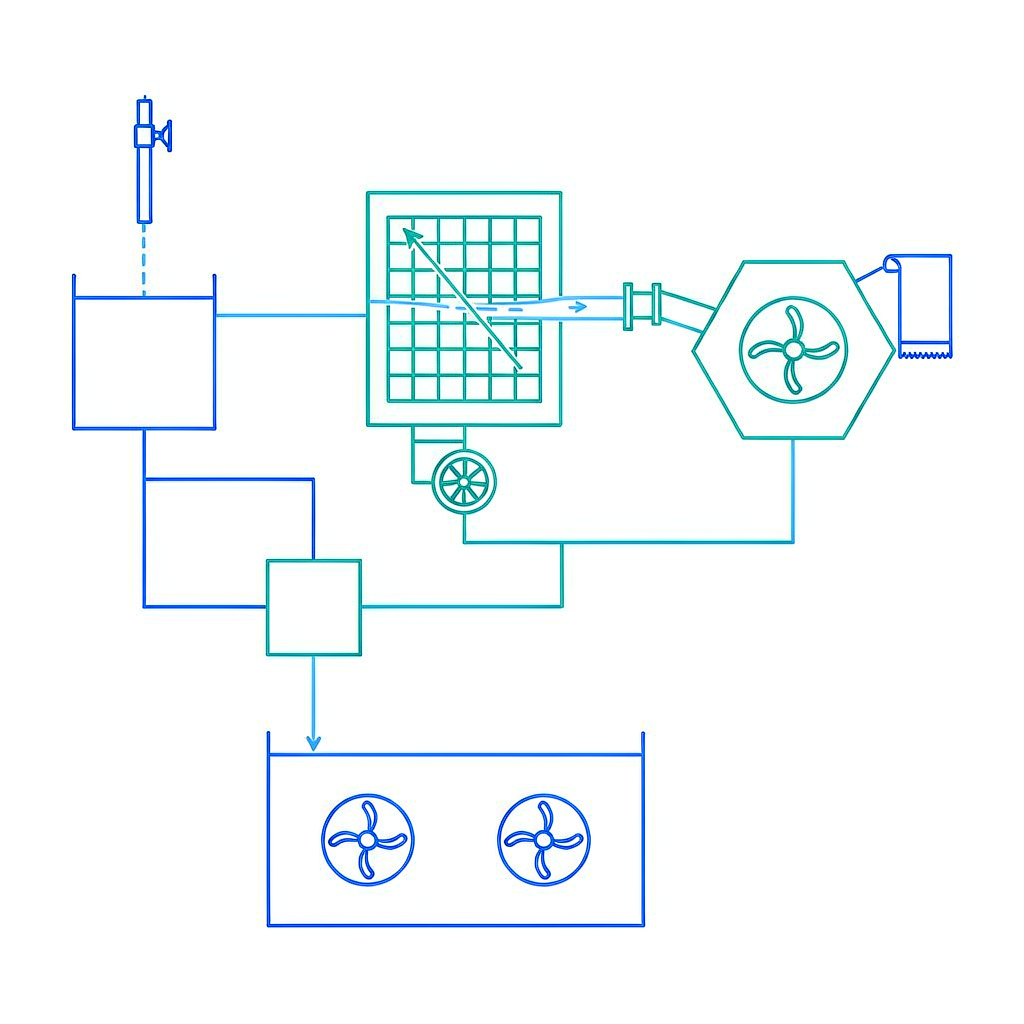
4. Air Stripping vs. Steam Stripping vs. Biological Nitrogen Removal vs. MAP Precipitation
| Method | Applicable Ammonia Nitrogen Concentration | Typical Operating Conditions | Energy Consumption | Ammonia Recovery | Removal Rate | Key Constraints |
|---|---|---|---|---|---|---|
| Air Stripping | High (>500 mg/L) | pH 11±, ambient temperature, air-to-liquid ratio 3000:1 | Blower power consumption 0.8–1.5 元/t | No (acid absorption of off-gas can produce ammonium sulfate) | Single-stage 85–90%, multi-stage >90% | No desalination or COD reduction; requires subsequent biological treatment; efficiency drops sharply at low temperatures |
| Steam Stripping | High (>1000 mg/L) | pH 11±, 80–95℃ | Steam 150–200 kg/t water | Yes (ammonia water/ammonium salt) | 85–95% | High energy consumption; suitable when waste heat is available or ammonia recovery is required |
| Biological Nitrogen Removal (Nitrification-Denitrification / PN-A) | Low to medium (mainstream <500 mg/L) | Neutral pH, ambient temperature | Relatively low | No | >90%, but high ammonia nitrogen causes significant inhibition | High ammonia nitrogen requires dilution or prior stripping pretreatment |
| Magnesium Ammonium Phosphate (MAP) Precipitation | Medium to high (500–10000) | pH 8.5–9.5, dosing Mg/PO₄ | Chemical cost | No (struvite used as fertilizer) | >95% | Chemicals are expensive; economical only when by-products are utilized |
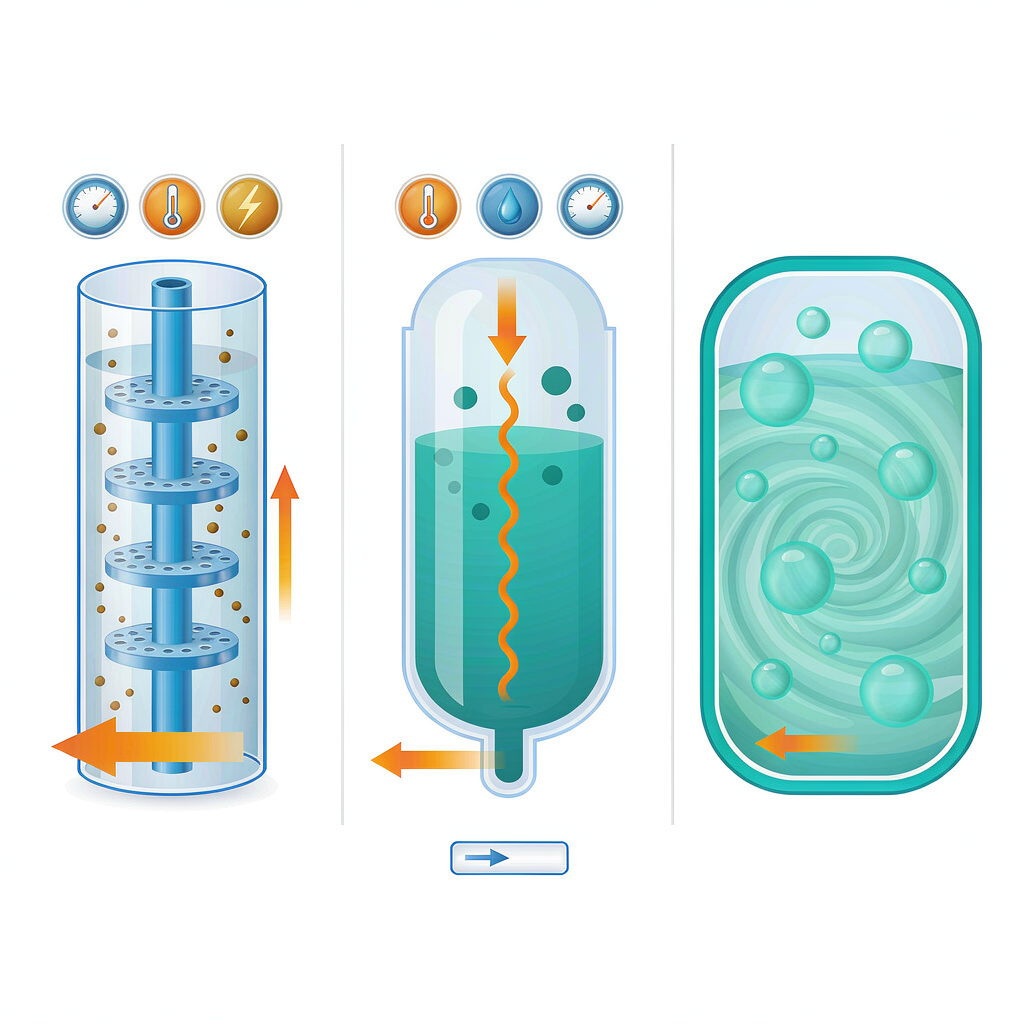
5. Engineering Realities: 6 Pitfalls That Must Be Watched
1. Low Temperature: A Cliff in Efficiency
EPA manual field tests show 90–95% at 20℃, dropping to 75% at 10℃. For northern regions or winter operation, either use waste heat (flue gas, process residual heat) for preheating, or accept a larger air volume—which is directly reflected in fan power consumption.
2. Scaling Clogs Packing Media
Using lime for pH adjustment introduces Ca²⁺, causing carbonate scaling on packing media (Pall rings, Intalox saddles), blocking the tower, and reducing mass transfer. Many projects switch to NaOH or add scale inhibitors, and control the packing section height at 4–8 m with regular cleaning schedules.
3. Secondary Pollution Red Line
Escaped ammonia gas must be treated with acid absorption (dilute H₂SO₄ → ammonium sulfate), otherwise it constitutes an air emission violation. Meanwhile, effluent pH reaches 11–12, and must be neutralized with acid (typically H₂SO₄) before discharge or downstream biological treatment. Both steps are indispensable.
4. It Only Removes Ammonia Nitrogen
Stripping does not reduce COD or remove salts. For reuse scenarios, RO/NF must follow downstream; for discharge compliance, biological treatment (A/O, MBR) must follow to further reduce residual ammonia nitrogen and organics—the coking case is exactly a "stripping + two-stage absorption + A/O" combination.
5. Single-Stage Has a Ceiling
Single-stage stripping has an influent ammonia nitrogen limit of approximately 5000 mg/L; beyond this, removal efficiency drops sharply, requiring multi-stage series configuration or switching to steam stripping. Coking/semi-coke wastewater reaching 20000 mg/L must use enhanced processes such as negative-pressure desorption ammonia distillation.
6. High Oil and Solids Cause Fouling
Total solids TS>5% or oily wastewater will clog packing media and interfere with mass transfer. Coking wastewater must undergo oil removal (hydrocyclone + air flotation) before entering the stripping tower, otherwise the operating cycle is significantly shortened.
VI. One-Sentence Selection Recommendation
Suitable for: Wastewater with high ammonia nitrogen (>500 mg/L) requiring rapid concentration reduction to relieve the load on downstream biological treatment; or scenarios with local waste heat available and a desire to recover ammonia as a resource into ammonium sulfate/ammonia water—most commonly used in coking, coal chemical, semiconductor, landfill leachate, fertilizer, and rare earth industries.
Not suitable for: Low-concentration ammonia nitrogen (biological treatment is more economical), cases requiring simultaneous desalination and COD reduction, or sites without compliant off-gas absorption conditions—in these cases stripping is both costly and carries environmental risks.
References (Verifiable Sources)
- U.S. EPA. Wastewater Technology Fact Sheet — Ammonia Stripping. Cited by Culp et al. (1978) referencing the Lake Tahoe project; design criteria: pH 10.8–11.5, media depth 6.1–7.6 m, 20℃ removal 90–95% / 10℃ reduced to 75%. nepis.epa.gov.
- IWA Publishing (2000). Study on ammonia nitrogen stripping from landfill leachate: removal rate >85% at pH 12 ; MAP precipitation >90% for the same water quality. (Cited from hydropurewater engineering review, 2025)
- hydropurewater. How Ammonia Is Removed from Landfill Leachate by Air Stripping (2025). Operating window: pH 10.5–12, temperature 20–60℃, A/L 2000–5000, single-stage 85–90%, alkali consumption 1.5–3.0 g NaOH/g NH₃-N.
- Applied Sciences (MDPI), 2021, 11(1):441. Influence of Ammonia Stripping Parameters on Efficiency and Mass Transfer Rate. Optimal liquid-to-gas ratio for packed tower: 26.8–53.6 L/m³; 70℃, pH 8.5, 6 h removal 63.0%.
- Advanced Technologies for Nitrogen Removal and Recovery from Municipal and Industrial Wastewater (europepmc review, 2024/2025). Table 3 presents stripping case studies across multiple industries: industrial wastewater 99%, anaerobic digestion liquor 91–96%, landfill leachate 98%, etc.
- wateretechs. Process selection and compliance solutions for ammonia-nitrogen wastewater treatment in the electronics and semiconductor industry (2024 industry report). Air stripping 60–80%, steam stripping 85–95%, blower 15–22 kW, steam consumption 150–200 kg/t.
- Zhao Junfeng. Field measurements of steam stripping + two-stage absorption + A/O process for coking wastewater (Master's thesis, Taiyuan University of Technology, Chapter 7 , 2022, ). Stripping efficiency 94.8%, steam 0.18 t/t water, producing 22% ammonia water at 1.2 t/h. [To be verified — cited from third-party wiki]
- Yixing Dayang Environmental Technology. Single-tower negative-pressure desorption and ammonia distillation process for coking/semi-coke wastewater (dowater engineering report, 2022). Influent ≤20000 mg/L, effluent ≤5 mg/L, Liupanshui steel plant case study. [To be verified — commercial source]
- bjx.com.cn (Polaris Environmental Protection). Analysis of coking wastewater pretreatment and changes in characteristic pollutants (2017). Three-stage enhanced ammonia stripping tower system, lime slurry pH 10–12, recovering approximately 75% ammonia nitrogen.
- anfengtech. Stripping method for high-concentration ammonia nitrogen wastewater treatment. Fu Jinxiang et al., landfill leachate stripping: pH 11, gas-to-liquid ratio 360:1, 1 h, removal 88.75%.
- Longda Environmental Protection. High ammonia nitrogen wastewater treatment technologies. At water temperature >25℃, gas-to-liquid ratio 3500, pH 10.5 , leachate (2000–4000 mg/L) removal >90%; ultrasonic stripping at a fertilizer plant 882 mg/L, pH 11, removal >90%.