


 Across multiple industries nationwide (landfill leachate / anaerobic digestion e
 Pilot-scale to full-scale implementation (from tens to tens of thousands of m³/d
Magnesium Ammonium Phosphate (MAP/Struvite) Crystallization Precipitation: Turning High Ammonia Nitrogen and Phosphorus in Wastewater into a Bag of Slow-Release Fertilizer
Biological nitrogen removal relies on microorganisms "consuming" ammonia nitrogen (often requiring supplemental carbon sources), while stripping uses alkali to "evaporate" ammonia (without phosphorus removal and with energy consumption). Magnesium Ammonium Phosphate (MAP/struvite) crystallization takes a third path—at a pH around 9 , it "locks" NH₄⁺, PO₄³⁻, and Mg²⁺ together into MgNH₄PO₄·6H₂O crystals, achieving nitrogen and phosphorus removal in a single step, with the product being a qualified slow-release fertilizer. This article uses real data from kitchen waste digestate, fermentation wastewater, landfill leachate, and municipal digester effluent to fully clarify the reaction window, magnesium source selection, and engineering constraints.
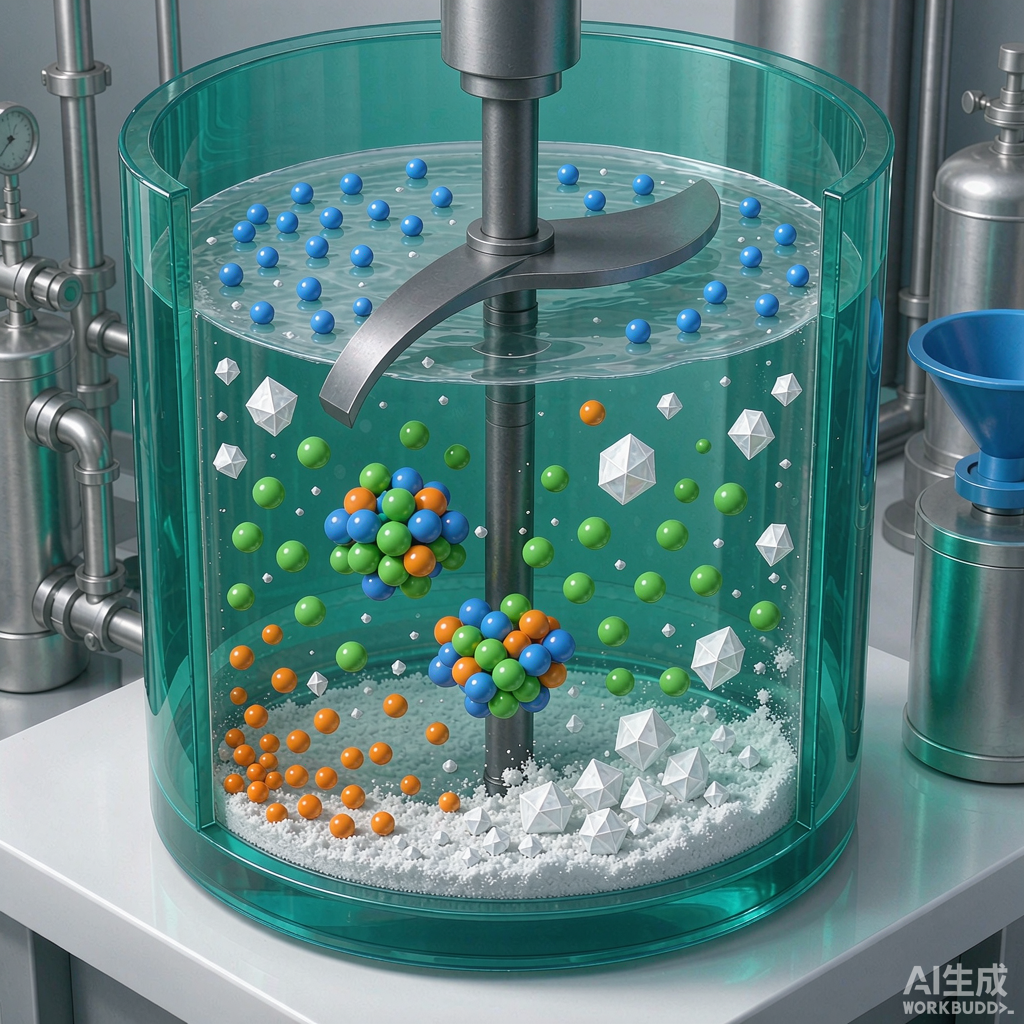
1. Principle: "Locking" NH₄⁺, PO₄³⁻, and Mg²⁺ into a Single Crystal
The core reaction of MAP is extremely simple:
Mg²⁺ + NH₄⁺ + PO₄³⁻ + 6H₂O → MgNH₄PO₄·6H₂O↓ (Struvite)
When the concentration product of the three ions reaches the solubility product (Ksp) of struvite, crystals spontaneously grow and precipitate. The key point is that pH determines "which precipitate forms": at lower pH, PO₄³⁻ is insufficient and the reaction cannot proceed; at higher pH (>10), Mg²⁺ preferentially reacts with OH⁻ to form Mg(OH)₂, wasting chemicals and reducing crystal purity; the literature consistently indicates that the usable range for struvite crystallization is pH 7.0~10.0, with the optimum at 9.0~9.5. Stoichiometrically, the three ions combine at an equimolar ratio of 1:1:1—which means chemical dosing must be "balanced," rather than overdosing a single reagent.
2. Three Operating Controls: pH, Molar Ratio, and Retention Time (Engineering Fundamentals)
① pH: 9~9.5 is the Optimal Window, and It Must Be "Stable"
A study in the Journal of Nanjing Agricultural University (2019) conducted single-factor experiments with actual kitchen waste digestate (ammonia nitrogen 3382 mg/L): within the pH 7.5~11 range, the optimum was found near 9.0 ; adjusting the initial pH to 9.0 is sufficient (without requiring constant control throughout), achieving efficient ammonia removal while avoiding ammonia volatilization interference and Mg(OH)₂ side reactions at high pH. In engineering practice, NaOH or the inherent alkalinity of MgO is commonly used to raise alkalinity.
② Molar Ratio: Approximately 1:1:1, with Slight Magnesium Excess
Theoretically, Mg:N:P = 1:1:1. In practice, to reduce residual ammonia nitrogen, magnesium is often slightly overdosed: multiple studies identify the optimum at Mg:N:P ≈ 1.1~1.5:1:1~1.3. For example, the optimal n(NH₄⁺):n(Mg²⁺):n(PO₄³⁻) for grain fermentation wastewater is 1:1.21:0.98 (VIP), and the optimal Mg:P:N for kitchen waste digestate is 1.43:1.3:1. Excess magnesium ends up in the sludge, while insufficient magnesium leaves residual ammonia nitrogen—this is the first trade-off in chemical dosing.
③ Retention Time and Temperature: 10~90 min, Nearly Temperature-Insensitive
Crystallization is rapid: in a simulated high-ammonia nitrogen wastewater test at a chemical plant, ammonia nitrogen removal reached 91.52% within 10 min; kitchen waste digestate completed most of the reaction within 75 min (the initial 45 min showed a slope of −3.83 mg/(L·min), with 68.9% removal), and 90 min allowed for complete reaction. More remarkably, temperature has minimal influence within the 20~40℃ range—in the same study, raising the temperature only reduced the removal rate by 2.31%. This is precisely MAP's greatest engineering advantage over "stripping, which requires heating": it can operate at ambient temperature.

III. Real-World Track Record (All from Published Experiments and Engineering Projects)
| Wastewater Type / Scale | Key Conditions | Removal / Product | Source |
|---|---|---|---|
| Food waste digestate (Shijiazhuang, NH₃-N 3382 mg/L) | 28℃, initial pH 9.0, 90 min, Mg:P:N=1.43:1.3:1 | NH₃-N removal ~98%, residual 48.74 mg/L, P 35.35 mg/L; COD/TN increased from 5.38 to 43.96 (~8 ×, favorable for subsequent biological treatment) | Journal of Nanjing Agricultural University 2019 |
| Chemical plant high NH₃-N wastewater (simulated) | pH 9, 10 min, NH₄:PO₄:Mg=1:1.05:1.15 | NH₃-N 91.52%, P 99.58%, Mg 90.52%; residual NH₃-N 90.87 mg/L, P 4.96 mg/L | Beijing International Science and Technology Innovation Center Open Platform |
| Grain fermentation wastewater | pH 9.12, 30℃, 100 r/min, 20 min, N:Mg:P=1:1.21:0.98 | NH₃-N 500→75.05 mg/L (84.99%), P 100→2.35 mg/L (97.65%), precipitate purity 87.19% | VIP 675410074 |
| Blackwater (residential fecal waste) | Mg:N:P=1.5:1:1, pH 9.5, initial P 200 mg/L | NH₃-N recovery 69.14%, P 94.04%; after Ca-based bentonite adsorption: NH₃-N 84.37%, P 98.68% | China Agricultural Journal Cluster |
| Steel slag (SRB) leachate | [Mg]:[NH₃-N]:[PO₄-P]=2:1:2, pH 9.5 | P 99.6%, NH₃ 98.2% | J. Environ. Manage. 2022 (PubMed 34794051) |
| Sludge dewatering liquor | pH 9.0, N:P:Mg=4:1:1.3, reaction 4 d | P removal 85%, mean crystal size 0.74 mm, purity 98.23% | Wu Jian et al. (cited from literature) |
| Municipal wastewater + sludge digestion supernatant (Xi'an) | pH 9.5, n(Mg)/n(P)=1.3, 200 r/min, 20 min | P 27.6%, NH₃-N only 18.5% (uneconomical for low-strength wastewater, see Section 4) | CNKI, a WWTP in Xi'an |
| Landfill leachate | pH 8.5~9 | NH₃-N removal >96% | Li et al. (cited from literature) |
4. Selecting the Magnesium Source: Reagent-Grade vs. Waste-for-Waste Treatment
- MgCl₂·6H₂O (Magnesium Chloride): The most commonly used, with fast dissolution and stable reactions; nearly all bench-scale tests employ it. The drawback is reagent cost, which requires careful accounting for full-scale operations.
- MgO / Mg(OH)₂: Inexpensive and inherently alkaline (offering the dual benefit of raising alkalinity), but dissolution is slow, requiring acid assistance or extended retention time. In engineering practice, they are often paired with dosing and maturation tanks.
- Brine, Dolomite, and Steel Slag (Waste-for-Waste Treatment): After nitric acid leaching of steel slag (SRB), the Mg²⁺-rich solution has achieved phosphorus 99.6%/ammonia 98.2% removal at pH 9.5 and [Mg]:[NH₃-N]:[PO₄-P] = 2:1:2 (J. Environ. Manage. 2022) — converting industrial solid waste into a magnesium source represents a mainstream direction for cost reduction and circular economy.
5. Engineering Realities: 5 Constraints That Must Be Monitored
6. MAP vs. Biological Nitrogen Removal vs. Air Stripping: How to Choose
| Dimension | MAP Crystallization | Biological Nitrogen Removal (Nitrification-Denitrification/PN-A) | Stripping (Air/Steam) | Sulfur-Based Autotrophic Denitrification* |
|---|---|---|---|---|
| Nitrogen Removal Mechanism | Chemical precipitation/crystallization | Microbial conversion to N₂ | Alkalinization releases NH₃ for volatilization | Thiobacillus denitrification |
| Phosphorus Removal | Simultaneous P removal | No (separate P removal required) | No | No (for advanced N removal) |
| Resource Recovery | Produces slow-release fertilizer | No | Can produce ammonia water (requires absorption) | No |
| Applicable Concentration | High NH₄⁺ and high PO₄³⁻ | Low to medium concentration | High ammonia nitrogen | Low C/N ratio |
| Temperature Sensitivity | Insensitive (10–40℃) | Sensitive to low temperature (<15℃ decline) | Higher temperature beneficial | Moderate temperature |
| Chemical/Energy Consumption | Requires Mg+P chemicals; no steam consumption | Requires carbon source (supplement needed for low C/N) | High alkali + steam/air energy consumption | Sulfur source |
| Key Constraints | Uneconomical at low concentrations; product must meet agricultural standards | Large tank footprint; inhibition at high ammonia levels | No P removal; NH₃ requires absorption | Sulfate accumulation; acidification |
7. One-Sentence Selection Recommendation
Suitable for: Wastewater with high ammonia nitrogen and high phosphorus—"nutrient-rich" streams such as landfill leachate, sludge/kitchen waste anaerobic digestion liquor, livestock wastewater, and fermentation wastewater—where the owner is willing to recover nitrogen and phosphorus as resources (producing slow-release fertilizer to offset part of the chemical costs).
Not suitable for: Low-concentration municipal sewage (insufficient recovery value), influent lacking phosphorus without willingness to supplement phosphorus, or scenarios where agricultural product sales channels/standards are not yet established—in these cases, biological nitrogen removal or air stripping is typically more economical. Reserve MAP for the hard requirement of "recovery with simultaneous nitrogen and phosphorus removal."
References (Authentic Sources)
- Study on factors affecting ammonia nitrogen recovery by struvite crystallization (chemical plant high ammonia nitrogen wastewater pretreatment, synthetic wastewater, pH 9/10 min/NH₄:PO₄:Mg=1:1.05:1.15, ammonia nitrogen 91.52%). Beijing International Science and Technology Innovation Center Open Science Platform. os.bjast.ac.cn
- Study on ammonia nitrogen removal from kitchen waste biogas slurry by struvite crystallization (actual kitchen waste biogas slurry, ammonia nitrogen 3382 mg/L, 28℃/initial pH 9.0/90 min/Mg:P:N=1.43:1.3:1, removal ~98%). Journal of Nanjing Agricultural University, 2019. html.rhhz.net/njnydxxb/201902014.htm
- Optimization of nitrogen and phosphorus removal from grain fermentation wastewater by struvite method using response surface methodology (pH 9.12/30℃/20 min/N:Mg:P=1:1.21:0.98, ammonia nitrogen 84.99%/phosphorus 97.65%). VIP 675410074
- Nitrogen and phosphorus recovery from black water based on MAP precipitation method (Mg:N:P=1.5:1:1/pH 9.5, ammonia nitrogen 69.14%/phosphorus 94.04%, +bentonite adsorption followed by 84.37%/98.68%). China Agricultural Journal Cluster. agrijournal.com.cn
- Recovery of phosphate and ammonia from wastewater via struvite precipitation using spent refractory brick gravel from steel industry ([Mg]:[NH₃-N]:[PO₄-P]=2:1:2/pH 9.5, phosphorus 99.6%/ammonia 98.2%). J. Environ. Manage. 2022, 302:114110 (PubMed 34794051)
- Study on ammonia nitrogen recovery from kitchen waste biogas slurry by struvite crystallization combined with biological coagulation sludge removal (Shijiazhuang kitchen waste treatment center, purity 73.82%). National Academic Search napstic.cn
- Effect of ammonia nitrogen removal by struvite precipitation on anaerobic fermentation of chicken manure (in-situ ammonia stripping pH 6.9–7.8, salt utilization rate 90–91%). Transactions of the Chinese Society of Agricultural Engineering, 2021, 37(22). tcsae.org
- Study on factors affecting phosphorus and ammonia nitrogen recovery from municipal wastewater by struvite crystallization (a wastewater treatment plant in Xi'an, low ammonia nitrogen concentration of only 18.5%). CNKI Journal Publishing Platform
- Struvite crystallization granulation technology (Unitika-Phosnix air-agitated fluidized bed reactor, recovering struvite from anaerobic digestion sludge supernatant). ima.qq.com wiki