


 National Multi-Industry (Pharmaceutical / Coking / Printing and Dyeing / Chemica
 Pilot-scale to full-scale engineering (from tens to tens of thousands of m³/d)
Iron-Carbon Micro-Electrolysis (Internal Electrolysis): A "Micro-Galvanic Cell" Without External Power, Breaking Down Refractory Wastewater for Biological Treatment
Refractory industrial wastewater (pharmaceutical, coking, printing and dyeing, chemical) often gets stuck at "poor biodegradability, biochemical system directly shuts down." Iron-carbon micro-electrolysis does not rely on electricity or expensive reagents — it only uses iron filings and carbon to build countless micro-galvanic cells in acidic water, breaking macromolecular chains and rings, destroying color, reducing heavy metals, and raising the B/C ratio before handing off to biochemical treatment. This article uses public literature and real engineering records to explain the mechanisms, parameter windows, and coupling points in one go.
1. Principle: Micro-galvanic Cells + Redox + Coagulation — Triple Synergy
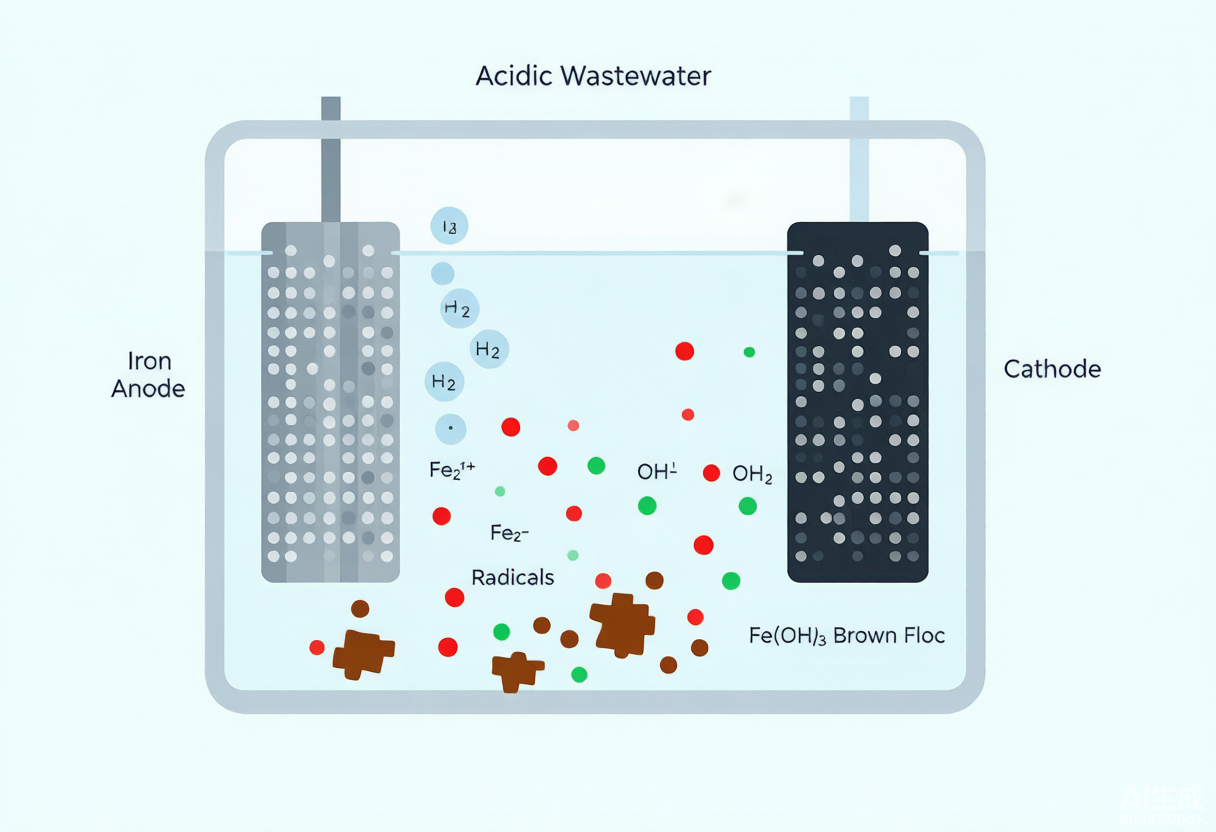
When iron filings (anode) and carbon particles (cathode) are immersed in an acidic electrolyte solution, the electrode potential difference between them (manufacturers and textbooks often cite approximately 1.2 V, see fact check in Section 5) forms countless micro-galvanic cells, and the following reactions occur:
- Anode (Fe): Fe → Fe²⁺ + 2e⁻, iron is continuously corroded and dissolved, steadily supplying Fe²⁺;
- Cathode (C): Under acidic conditions 2H⁺ + 2e⁻ → H₂ (or with aeration O₂ + 4H⁺ + 4e⁻ → 2H₂O), producing nascent [H];
- Redox chain breaking: Fe²⁺ and nascent [H] reduce and break the chains and rings of refractory organics (azo groups —N=N—, double bonds, benzene rings), converting macromolecules into small-molecule acids/alcohols, thereby raising the B/C ratio;
- Coagulation and precipitation: Fe²⁺ is further oxidized to Fe³⁺, which hydrolyzes to form Fe(OH)₂ / Fe(OH)₃ colloids that adsorb and flocculate suspended solids, colloidal organics, and some heavy metals, simultaneously achieving decolorization and partial COD removal.
Aeration serves two purposes in micro-electrolysis: supplying oxygen to enhance the cathodic reaction (O₂ acts as an electron acceptor with higher potential and stronger oxidation), and mechanically scouring the packing to alleviate caking and passivation. For this reason, modern engineering predominantly adopts "aerated micro-electrolysis" rather than static operation. Note that the effluent Fe²⁺ concentration often happens to satisfy the iron source required for the subsequent Fenton reaction — this is precisely why the "micro-electrolysis-Fenton coupling" works smoothly (detailed in Section 5).
2. Key Parameter Windows (Basic Framework for Selection)
The consistent ranges given by public literature and engineering trials are as follows: influent must be acidified is a hard prerequisite for iron-carbon micro-electrolysis (under neutral/alkaline conditions, the potential difference and reaction rate drop sharply):
| Parameter | Common Range | Typical Optimum (Literature-Measured) | Source |
|---|---|---|---|
| Influent pH | 2–6 (acidic) | 2.5–4 | Consistent across multiple sources; Environmental Science & Technology 2009 adopted 2.5 |
| Hydraulic Retention Time (HRT) | 0.5–3 h | 1–2 h (up to 3 h in isolated cases) | Water & Wastewater Engineering 2016 adopted 3 h; thesis adopted 120 min |
| Iron-Carbon Mass Ratio | 1:1 –5:1 | 1:1 –4:5 | Water & Wastewater Engineering 2016 Fe:C = 4:5; Chem. Eng. J. 2018 adopted 1:1 |
| Media Filling Ratio | 400–600 g/L | 400–600 g/L | Water & Wastewater Engineering 2016 adopted 400; thesis adopted 600 |
| Aeration (Air-Water Ratio) | Micro-aerobic environment | Air-water ratio 3:1 –10:1 | Thesis 3:1; Chemosphere 2016 adopted 10 |
| COD Removal (Pretreatment Stage) | 30%–60% | 47.5%–60% | See ledger in Section 3 |
| B/C Improvement | +0.1 –+0.4 | On the order of 0.15→0.4 | Multiple sources; Chemosphere 2016 improved by 1.7 × |
3. Real-World Engineering Track Record (All from Public Literature/Engineering Reports)
| Industry / Wastewater | Process & Key Operating Conditions | Treatment Performance | Source |
|---|---|---|---|
| Synthetic pharmaceutical wastewater | Micro-electrolysis pretreatment: dosing 400 g/L, Fe:C=4:5, HRT=3 h, pH=4, aeration 3 L/min, followed by Hydrolysis Acidification + MBR | Micro-electrolysis COD removal 47.50%, B/C 0.23→0.38, final effluent meets GB 21904—2008 | Water & Wastewater Engineering 2016,42(3); Chinese Journal of Environmental Engineering 2017,11(1):260(DOI:10.13789/j.cnki.wwe1964.2016.0084) |
| Coal pyrolysis wastewater | Fe-C media 50 g/L, pH=5 | COD removal 51.87%, total phenols 54.32%, B/C increased to 0.41, acute toxicity TU reduced by ~65% | Coal Science and Technology — Pretreatment of coal pyrolysis wastewater by iron-carbon micro-electrolysis |
| Coking wastewater (steel solid waste media) | Steel slag / blast furnace dust-based metallized briquettes, Fe content 70%–90%, carbon 10%–30%, porosity 63% | Optimal COD reduction 40%, B/C increased 43% ("waste control by waste") | J. Environ. Chem. Eng. 2024(ScienceDirect) |
| Azo dye (Sunset Yellow) wastewater | pH=6, Fe:C=1:1, total media 500 g/L, gas flow 45 L/h, 90 min, coal-based spherical AC 3–6 mm | Dye degradation 99.0%, COD removal 77.5% | Chemical Engineering Journal 2018(DOI:10.1016/j.cej.2017.10.039) |
| Steroidal hormone pharmaceutical wastewater | IME: initial COD≈15000 mg/L, pH=4, Fe-C/water=1:1, gas-water ratio 10, 180 min; followed by Fenton Oxidation-coagulation (FOF) + biological treatment | IME COD removal 31.8%, B/C enhanced 1.7 times; FOC further reduction 30.1%, B/C reached 0.59; on-site 96 m³/d continuous 90 d, final effluent COD<90, BOD₅<15 mg/L | Chemosphere 2016(DOI:10.1016/j.chemosphere.2016.02.100) |
| Sulfur red-brown intermediate wastewater | Micro-electrolysis pH=2.5, Fe:C=5:1, 2 h; Fenton enhanced Fe²⁺ 116.2 mg/L, H₂O₂ 20 mL/L, 65 min | Micro-electrolysis COD 60.47%, color 96.8%, B/C 0.08→0.21; after Fenton COD 89.0%, total removal 95.6% | Environmental Science & Technology 2009,32(10) |
| Pharmaceutical intermediate wastewater | Evaporation - iron-carbon micro-electrolysis - Fenton - facultative - contact oxidation - nitrification/denitrification - flocculation, high salinity, high ammonia nitrogen, N-containing heterocyclic compounds | Toxicity reduced, effluent meets Grade III of GB 8978—1996 | Environmental Technology 2017,30(1):16-20 |
| Dye intermediate oxidation pond concentrated wastewater | Fenton coupled with micro-electrolysis: sponge iron 150 + Activated Carbon 150 g/L, H₂O₂ 200 mL/L, FeSO₄ 40 g/L, reaction 4 h, followed by coagulation + Activated Carbon adsorption | Total COD removal 97.7%, color 99.9%, meets CJ 343—2010 | Textile Dyeing and Finishing Auxiliaries 2017,34(6):31-34 |
4. Micro-electrolysis vs. Fenton vs. Hydrolysis Acidification vs. Advanced Oxidation (How to Select Pretreatment)
| Dimension | Iron-Carbon Micro-Electrolysis | Fenton | Hydrolysis Acidification | Advanced Oxidation (Ozone/PS/Electro-Fenton) |
|---|---|---|---|---|
| External power supply required | No (media + acid adjustment only) | No (consumes H₂O₂ + Fe²⁺ reagents) | No | Yes (electricity/ozone/oxidants) |
| B/C improvement | +0.1 ~ +0.4 | +0.15 ~ +0.35 | +0.1 ~ +0.2 | +0.15 ~ +0.35 |
| COD removal in pretreatment stage | 30%–60% | 40%–70% | 10%–30% | 30%–70% |
| Operating cost level | Low (approx. 0.3–0.8 元/t, to be verified) | Medium (H₂O₂ reagent is costly) | Low | High (electricity/oxidants) |
| Main by-products | Fe(OH)₃ iron sludge | Iron sludge + reagent-laden wastewater | Minimal sludge | Bromate/sulfate accumulation, etc. |
| Most suitable wastewater | High-concentration refractory/high-color/heavy-metal-laden | Refractory (benzene ring/dyes) | Macromolecular/food & paper | Refractory deep mineralization |
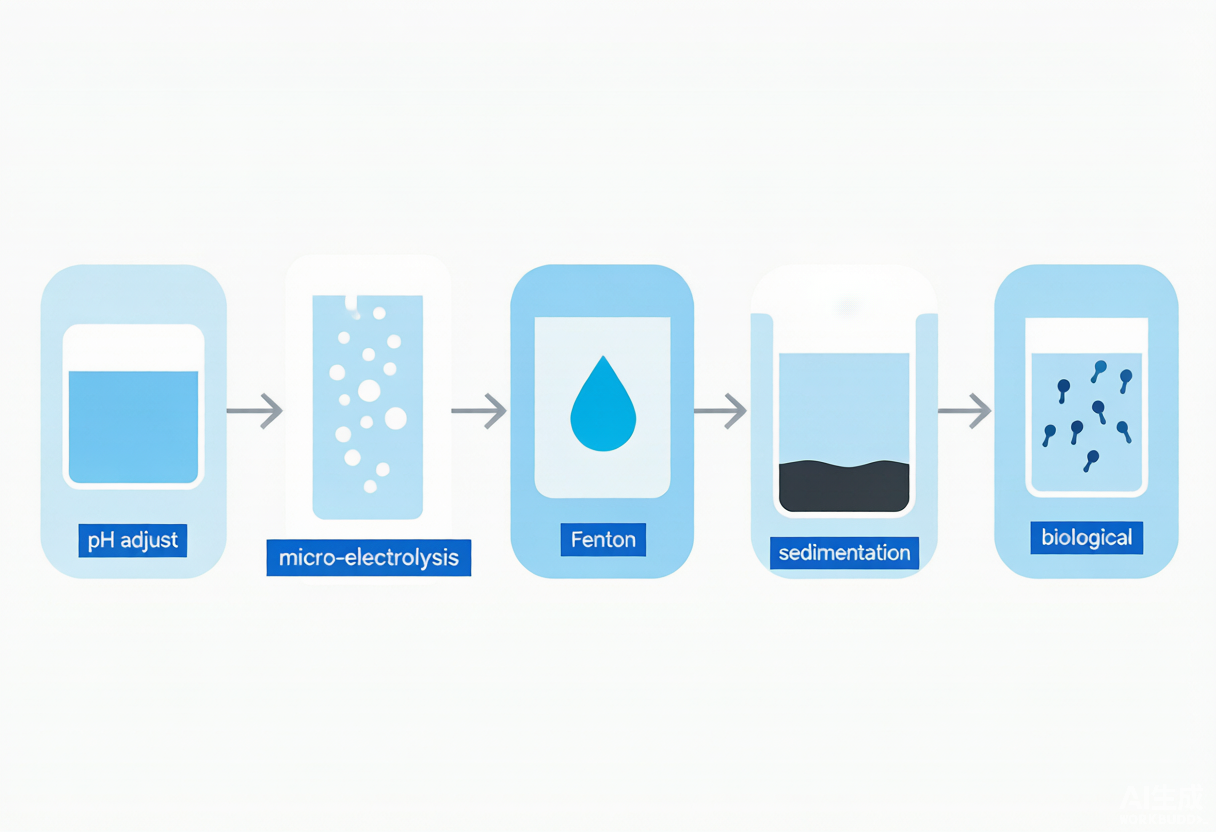
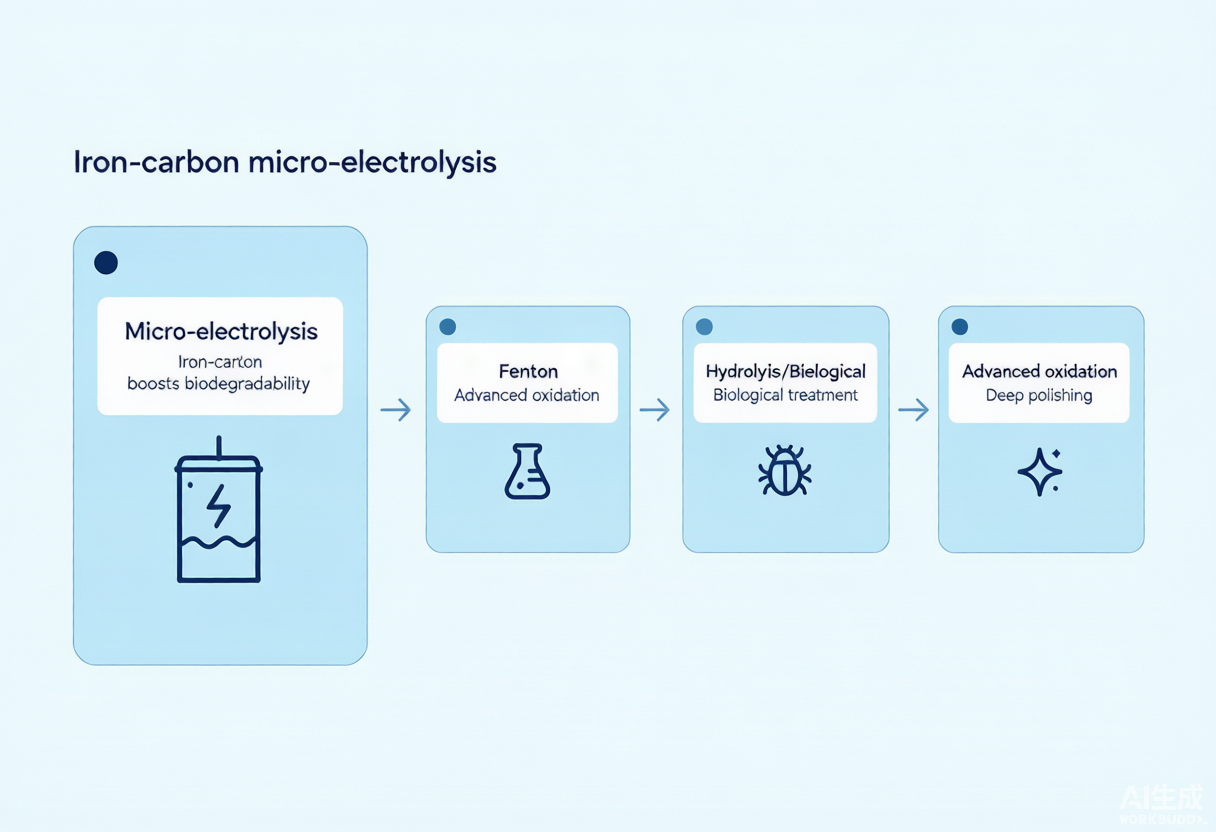
Basic logic for technology selection: For refractory wastewater requiring "biodegradability enhancement," micro-electrolysis is the priority; the effluent from micro-electrolysis naturally contains Fe²⁺, making it most cost-effective to follow up with Fenton (combined process total COD removal can reach 67%–95.6%, see cost ledger); if the pollutants are merely macromolecular and non-toxic, hydrolysis acidification is more economical; for deep mineralization to discharge standards, advanced oxidation should be applied. These three are often cascaded as "micro-electrolysis → (Fenton) → hydrolysis/biological → AOP."
5. 4 Pitfalls to Watch in Engineering Projects
1. Caking and Passivation (the #1 Enemy)
Traditional bulk fillers of "iron filings + carbon particles" are prone to caking and surface passivation (Fe is encapsulated by a dense oxide film), causing a sharp drop in mass transfer. The countermeasure is to switch to high-temperature sintered structured packing (iron-carbon framework alloy with non-separated anode and cathode), combined with aeration scouring and periodic backwashing; after passivation, dilute hydrochloric acid + ultrasonic regeneration can be used (thesis-verified reuse for over 10 cycles with COD removal still >28%).
2. Iron Sludge Disposal and pH Adjustment
Micro-electrolysis generates large amounts of Fe(OH)₃ iron sludge, and the effluent is acidic, requiring neutralization and sedimentation + sludge discharge. Iron sludge is classified as general industrial solid waste (subject to hazardous waste identification if it contains heavy metals), and disposal costs must be factored into the total budget — one cannot simply focus on "cheap fillers."
3. The "1.2 V Potential Difference" Is a Simplified Statement
4. Not a "One-Step Compliance" Process
Single-stage micro-electrolysis typically achieves 30%–60% COD removal — it addresses "biodegradability" rather than "discharge compliance." Using micro-electrolysis as the main process and skipping subsequent biological treatment often results in effluent that still exceeds standards. The correct role is as a front-end pretreatment, with the B/C ratio raised to above 0.3 before biological treatment for optimal stability.
6. One-Sentence Selection Recommendations
Suitable for: Refractory industrial wastewater with high COD, high color, poor biodegradability (B/C<0.3), or even heavy metal content (pharmaceutical, coking, printing and dyeing, chemical, coal chemical industries), serving as a front-end pretreatment "opener," with the advantages of low operating costs and no reliance on complex power sources.
Not suitable for: Using micro-electrolysis as the sole compliance unit; wastewater with low COD or readily biodegradable characteristics (hydrolysis acidification is more cost-effective); or scenarios where iron sludge disposal and acid dosing costs cannot be managed. Its value is maximized when placed in the cascade of "micro-electrolysis → Fenton/biological → advanced oxidation."
References (Verifiable Sources)
- Chen Wei, Huang Yanping, Yuan Shubao. Application of iron-carbon micro-electrolysis in synthetic pharmaceutical wastewater treatment[J]. Water Supply and Drainage, 2016, 42(3):58-63 (DOI:10.13789/j.cnki.wwe1964.2016.0084).
- Treatment of pharmaceutical wastewater by two-stage pretreatment/MBR process[J]. Chinese Journal of Environmental Engineering, 2017, 11(1):260-266.
- Study on the efficiency and biotoxicity of iron-carbon micro-electrolysis pretreatment of coal pyrolysis wastewater[J]. Coal Science and Technology.
- A purification agent for coking wastewater treatment using iron and steel solid wastes. J. Environ. Chem. Eng., 2024 (ScienceDirect, metallized agglomerate filler with COD removal of 40%, B/C increased to 43%).
- Investigating the influences of electrode material property on degradation behavior of organic wastewaters by iron-carbon micro-electrolysis. Chemical Engineering Journal, 2018 (DOI:10.1016/j.cej.2017.10.039, sunset yellow COD removal of 77.5%).
- Treatment of pharmaceutical wastewater using interior micro-electrolysis/Fenton oxidation-coagulation and biological degradation. Chemosphere, 2016 (DOI:10.1016/j.chemosphere.2016.02.100, IME COD 31.8%, field 96 m³/d).
- Yu Fenggang, Li Yanfeng, Zhou Lincheng, et al. Treatment of sulfurized red-brown intermediate wastewater by Fenton-enhanced iron-carbon micro-electrolysis process[J]. Environmental Science and Technology, 2009, 32(10) (micro-electrolysis COD 60.47%, total removal 95.6%).
- Treatment of pharmaceutical intermediate wastewater by combined micro-electrolysis, Fenton oxidation and biological process[J]. Environmental Science and Technology, 2017, 30(1):16-20.
- Treatment of concentrated dye wastewater from oxidation pond by Fenton coupled with micro-electrolysis-coagulation-adsorption process[J]. Textile Auxiliaries, 2017, 34(6):31-34 (total COD 97.7%, colority 99.9%).
- Performance and optimization study of iron-carbon micro-electrolysis system (dissertation, napstic): optimal pH=3, gas-water ratio 3:1, 120 min, 600 g/L, COD removal 30.6%; micro-electrolysis-Fenton combined COD 67%, B/C 0.15→0.37.
- 51shuichuli / wanhonghuanbao / hbzhan and other product technical data (commercial sources, COD removal 35%–60%, B/C +0.1–0.4, cost 0.3–0.8 元/t, etc. marked as [to be verified], requiring secondary source tracing).