


 National Multi-Industry (Coal Chemical / Coking / Printing and Dyeing / Lithium
  Pilot-scale to full-scale engineering (from tens to tens of thousands of m³/d; s
Electrodialysis (ED): Using an "Ion Sieve" to Separate Salt from Water in an Electric Field, Then Bipolar Membranes to Convert Salt Back into Acid and Base
Reverse Osmosis (RO) relies on pressure to "strain" out salt and struggles with high salinity; evaporation crystallization relies on steam to "boil" out salt and consumes significant energy. Electrodialysis (ED) takes a third path—using ion exchange membranes and a direct current electric field to make salt ions "migrate" themselves into the concentrate compartment, separating water and salt at ambient temperature and pressure in one step; Bipolar Membrane Electrodialysis (BMED) goes further, hydrolyzing inorganic salts directly into their corresponding acids and bases. This article draws on peer-reviewed journals and multiple real-world engineering accounts to clarify the mechanisms, parameter windows, and current efficiency/energy consumption in one go.
1. Principle: Ion Exchange Membranes + DC Electric Field, Alternating Diluate and Concentrate Compartments
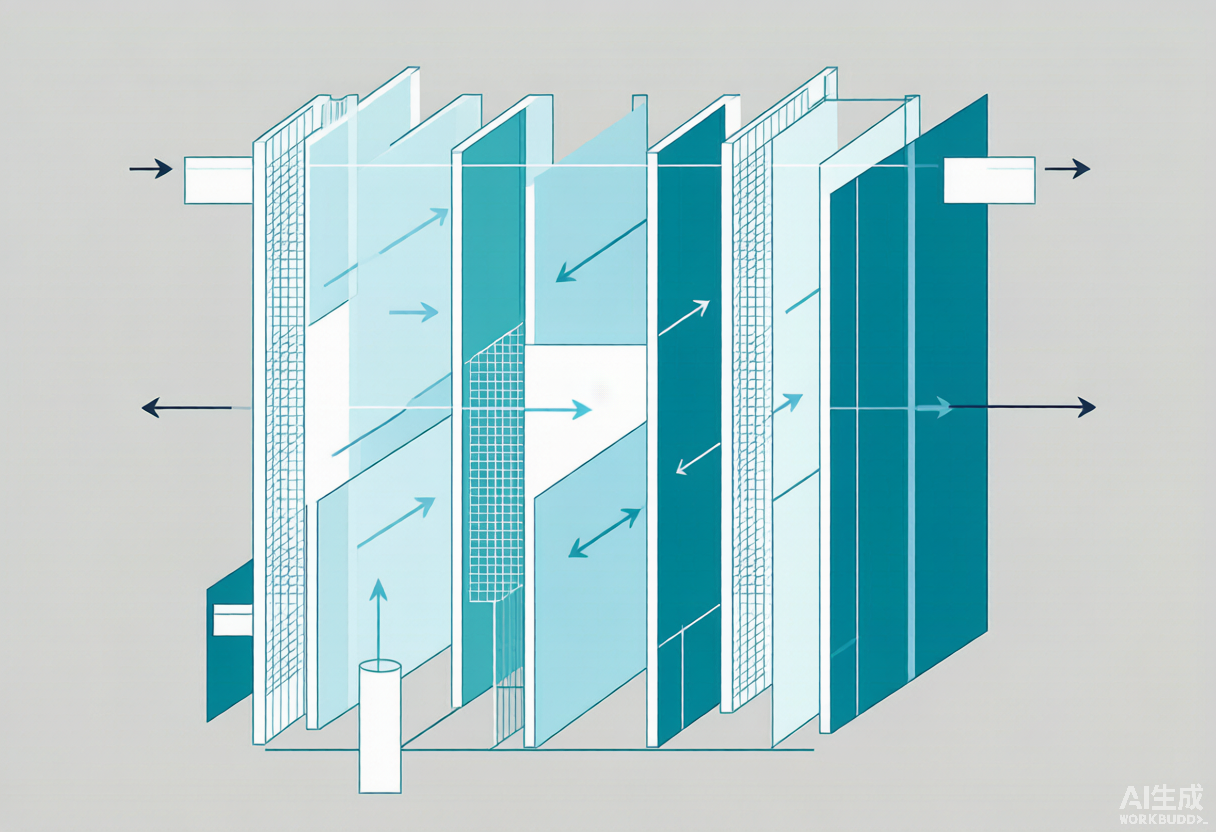
The core device of ED is the membrane stack: dozens to hundreds of pairs of anion and cation exchange membranes stacked alternately, with the compartments formed between adjacent membranes; electrodes (anode/cathode) are at both ends, connected to a DC power supply. Under the electric field:
- Cations (Na⁺, etc.) migrate toward the cathode, passing through cation exchange membranes but being blocked by anion exchange membranes, ultimately accumulating in the "concentrate compartment";
- Anions (Cl⁻, SO₄²⁻, etc.) migrate toward the anode, passing through anion exchange membranes but being blocked by cation exchange membranes, also entering the concentrate compartment;
- Salt in the diluate compartment is continuously "removed," and the outlet stream is low-salinity fresh water; salinity in the concentrate compartment continuously increases.
In engineering practice, ED is often coupled with RO: RO first removes the bulk of the salt, then the RO brine is fed to ED for further concentration and volume reduction, improving water recovery while lowering overall energy consumption. Membrane stacks typically contain 200–400 pairs of membranes with a membrane spacing of 0.5–2 mm; electrodes are commonly made of corrosion-resistant materials such as titanium coated with ruthenium/iridium, and the operating voltage per membrane pair is generally controlled at 0.8–1.5 V, with a current density of 100–300 A/m² being appropriate.
The operating mode of ED directly determines the concentration limit and energy consumption: batch mode (feed solution circulates through the membrane stack until the target is reached, then is discharged) suits small to medium scales; overflow mode (small concentrate tank with circulating overflow for gradual concentration) suits medium to large scales; continuous mode (feed passes through the membrane stack once) requires multiple membrane stages to achieve sufficient desalination and suits large-scale industrial applications. Multi-stage/overflow modes can suppress the concentration difference between diluate and concentrate compartments and limit water migration, enabling NaCl concentration up to the order of 18%–20%—this is precisely why ED can continue as the "backup concentrator" after RO.
2. Key Operating Parameter Windows
Extensive pilot and industrial studies have largely mapped out ED's "operating envelope." Below is a set of practical ranges compiled from multiple literature sources and engineering projects:
Current density is not necessarily better the higher: the closer it approaches the "limiting current density," the more severe the concentration polarization at the membrane surface and the greater the water migration (freshwater being "carried" by the electric field into the concentrate), which instead dilutes the concentration effect and increases energy consumption. The limiting current density given by the ED pilot test for printing and dyeing wastewater is only about 11.57 m A/cm² (corresponding to a limiting current of 25 A), and sufficient margin must be reserved in actual operation.
III. Real Engineering Cost Accounting (ED Desalination/Concentration, All from Public Literature and Engineering Reports)
| Industry / Scenario | Process & Key Operating Conditions | Effluent / Performance | Source |
|---|---|---|---|
| Wastewater from retired lithium-battery hydrometallurgical workshop / Full-scale | Pretreatment + ED + evaporation synergy; workshop wastewater conductivity 104.6 mS/cm, Na⁺ 2.3 g/L | Conductivity reduced to 22.09 mS/cm, suitable for leaching recycle; Na⁺ increased to 42.30 g/L; current efficiency 71.41%, energy consumption 0.70 kWh/kg; treatment cost 100→89.89 元/t | Liu Shuifa et al. Environmental Engineering, 2023 Suppl. (S1) (listed in Jiancai Zhihui Net) |
| Printing and Dyeing Wastewater / Pilot | Effluent from high-density clarifier as feed; limiting current 25 A, limiting current density 11.57 mA/cm², optimal voltage 80 V | Fresh water <1500 μS/cm; desalination rate 78.07%, hardness removal 85.88%, chloride removal 88.50% | Water Purification Technology (National Major Science and Technology Project 2012ZX07101-003) |
| RO concentrate / Overflow concentration | Current density 350 A/m² | NaCl concentrated to 185 g/L; energy consumption only 0.12 kWh/kg NaCl | Reig et al. (cited in Chemical Industry and Engineering Progress 2019 review) |
| Coal chemical/coking wastewater advanced treatment / Full-scale | Operating voltage 10 V | Current efficiency 89.2%, energy consumption 1.03 kWh/kg, feed-chamber COD reduced to 42 mg/L; treatment cost approx. 1 元/t (lower than RO) | Li Xing, Gou Mangmang. Improved Electrodialysis for Advanced Treatment of High-Salt Pharmaceutical Wastewater. Water Treatment Technology, 2018, 44(10):106-109 (cited in review) |
| RO–ED integration / Research | ED-RO recirculation integration | Water recovery up to 95%; operating cost as low as 0.19 EUR/m³ | Zhang et al. (cited in Chemical Industry and Engineering Progress 2019 review) |
| Coal chemical RO concentrate / Homogeneous membrane separation | Self-developed homogeneous anion/cation exchange membranes, multi-stage ED | Conductivity reduced to <10 mS/cm; COD rejection 85.3%–91.4%; salt re-concentrated to 15%–20% | Wang Yaoming et al. (cited in Chemical Industry and Engineering Progress 2019 review) |
4. Bipolar Membrane Electrodialysis (BMED): Converting Salt Directly into Acid and Base in One Step
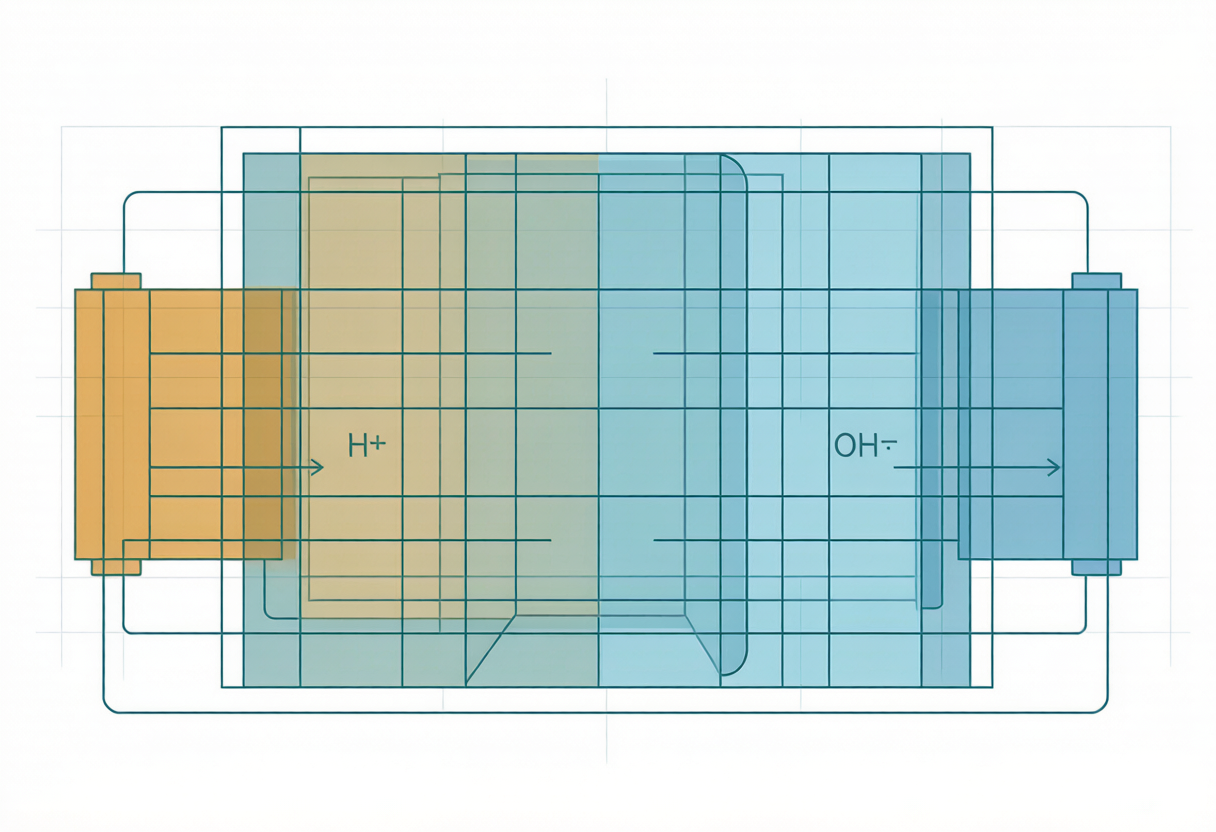
BMED introduces bipolar membranes into the membrane stack: its intermediate interface dissociates water directly into H⁺ and OH⁻ under an electric field. The typical three-compartment configuration is "salt compartment | bipolar membrane | acid/base compartment": NaCl (or Na₂SO₄) in the salt compartment is split, with Na⁺ migrating to the base compartment to combine with OH⁻ to form NaOH, and Cl⁻ (or SO₄²⁻) migrating to the acid compartment to combine with H⁺ to form HCl (or H₂SO₄). Thus, mixed salts are no longer low-value solid waste but are converted into reusable acids and bases.
Furthermore, there is Bipolar Membrane Selective Electrodialysis (BMSED): first, ion selectivity is used to separate monovalent salts (NaCl) from divalent salts (Na₂SO₄) in the mixed salt stream, and then the monovalent salt is converted into acid and base using bipolar membranes. This process has achieved mixed salt resource recovery with NaOH 2.2 m mol/L, HCl 1.9 m mol/L, and purity of 99.99% for both (as cited by Chen et al. in the 2019 review in Chemical Industry and Engineering Progress). For "mixed salts" rather than single salt species, BMSED is more aligned with engineering practice than pure BMED.
5. The Real Cost-Benefit of BMED (Salt → Acid/Base, All Data from Public Literature)
| Feedstock / Configuration | Key Operating Conditions | Products & Efficiency | Source |
|---|---|---|---|
| Sulfanilic acid wastewater / Three-compartment BP-A-C | Current density 40 mA/cm², initial salt 80 g/L, membrane surface velocity 4.0 cm/s | Desalination rate 97%; acid 1.17 mol/L, base 1.18 mol/L; current efficiency 58.9%; energy consumption 1.86 kWh/kg (as NaOH) | Dissertation/Journal (BMED treatment of sulfanilic acid wastewater) |
| Coking high-salinity concentrate / Three-compartment | Salt compartment conductivity ≥130 mS/cm, current density 800 A/m², single cycle 200 min | Produces 6.9% HCl and 7.5% NaOH; current efficiency 42.0%; total energy consumption 3 kWh/kg NaOH | Guangdong Chemical Industry, 2026, 53(7):14-19 |
| Na₂SO₄ waste solution / Three-compartment constant current | 1.30 M Na₂SO₄, 360 A/m² | H₂SO₄ recovery 77.35%, NaOH 75.18%; energy consumption 1.43 kWh/kg; current efficiency acid 51.1%/base 49.7% | Constant-current BMED of Na₂SO₄ (English journal) |
| Sodium sulfate wastewater / Multi-unit | Current density 70 mA·cm⁻², circulation rate 80 mL·min⁻¹ | SO₄²⁻ recovery 94.2%, Na⁺ 71.2%; specific energy consumption 3.10/1.80 kWh·mol⁻¹; current efficiency 52.4%/50.5% | CNKI journal publishing platform (BMED recovery of H₂SO₄ and NaOH) |
| Salicylic acid wastewater / BMED | Current density 40 mA/cm², flow rate 4.0 cm/s, initial Na₂SO₄ 80 g/L | Desalination rate 96.3%; H₂SO₄ 0.97 mol/L, NaOH 1.56 mol/L; current efficiency acid 55.2%/base 50.2%; energy consumption 2.89/3.98 kWh/kg | Desalination, 2022, 537:115866 (doi:10.1016/j.desal.2022.115866) |
| Acid mine drainage / EDBM | 450 A/m², volume ratio 2:2:2 | Current efficiency 93%, specific energy consumption 2.26 kWh/kg NaOH; obtains 0.5 mol/L NaOH and 0.4 mol/L H₂SO₄ | Separation and Purification Technology / Elsevier, 2025 |
| Na₂SO₄ pilot / 30 membrane pairs 0.02 m² | 20 wt% Na₂SO₄, 750 / 550 A/m² | H₂SO₄ 10.4 wt%, NaOH 7.4 wt%; purity 96.1%/99.6%; energy consumption 1.3 / 0.9 kWh/kg | ScienceDirect, 2025 (pilot-scale BMED) |
6. Process Comparison: ED / BMED / RO / MD / Evaporation
| Dimension | Electrodialysis (ED) | Bipolar Membrane Electrodialysis (BMED) | Reverse Osmosis (RO) | Membrane Distillation (MD) | Evaporation Crystallization |
|---|---|---|---|---|---|
| Driving Force | DC electric field | DC electric field + water dissociation | Pressure difference | Vapor pressure difference (waste heat) | Steam/heat |
| Core Products | Fresh water + concentrated brine | Acid + base (+ fresh water) | Fresh water + concentrate | High-purity permeate + concentrated solution | Permeate + crystalline salt |
| Maximum Salt Tolerance | Concentration up to ~18%–20% NaCl | Medium-high salinity (salt chamber concentration limited) | ~7% TDS | 25%–30%+ TDS | Any (up to crystallization) |
| Typical Energy Consumption | 0.12–1.0 kWh/kg salt (desalination) | 1–4 kWh/kg NaOH | ~2–4 kWh/t (salt-limited) | Low-temperature heat from single-digit kWh/t | >200 kWh/t (high) |
| Key Limitations | Polarization/water transport limits concentration; scaling | Acid/base crossover reduces current efficiency/purity | Not tolerant of high salinity; concentrate difficult to dispose of | Low flux, membrane wetting, heat source required | High energy consumption, scaling and corrosion |
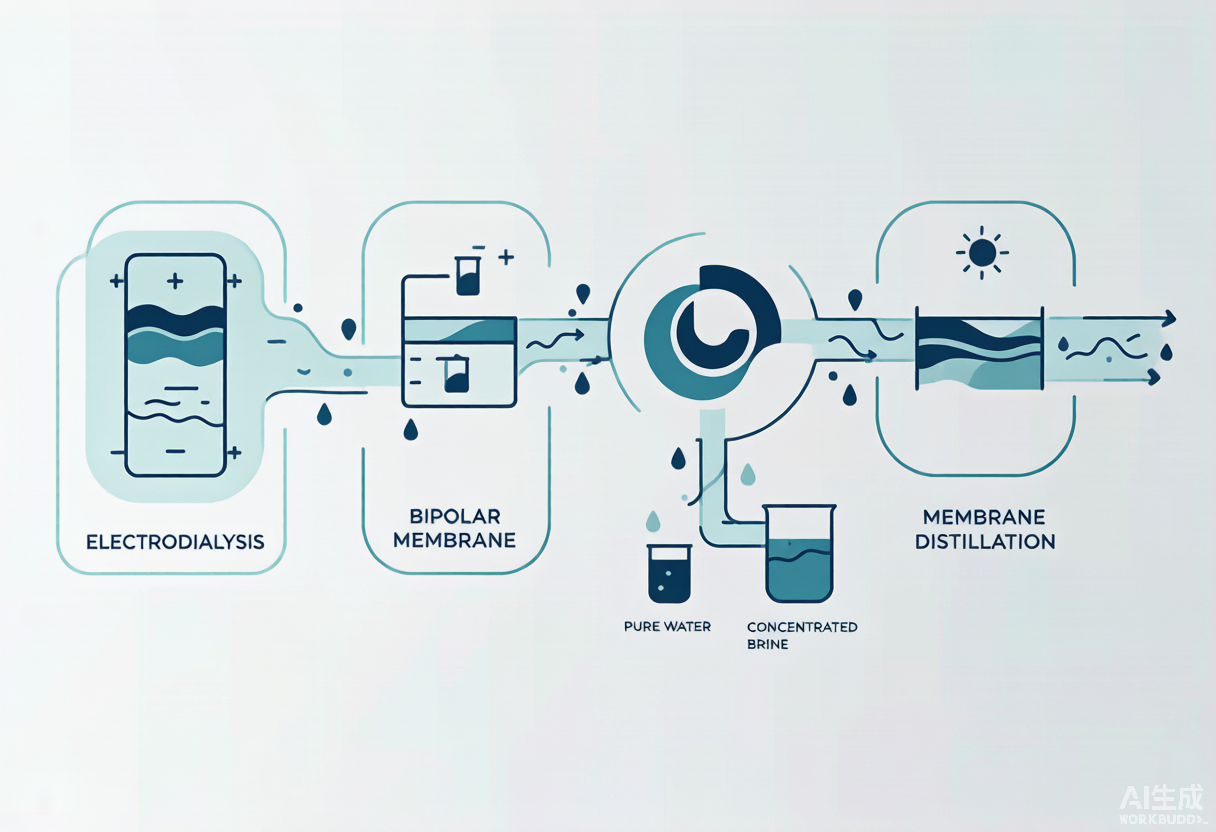
Positioning in one sentence: ED is the step for "ambient-temperature electric-field desalination and concentration," while BMED is the step for "converting mixed salts into valuable acid and base." Both should be coupled with RO and evaporation/crystallization rather than operating standalone — ED/BMED only make sense when integrated into the chain of "pretreatment → RO → ED concentration → BMED/evaporation crystallization."
VII. 5 Practical Truths That Must Be Watched in Engineering
VIII. One-Sentence Selection Recommendations
Suitable for: Scenarios with existing RO concentrate/high-salinity wastewater requiring "volume reduction + salt value enhancement," desalination at ambient temperature without phase change, or conversion of mixed salts into reusable acid/alkali (coking/coal chemical/lithium battery recycling/mining/printing and dyeing/pharmaceutical); especially when low-cost electricity is available on site and the salt species is relatively simple — ED/BMED economics are most stable under these conditions.
Not suitable for: Cases requiring high-purity crystalline salt in a single step, or where salt concentration is already near saturation without downstream evaporation as a safety net — in such cases ED is only responsible for "concentration and volume reduction," while crystallization and salt separation must still be handed to evaporation; BMED is only suitable for closed loops where "salt → corresponding acid/alkali has a practical reuse destination," otherwise the produced acid/alkali becomes a burden with nowhere to go.
References (Authentic Sources)
- Liu Shuifa, Hu Jian, Wu Na, et al. Study on electrodialysis concentration of wastewater from wet recycling workshop of retired lithium-ion batteries. Environmental Engineering, 2023 Supplement (S1) (listed on Building Materials Smart Net). Conductivity 104.6→22.09 mS/cm, Na⁺ 2.3→42.30 g/L, current efficiency 71.41%, energy consumption 0.70 kWh/kg, cost 100→89.89 元/t.
- Pilot test of electrodialysis desalination of printing and dyeing wastewater and its influencing factors. Water Purification Technology (National Science and Technology Major Project 2012ZX07101-003). Limiting current 25 A, limiting current density 11.57 mA/cm², optimal voltage 80 V, desalination rate 78.07%, hardness removal 85.88%, chloride removal 88.50%.
- Yan Haiyang, Wang Yaoming, Jiang Chenxiao, et al. Application, opportunities and challenges of ion-exchange membrane electrodialysis in "zero liquid discharge" of high-salinity wastewater. Chemical Industry and Engineering Progress, 2019, 38(1):672-681. (Review citing Reig et al. on ED concentration of RO brine, Zhang et al. on RO-ED integration, Wang Yaoming et al. on homogeneous membrane separation of RO concentrate from coal chemical industry, etc.).
- Li Xing, Gou Mangmang. Study on advanced treatment of pharmaceutical high-salinity wastewater by improved electrodialysis. Water Treatment Technology, 2018, 44(10):106-109. (Review citing: ED of coking/coal chemical wastewater, operating voltage 10 V, current efficiency 89.2%, energy consumption 1.03 kWh/kg, COD reduced to 42 mg/L, cost approx. 1 元/t).
- Treatment of sulfanilic acid wastewater by BMED (dissertation/journal article). Three-compartment BP-A-C: 40 mA/cm², 80 g/L → desalination rate 97%, acid 1.17/base 1.18 mol/L, current efficiency 58.9%, energy consumption 1.86 kWh/kg NaOH.
- Study on resource recovery from coking high-salinity concentrate by bipolar membrane electrodialysis. Guangdong Chemical Industry, 2026, 53(7):14-19. Three-compartment: ≥130 mS/cm, 800 A/m², 200 min → 6.9% HCl + 7.5% NaOH, current efficiency 42.0%, total energy consumption 3 kWh/kg NaOH.
- Constant-current BMED of Na₂SO₄ waste solution (English journal). 1.30 M, 360 A/m² → H₂SO₄ 77.35%, NaOH 75.18%, energy consumption 1.43 kWh/kg, current efficiency acid 51.1%/base 49.7%.
- Recovery of sulfuric acid and sodium hydroxide by bipolar membrane electrodialysis (CNKI journal publishing platform). 70 mA·cm⁻², 80 mL·min⁻¹ → SO₄²⁻ 94.2%, Na⁺ 71.2%, energy consumption 3.10/1.80 kWh·mol⁻¹, current efficiency 52.4%/50.5%.
- Liu Y, Sun Y, Peng Z. Evaluation of bipolar membrane electrodialysis for desalination of simulated salicylic acid wastewater. Desalination, 2022, 537:115866 (doi:10.1016/j.desal.2022.115866). 40 mA/cm², 80 g/L → desalination rate 96.3%, H₂SO₄ 0.97/NaOH 1.56 mol/L, current efficiency acid 55.2%/base 50.2%, energy consumption 2.89/3.98 kWh/kg.
- Integration of ED with bipolar membranes for acidic mine waters valorisation (EDBM). Separation and Purification Technology / Elsevier, 2025. 450 A/m², 2:2:2 → CE 93%, SEC 2.26 kWh/kg NaOH, 0.5 mol/L NaOH + 0.4 mol/L H₂SO₄.
- Pilot-scale bipolar membrane electrodialysis of high-concentration Na₂SO₄. ScienceDirect, 2025. 30 membrane pairs 0.02 m², 20 wt% Na₂SO₄ → H₂SO₄ 10.4 wt%/NaOH 7.4 wt%, purity 96.1%/99.6%, energy consumption 1.3/0.9 kWh/kg.
- Application of ion-exchange membrane electrodialysis in zero liquid discharge of high-salinity wastewater (dowater technical review, 2022). Membrane stack 200–400 membrane pairs, membrane spacing 0.5–2 mm, limiting concentration 18%–20% NaCl, bipolar membrane water dissociation voltage lower than electrolysis of brine (no Cl₂ by-product), and other statements as sources.