



 Across multiple industries nationwide (food processing/slaughtering/pharmaceutic
 Pilot-scale to full-scale implementation (from thousands to hundreds of thousand
A²/O (Anaerobic-Anoxic-Oxic): A Flow Diagram Explaining How "Simultaneous Nitrogen and Phosphorus Removal" Occurs in Industrial Wastewater
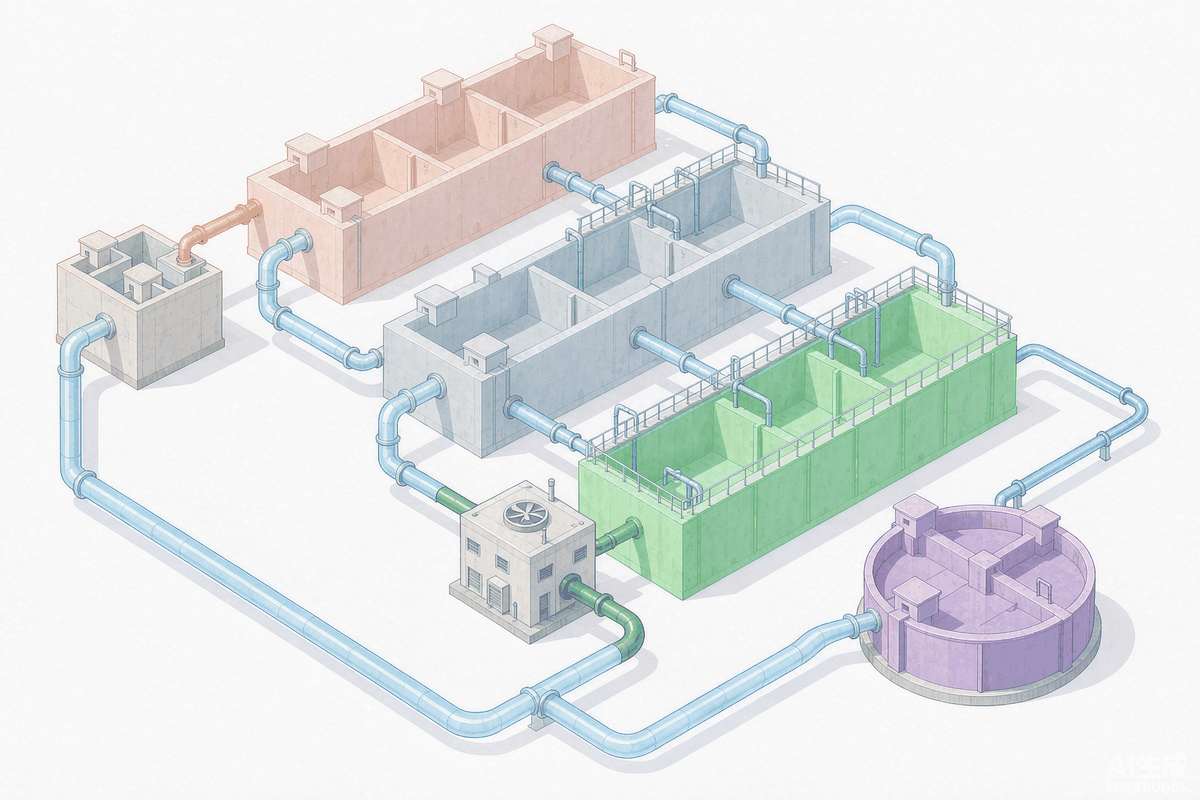
A²/O (Anaerobic–Anoxic–Oxic) is the most classic single-stage configuration in Biological Nutrient Removal (BNR): anaerobic, anoxic, and aerobic tanks work in sequence, packing "carbon removal, nitrogen removal, and phosphorus removal" into one continuous flow train. It does not rely on chemical dosing for phosphorus precipitation or membrane screening, but rather allows microorganisms to "take what they need." This article draws on publicly available peer-reviewed literature and real engineering accounts from food, slaughterhouse, and printing & dyeing industries to clarify the mechanisms, parameter windows, and process selection in one go.
1. Mechanisms: Three Zones in Sequence — Carbon, Nitrogen, and Phosphorus "Each Take Their Own Path"
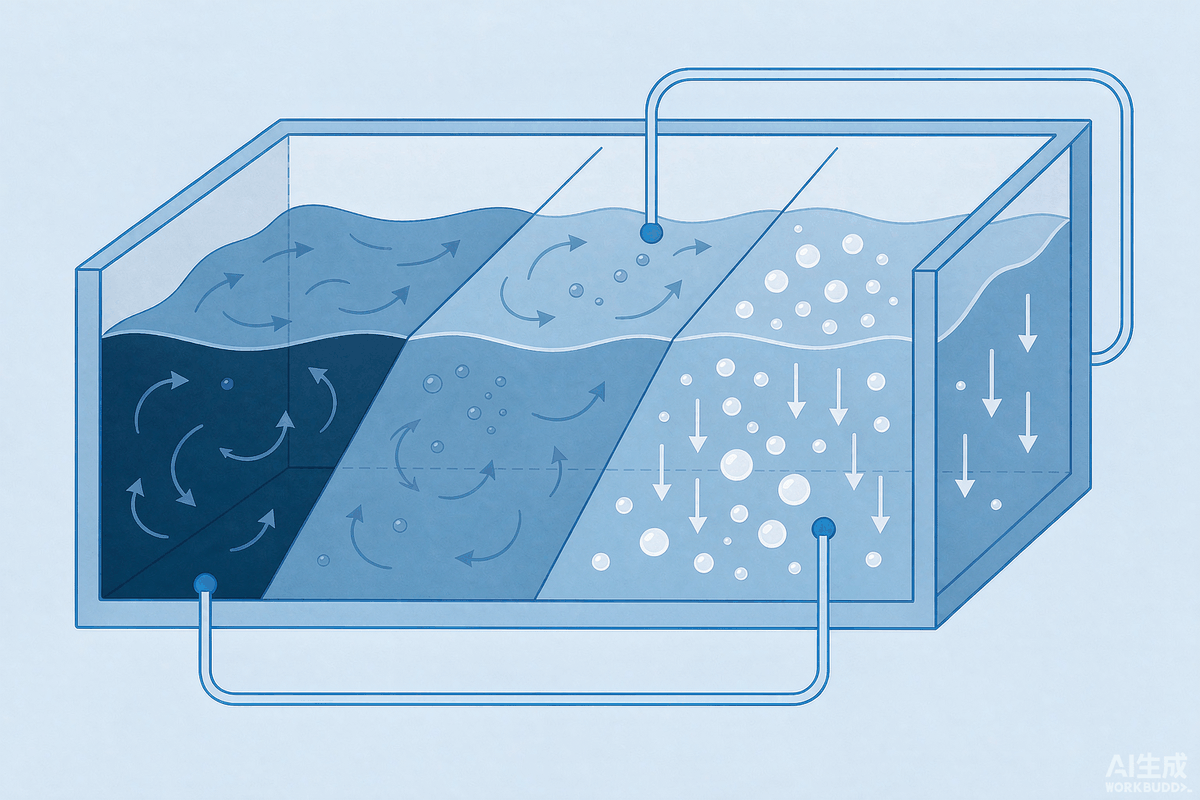
The essence of A²/O lies in using a continuous flow sequence to give three functional microbial groups each their most favorable oxidation–reduction environment:
- Anaerobic zone (no DO, no NO₃⁻): Polyphosphate-Accumulating Organisms (PAO) take the stage. Under anaerobic conditions, PAO hydrolyze intracellular stored polyphosphate to "release" orthophosphate (phosphorus release), while using the released energy to take up Volatile Fatty Acids (VFA) from the influent and convert them into intracellular storage compounds PHA (polyhydroxyalkanoates). This step of "losing first, gaining later" lays the groundwork for excess phosphorus uptake in the subsequent aerobic zone.
- Anoxic zone (no DO, with NO₃⁻): Denitrification for nitrogen removal. Nitrate recirculated from the aerobic zone is reduced here by heterotrophic bacteria as an "electron acceptor" to N₂, which escapes as gas. The anoxic zone is not aerated, so carbon sources are preferentially used for "denitrification" rather than aerobic oxidation — hence denitrification efficiency is highly dependent on the influent carbon-to-nitrogen ratio.
- Aerobic zone (with DO): Three processes occur simultaneously. First, residual organic matter (BOD/COD) is oxidized; second, ammonia-oxidizing bacteria (e.g., Nitrosomonas) nitrify NH₄⁺ to NO₂⁻, which is further oxidized to NO₃⁻ by nitrite-oxidizing bacteria (e.g., Nitrobacter); third, PAO use the PHA stored during the anaerobic zone for "excess phosphorus uptake," absorbing phosphorus far beyond their own metabolic needs, which is ultimately removed from the system with the waste Activated Sludge.
At the community level, multiple studies consistently indicate that Proteobacteria dominate denitrification and phosphorus removal, Nitrosomonas dominate ammonia oxidation, and Accumulibacter (facultative Dechloromonas) dominate excess phosphorus uptake by PAO — this is the microbiological foundation for A²/O's ability to achieve "three removals in one tank."
2. Key Parameter Windows: The Design Baseline
Typical ranges from public design codes and operating experience for industrial A²/O systems are:
① Hydraulic Retention Time (HRT) — "How long in each zone"
The three-zone volume ratio is typically anaerobic:anoxic:aerobic ≈ 1:1:3. Zone-specific HRT: anaerobic 1–2 h, anoxic 2–4 h, aerobic 4–8 h, with total HRT typically 12–18 h. For refractory wastewater such as printing and dyeing, HRT must be extended to 14–18 h (per HJ 471—2020 , etc.); for small townships/low-strength long-flow configurations, it can reach 21–32 h (see the multi-stage A²/O case study below).
② MLSS and SRT — "How concentrated and how long to keep the sludge"
Biological tank MLSS is generally 3,000–5,000 mg/L (optimized value for printing and dyeing: 4,500–6,000 mg/L); SRT is set at 15–25 d, because nitrifiers and PAO are slow-growing organisms — too short an SRT would "wash out the microbial population." A slaughterhouse wastewater pilot once operated at SRT=10 d (see the accounts section), representing a boundary condition on the short side.
③ DO and Recycle Ratios — "Where oxygen is supplied, where nitrate is sent"
DO in the aerobic zone is typically 2–3 mg/L (3.5–4.5 mg/L for printing and dyeing wastewater optimization); DO in the anaerobic zone must be strictly <0.2 mg/L, and <0.5 mg/L in the anoxic zone; otherwise, nitrate "backflow" will inhibit PAO phosphorus release. Two return lines: internal nitrified liquor return 100–400% (typically 200–250% in mainstream practice) and sludge return 50–100%.
④ Carbon Source Constraints — "Both Nitrogen and Phosphorus Removal Depend on Carbon"
Empirically, BOD₅/TN ≥ 4 is required to maintain stable denitrification, and BOD₅/TP ≥ 17–20 is sufficient for PAO biological phosphorus removal. Low C/N industrial wastewater (e.g., coal chemical, certain pharmaceutical streams) must be supplemented with carbon sources (sodium acetate, glucose); otherwise, both TN and TP will struggle to meet discharge standards.
III. Real-World Engineering Accounts (All from Published Literature and Engineering Case Studies)
| Industry / Scale | Process & Key Operating Conditions | Effluent / Removal Performance | Source |
|---|---|---|---|
| Meat processing wastewater / Upflow A²/O | HRT 12.5 h, COD/TN=100:8, aeration volume fraction 50% | COD 98.33%, TKN 92.06%, NO₃-N 91.97%, TN 90.48%, PO₄-P 83.48% | Chemosphere 2018, 213:197–204 (doi:10.1016/j.chemosphere.2018.09.047) |
| Slaughterhouse wastewater / Continuous-flow A²/O | HRT 16 h, SRT 10 d, COD:TKN=8.2, COD:TP=54, internal recycle 2Q | COD removal >90%, TP 85–89% (DO-dependent) | Environmental Technology 2011, Fongsatitkul et al. |
| Domestic sewage / Modified extended-SRT A²/O | SRT=19.6 d, MLSS=5.5 g/L, HRT=8.2 h, R=90%, r=250%, DO=1.5~0.3, intermittent aeration | COD 88.71%, NH₄⁺-N 99.2%, TP 93.77%, TN 89.52% (DPAO accounts for 95.5% of PAO) | CIESC Journal 2014, 45(12):4985 (doi:10.3969/j.issn.0438-1157.2014.12.046) |
| Municipal wastewater / A²/O-MBR | SRT=60 d, total HRT=12 h, external/internal recycle 200% | COD >95%, TN 86.2%, TP only 55.9% (membrane does not remove phosphorus) | Int. Biodeterior. Biodegrad. 2015, 104:363 (doi:10.1016/j.ibiod.2015.07.001) |
| Rural sewage / Multi-stage A²/O + constructed wetland | Continuous 320 d, HRT 21–32 h, recycle ratio 200%, low C/N=3.3 | COD 74.2%, NH₄-N 93.4%, TN 90.6%, TP 86.3%, operating cost 0.12 USD/m³ | Science of Total Environment 2025 (PubMed 40121987) |
| Integrated food wastewater / UASB+A²/O | Influent COD 2500–3500 mg/L, ammonia nitrogen 50–80, total phosphorus 15–25 | Effluent COD 30–45 (98.5%), ammonia nitrogen 1–3 (95%), total phosphorus 0.3–0.5 (98%), operating cost 1.7 元/t | Weilin Environmental Protection engineering case [To be verified] |
| Knitting & dyeing / Hydrolysis Acidification + A²/O + Fenton | A 8000 t/d plant in Shandong, upgrade for stricter discharge standards | Effluent COD 120→38 mg/L, TN removal 82.3%, operating cost reduced by 18.7% | Industry engineering report 2026 upgraded version [To be verified] |
IV. 5 Practical Truths That Must Be Watched Closely in Engineering
V. Process Comparison: What Should A²/O Be Compared Against
| Process | Simultaneous Nitrogen & Phosphorus Removal | Footprint | Operational Complexity | Applicable Scale | Key Constraints |
|---|---|---|---|---|---|
| A²/O (Continuous-flow Three-stage) | Excellent (simultaneous C/N/P removal) | Medium | Medium (two return flows) | Suitable for large, medium & small | C/N ratio; nitrate-free anaerobic zone |
| SBR (Sequencing Batch) | Excellent (time-sequenced zones) | Small (single tank) | High (valves/timing) | Small & medium scale | High automation requirement; peak flow limited |
| Oxidation Ditch | Medium (often nitrification-biased) | Large (long hydraulic path) | Low | Medium & large scale | Chemical addition often required for P removal |
| MBR (Membrane Separation) | Excellent N removal; weak P removal | Small | High (membrane fouling) | Reuse / stringent standards | Membrane does not remove P; high CAPEX & energy |
| BAF (Biological Aerated Filter) | Excellent N removal; weak P removal | Small | Medium | Tertiary treatment | Prone to clogging; backwashing required |
6. One-sentence Selection Recommendations
Suitable for: Industrial wastewater (food processing, slaughterhouses, fermentation, some pharmaceutical/printing and dyeing/petrochemical parks) with effluent requirements for "dual control of nitrogen and phosphorus," medium to large flow rates (thousands to hundreds of thousands of m³/d), where integrated biological carbon–nitrogen–phosphorus removal is desired, and where the carbon source is largely sufficient.
Not suitable for: Water with severely imbalanced C/N ratios where carbon supplementation is not feasible, scenarios requiring "zero liquid discharge/reuse-grade desalination" (membrane processes must follow A²/O), and very small flow sites where automation is not desired (SBR may be more space-efficient). Only when A²/O is applied to the hard requirement of "stable nitrogen and phosphorus removal" does it justify the investment in its three-stage tank configuration.
References (Authentic Sources)
- Abyar H, Younesi H, Bahramifar N, Zinatizadeh A A. Biological CNP removal from meat-processing wastewater in an innovative high rate up-flow A2O bioreactor. Chemosphere, 2018, 213:197–204 (doi:10.1016/j.chemosphere.2018.09.047).
- Fongsatitkul P, Wareham D G, Elefsiniotis P, Charoensuk P. Treatment of a slaughterhouse wastewater: effect of internal recycle rate on COD, TKN and TP removal. Environmental Technology, 2011.
- Enhanced A²/O process for simultaneous nitrogen and phosphorus removal from low C/N domestic sewage under extended SRT. CIESC Journal, 2014, 45(12):4985–4996 (doi:10.3969/j.issn.0438-1157.2014.12.046).
- Falahti-Marvast H, Karimi-Jashni A. Simultaneous organic and nutrient removal in a pilot-scale A2O-MBR. Int. Biodeterior. Biodegrad., 2015, 104:363–370 (doi:10.1016/j.ibiod.2015.07.001).
- Wu L, Li P, Wang G, Sijan A H, Zhang B. High-efficiency nitrogen and phosphorus removal for low C/N rural wastewater using a full-scale multi-stage A2O biofilm reactor combined with constructed wetlands. Science of Total Environment, 2025 (PubMed 40121987).
- Spans Envirotech. A2O Process for Wastewater Treatment (BNR technology review, parameter range reference).
- Environment-Database. Biological Nutrient Removal (BNR mechanism and typical removal efficiency review).
- Weilin Environmental Protection. Wastewater treatment project of a large integrated food processing plant (UASB+A²/O engineering case) [To be verified].
- Industry engineering report. 2026 upgraded version: how to optimize the A2O process for printing and dyeing wastewater treatment (case analysis) [To be verified].