


 Across multiple industries nationwide (pharmaceutical / petrochemical / brewery
  Pilot-scale to full-scale engineering (from tens to tens of thousands of m³/d)
SBR (Sequencing Batch Reactor): One Tank Completes "Influent—Aeration—Settling—Discharge" in Time Sequence, a Highly Flexible Choice for Small-to-Medium Industrial Wastewater
The conventional continuous-flow activated sludge process splits the "aeration tank + secondary clarifier + sludge return" into multiple structures; SBR takes the opposite approach—packing all functions into a single reaction tank, operating cyclically through time-based sequencing, with no secondary clarifier and no sludge return, relying on quiescent settling to achieve near-ideal solid-liquid separation. Based on the HJ/T technical specification and multiple publicly available real-world engineering accounts, this article provides a comprehensive explanation of cycle design, parameter windows, nitrogen and phosphorus removal mechanisms, and process comparisons.
1. Principle: Trading Time for Space—One Tank Completes the Entire Process
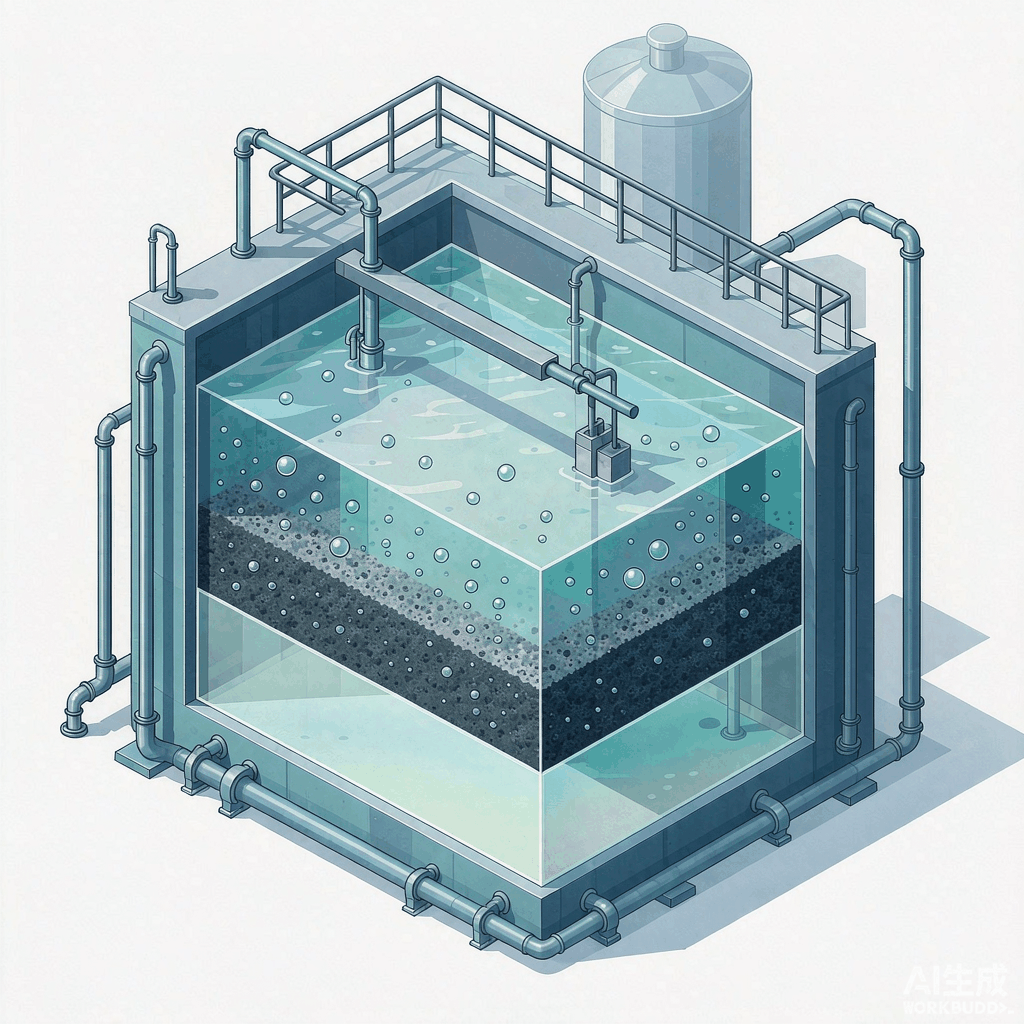
The core of SBR is "sequential operation within the same reactor over time." Each operating cycle consists of five phases:
- Fill: Water is fed from the lowest water level to the highest water level. This can be either limited-aeration filling (no aeration during the fill phase, suitable for readily degradable wastewater requiring concentration peak suppression) or non-limited aeration filling (aeration during filling, suitable for wastewater requiring immediate degradation). Submerged influent is recommended.
- React: The wastewater is aerated and treated, with aerobic, anoxic, or anaerobic phases combined as needed to achieve organic degradation, nitrification, and phosphorus uptake.
- Settle: Aeration ceases and the mixed liquor is left quiescent, allowing solid-liquid separation by gravity—this is SBR's "ideal settling," undisturbed by influent or effluent flows, yielding extremely clear supernatant when sludge settleability is good.
- Draw: A decanter removes the supernatant down to the lowest water level without disturbing the sludge blanket and while retaining floating scum.
- Idle: The idle period between the end of decanting and the next cycle's fill phase provides system buffering and preparation, and can be flexibly adjusted.
The specification (HJ/T Technical Specification for Sequencing Batch Reactor Activated Sludge Process, draft for comments) clearly states: the SBR process should combine the characteristics of ideal plug flow in time and complete mixing in space, must incorporate quiescent settling, should maintain a relatively high sludge concentration (MLSS 3000–6000 mg/L) in the reaction tank, and should preferably include a biological selector zone to prevent sludge bulking and enhance nitrogen and phosphorus removal.
2. How a Cycle Is Divided (Parameter Windows)
Based on the HJ/T Technical Specification for Sequencing Batch Reactor Activated Sludge Process (draft for comments) and Section 7.6 of GB 50014—2006 Code for Design of Outdoor Wastewater Engineering, the key design parameters for SBR are as follows:
- Number of Reactors: Not less than 2 sets (one tank under maintenance while the other is in operation to ensure continuous operation).
- MLSS: 3000–6000 mg/L recommended (typically controlled at 2000–4000 mg/L during operation);
- BOD-SS Loading Rate: 0.03–0.4 kg-BOD/kg-ss·d.
- Total Cycle Time: 4–12 h, typically 8–12 h;
- Phase Durations: Fill 0.5–2 h, React (Aeration) 3–6 h, Settle 0.5–2 h (per code 7.6.4 , settle for 1.0 h recommended), Decant 0.5–1 h (preferably 1.0–1.5 h), Idle 0–1 h.
- Tank: Water depth 4.0–6.0 m; fill ratio m: 0.25–0.50 for phosphorus removal only, 0.15–0.30 when denitrification is required.
- Operational Control: DO ≥2 mg/L in aerobic phase, ≤0.5 mg/L in anoxic phase; C/N ratio of 5–8:1 and C/P ratio of 15–20:1 recommended.
- Typical Removal Efficiencies (per codes and published summaries): BOD 80–95%, COD 80–90%, NH₃-N 85–95%, TN 60–85%, TP 50–85%, TSS 70–90%.
3. Real-World Project Data (All from Published Literature and Engineering Reports)
| Industry / Scale | Process & Key Operating Conditions | Effluent / Removal Performance | Source |
|---|---|---|---|
| Pharmaceutical Wastewater / 2000 m³/d | Hydrolysis Acidification-SBR; aeration 8 h; sludge loading 0.23–0.28 kgCOD/kgMLSS·d; temperature 26–30℃ | COD 92.2–95.8% (avg. 94.23%); NH₃-N 82.7–97.6% (avg. 90.73%); meets GB 8978—1996 Level 2 | "Study on Factors Affecting SBR Treatment of Pharmaceutical Wastewater," Environmental Science (hjkx.ac.cn) |
| Brewery Wastewater / 6500 m³/d | UASB-SBR; UASB volumetric loading 8.7 kgCOD/(m³·d), HRT 7 h; SBR sludge loading 0.17 kgBOD/(m³·d), cycle 12 h (fill 4/aerate 6/settle 2/decant 1/idle 1) | SBR stage COD removal 95%, effluent COD ≤20–30 mg/L; meets GB 8978—1996 Level 1 | Wastewater Treatment Engineering Network, "Treatment of Brewery Wastewater Using UASB-SBR Process" (2008) |
| Petrochemical Wastewater / 430 m³/d | SBR (fill-mix 2 h / aerate 8 h / settle 2 h / decant); the other half of the same plant's wastewater treated by MBR for comparison | SBR: COD 1672→218 mg/L, removal 86%; power consumption 2.97 kWh/t (electricity cost 5.83 元/t). MBR stage: COD 94%, 4.78 kWh/t | Master's thesis, National Sun Yat-sen University, "Comparison of SBR and MBR for Treating Alkyd Resin Petrochemical Wastewater" (2017) |
| Slaughterhouse Wastewater / 10 L bench-scale | Intermittently aerated SBR; influent COD 4672±952, TN 356±46, TP 29±10 mg/L; cycle 8 h (fill 7 min/react 393 min/settle 30 min/decant-idle 50 min); intermittent aeration 0.8 L/min | OLR 1.2 gCOD/(L·d) → effluent COD 150, TN 15, TP 0.8 mg/L; COD/TN/TP removal 96% / 96% / 99% | Li et al., Bioresource Technology 2008, 99(16):7644-7650 (doi:10.1016/j.biortech.2008.02.001) |
| Slaughterhouse Wastewater / bench-scale | Intermittently aerated SBR, comparison of aeration rates 0.8 vs. 1.2 L/min | Effluent COD 115, TN 19, TP 0.7 mg/L; removal 97% / 95% / 97% | University of Galway, study on aeration rate effects (agris.fao.org) |
| Papermaking Wastewater / full-scale | Coagulation-sedimentation + Hydrolysis Acidification + SBR | Overall COD 1813→199 (89%), SS 840→199 (90.3%), BOD₅ 535→52 (90.2%), NH₃-N 6.5→0.81 (87.5%), TP 0.08→0.02 (75.4%); meets GB/T 31962—2015 Level B | Wastewater Treatment Engineering Network, "Analysis of Operational Performance of Papermaking Wastewater Treatment Process" (2023, Shouning Monitoring Station, Ningde) |
| High-Strength Organic Wastewater / RSM optimization | SBR; MLSS 4000 mg/L; COD:N:P = 100:8:2; aeration 40 min/h; cycle 40 h | COD 82.53%, TKN 89.83%, PO₄-P 87.23%, NO₃-N 73.46%; SVI 64.8, MLVSS/MLSS 0.8 | Najartabar Bisheh et al., Advances in Environmental Technology 2021, 7(2):119-136 |
| High-Strength Organic Wastewater / cycle optimization | SBR; COD≈1000 mg/L; C:N:P = 100:5:1; cycle 9 h | COD 95.7%, NH₃-N 99.6%, PO₄-P 90.31%; SVI 30 55 mL/g | Sharma et al., Processes 2022, 10(10):1903 (doi:10.3390/pr10101903) |
IV. SBR vs. Conventional Activated Sludge vs. CASS vs. Oxidation Ditch vs. MBR
| Process | Secondary Clarifier / Sludge Return | Shock Resistance | Footprint | Flexibility for N/P Removal | Applicable Scale |
|---|---|---|---|---|---|
| SBR | No secondary clarifier, no return | High (time-programmable adjustment) | Small (single-tank integration) | High (time-phase programmable sequencing) | Small to medium (tens to tens of thousands m³/d) |
| Conventional Activated Sludge (Plug-flow) | Yes | Medium | Large | Medium | Large |
| CASS (Cyclic Activated Sludge System) | No independent secondary clarifier | High | Small | High | Small to medium |
| Oxidation Ditch | Yes | High | Large | Medium | Large |
| MBR | Membrane replaces secondary clarifier | Medium | Smallest | Medium (membrane does not remove P) | Small to medium |
5. Engineering Realities (6 Key Points to Watch Closely)
VI. One-Sentence Selection Recommendation
Suitable for: Industrial wastewater with small-to-medium flow rates (tens to tens of thousands of m³/d), significant fluctuations in water quality and quantity, nitrogen and phosphorus removal requirements, limited land availability, and the desire to eliminate secondary clarifiers and sludge return—such as food, slaughterhouse, brewery, pharmaceutical, papermaking, petrochemical, and tannery industries.
Not suitable for: Scenarios with very large flow rates and stable discharge requirements (continuous-flow processes are more economical), wastewater with high salinity/high toxicity without pretreatment, and facilities lacking automation and O&M capabilities (SBR is highly dependent on program control).
References (Verifiable Sources)
- HJ/T Technical Specification for Sequencing Batch Reactor Activated Sludge Wastewater Treatment Engineering (Draft for Comments). State Environmental Protection Administration. mee.gov.cn.
- GB 50014—2006 Code for Design of Outdoor Wastewater Engineering (Section 7.6 Sequencing Batch Reactor Activated Sludge Process).
- Environmental Science. Study on Influencing Factors of Pharmaceutical Wastewater Treatment by SBR (Hydrolysis Acidification-SBR 2000 m³/d, COD 94.23%, NH₃-N 90.73%). hjkx.ac.cn.
- Wastewater Treatment Engineering Network. Treatment of Brewery Wastewater by UASB—SBR Process (Guilin Brewery 6500 m³/d). dowater.com, 2008.
- Master's Thesis, National Sun Yat-sen University. Comparison of SBR and MBR for Treating Alkyd Resin Manufacturing Petrochemical Wastewater (2017). COD 86%(SBR)/94%(MBR), Power Consumption 2.97/4.78 kWh·t⁻¹.
- Li J.P., Healy M.G., Zhan X.M., Rodgers M. Nutrient removal from slaughterhouse wastewater in an intermittently aerated sequencing batch reactor. Bioresource Technology, 2008, 99(16):7644-7650. doi:10.1016/j.biortech.2008.02.001.
- University of Galway. Effect of Aeration Rate on Nutrient Removal from Slaughterhouse Wastewater in Intermittently Aerated SBRs. agris.fao.org.
- Wastewater Treatment Engineering Network. Analysis of Operation Performance of Papermaking Wastewater Treatment Process (Ningde Shouning Environmental Monitoring Station, 2023). dowater.com.
- Najartabar Bisheh F., et al. Response surface methodology approach for simultaneous carbon, nitrogen, and phosphorus removal from industrial wastewater in a sequencing batch reactor. Advances in Environmental Technology, 2021, 7(2):119-136.
- Sharma A., Bhatti M.S. Simultaneous Removal of Organic Matter and Nutrients from High Strength Organic Wastewater Using Sequencing Batch Reactor. Processes, 2022, 10(10):1903. doi:10.3390/pr10101903.
- Shaoxing Chaoyang Environmental Protection. SBR Biochemical Reactor Wastewater Treatment Equipment Performance Table (Manufacturer Data, [To Be Verified]).
- Baidu Baike. Sequencing Batch Reactor (Technical Parameters and Operational Management: MLSS/HRT/SRT/Cycle/Removal Rate Summary).