


 Multiple industries nationwide (food/beer/soy sauce/paper/vinylon/bleaching and
  Pilot to full-scale engineering (thousands to hundreds of thousands of m³/d)
Oxidation Ditch: An Industrial Wastewater Treatment Process That Packs "Extended Aeration + Simultaneous Denitrification" into a Ring-shaped Channel
The oxidation ditch is not a novel process, but it is a representative of "stability first" in industrial wastewater treatment: a ring-shaped ditch, a few surface aerators, and extended aeration can accommodate both organic matter degradation and simultaneous nitrification-denitrification. This article uses real engineering ledgers from vinylon, bleaching and dyeing, papermaking, beer, and soy sauce production to explain its parameter windows, configuration differences, and selection boundaries in one go.
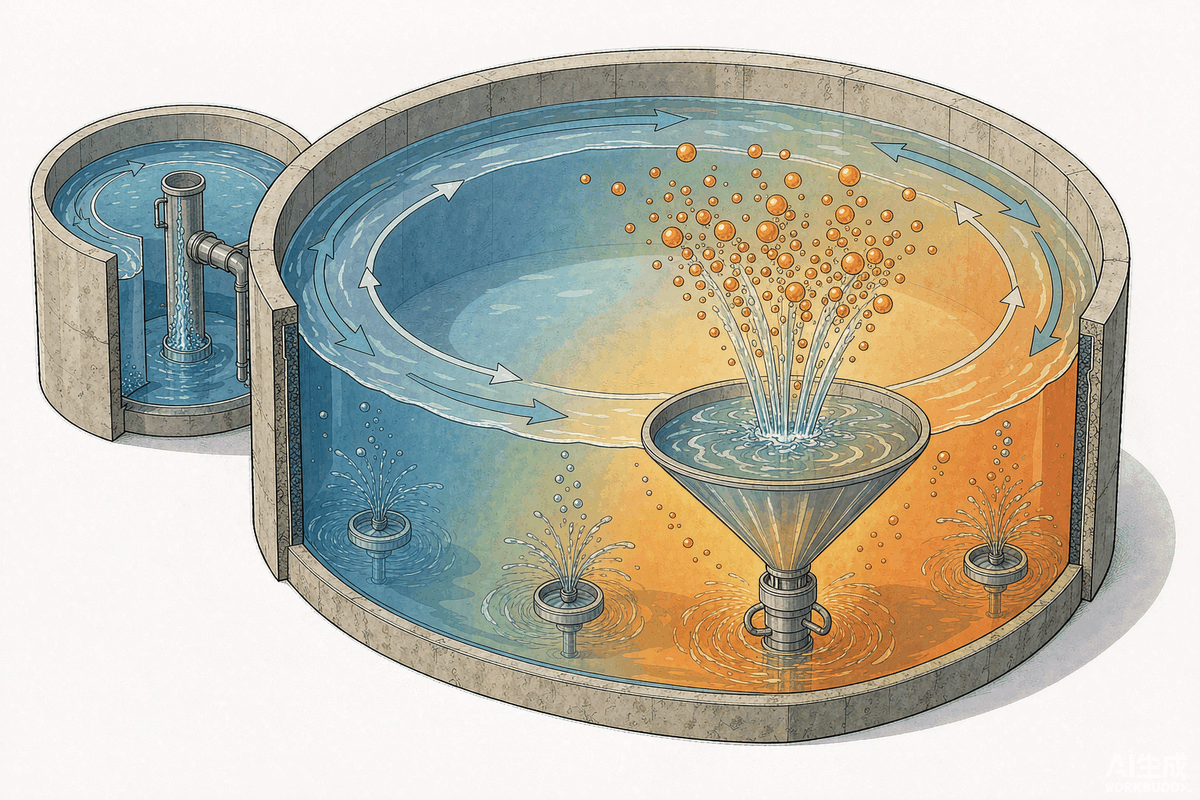
I. Principle: A plug flow-complete mixing "hybrid" in a ring-shaped ditch
The history of the oxidation ditch can be traced back to 1920年, when the first ring-shaped aeration tank was built in Sheffield, UK; in 1954年, the Pasveer oxidation ditch in the Netherlands formally established the modern concept; in 1968年, the Dutch company DHV introduced the vertical inverted-umbrella surface aerator into the oxidation ditch, developing today's most common engineering configuration, the Carrousel oxidation ditch. China began applying it in Guangzhou, Kunming, Shanghai, and other places in the 80年s, and it is now widely used in municipal sewage and industrial wastewater from petrochemicals, papermaking, printing and dyeing, food processing, and other sectors.
The reason the oxidation ditch has endured lies in two structural characteristics:
- Combination of plug flow and complete mixing: After entering the ditch, the sewage is rapidly diluted by several times to several dozen times its volume of circulating liquor. In the short term it appears to be plug flow; in the long term it is complete mixing. This allows it to withstand fluctuations in water quality and quantity while ensuring the influent undergoes at least one circulation, avoiding short-circuiting.
- Dissolved oxygen gradient: Downstream of the surface aerator is oxygen-rich (DO 2–3.5 mg/L), and DO gradually decreases as the flow moves along the ditch, reaching anoxic or even anaerobic conditions at distant points. Aerobic and anoxic zones coexist within a single structure, providing natural conditions for simultaneous nitrification-denitrification.
Another benefit of this structure is impact load resistance. Industrial wastewater often experiences fluctuations in water quality and quantity due to shifts, seasonality, or accidental discharges. The internal circulation flow in an oxidation ditch is usually several times to several dozen times the influent flow. Once the influent enters the ditch, it is diluted by a large volume of circulating liquor, so the microbial community will not collapse due to short-term high loads. This is also one of the reasons why intermittent discharge industries such as beer, soy sauce, and papermaking prefer oxidation ditches.
From an operational perspective, a conventional oxidation ditch uses extended aeration, with a design organic load generally below 0.10 kg BOD₅/(kgMLVSS·d) and a sludge age of 15–30 d. A long sludge retention time means a more stable microbial community, and the excess sludge production rate can be 30%–50% lower than that of conventional Activated Sludge, but it also means a large reaction tank volume and a large footprint.
II. Core parameter windows (the design baseline)
An oxidation ditch is not simply "a ditch that runs." What truly determines effluent stability is the six mutually constraining parameters: load, retention time, DO, MLSS, return ratio, and in-ditch flow velocity. The following summarizes common windows in industrial wastewater engineering, with data from the compilation notes of the Technical Specification for Oxidation Ditch Activated Sludge Process Wastewater Treatment Engineering, CECS 112-2000 Oxidation Ditch Design Regulations, and multiple real engineering cases.
It should be emphasized that these six parameters constrain one another rather than being optimized in isolation: the lower the load is set, the longer the HRT and the larger the tank volume required; the higher the DO, the more complete the nitrification, but denitrification will be inhibited and energy consumption will rise; increasing MLSS can reduce tank volume, but it increases aeration and mixing power and the sludge settling burden. In engineering practice, SRT and DO strategy are usually determined first according to effluent nitrogen and phosphorus requirements, and then tank volume and return ratio are used to provide the margin.
| Parameter | Typical Range for Industrial Wastewater | Notes and Sources |
|---|---|---|
| Sludge Loading F/M | 0.05–0.13 kgBOD₅/(kgMLSS·d) | Extended aeration low loading; optimal for printing and dyeing case 0.078 kgBOD₅/(kgMLSS·d) |
| Volumetric Loading (Oxidation Ditch Section) | 0.2–0.5 kgCOD/(m³·d) | Brewery wastewater 0.26; 10万t beer project integrated oxidation ditch 0.5 |
| HRT | 12–28 h | Carrousel 2000 typical 13.4–28 h; vinylon project 26 h |
| SRT | 15–30 d | Extended aeration long sludge age; phosphorus removal requires shorter SRT, which conflicts with denitrification |
| MLSS | 2000–4500 mg/L | Vinylon 2000; printing and dyeing industrial park 3500; Carrousel 2000 3600–4500 |
| DO Gradient | Aerobic zone 1.0–3.5 mg/L; anoxic zone ≤0.5 mg/L | Key to controlling simultaneous nitrification-denitrification |
| Sludge Return Ratio | 80%–135% | Vinylon 80%; Carrousel 2000 100%–135% |
| Internal Return Ratio (Denitrification) | 100%–350% | Carrousel 2000 typical range |
| Average Velocity in Ditch | 0.3–0.5 m/s | GB 50014-2021 / CECS 112-2000; below 0.3 m/s prone to sludge accumulation |
| Power Density | 20–30 W/m³ | Average velocity gradient in aeration zone G>100 s⁻¹, favorable for oxygen mass transfer and flocculation |
III. Mainstream Configurations: Carrousel, Orbal, Integrated and Three-Ditch
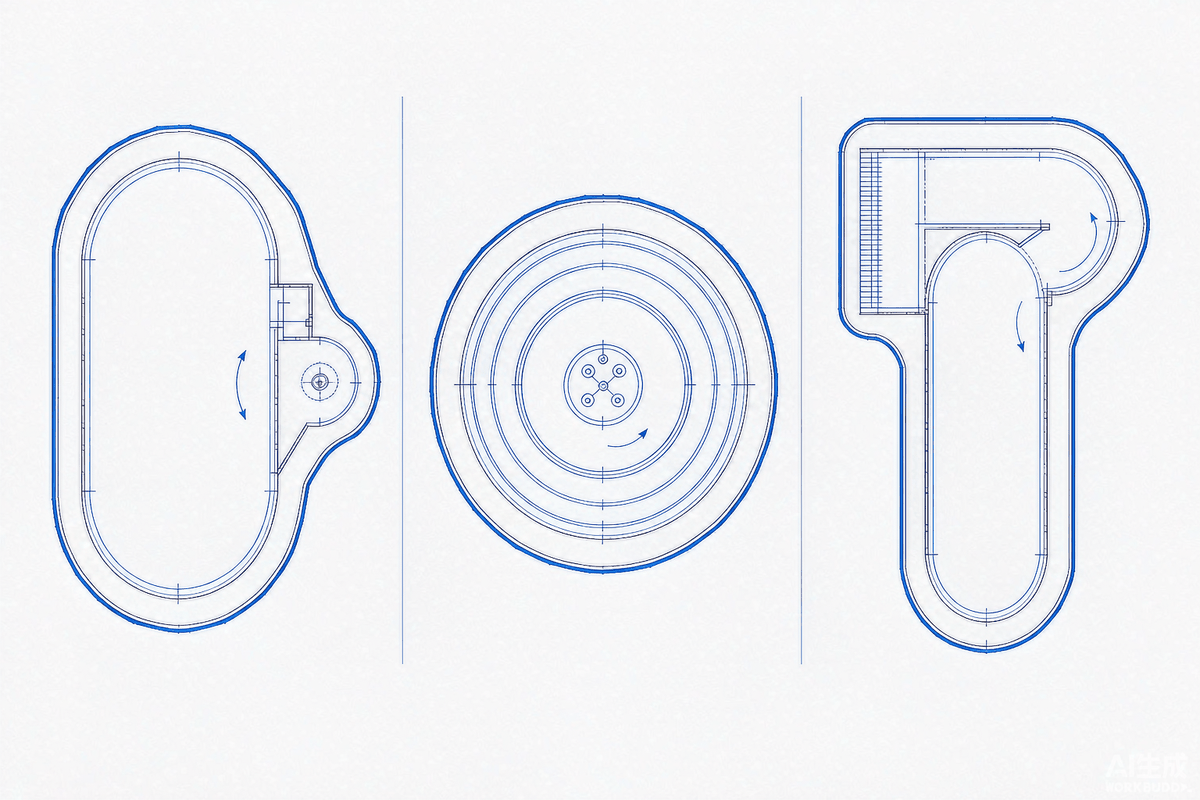
There are many "variants" of the oxidation ditch, and the most common ones in industrial wastewater are the Carrousel, Orbal and integrated oxidation ditches. During selection, the main trade-offs are water depth, maintainability of aeration equipment, footprint, and nitrogen and phosphorus removal requirements.
| Configuration | Aeration/Propulsion Equipment | Channel Depth | Core Features | Typical Applications |
|---|---|---|---|---|
| Carrousel | Vertical inverted-umbrella surface aerator + submersible propeller | 4–5 m (3000 type up to 7.5–8 m) | Single-channel/multi-channel in series; few equipment units, simple management; over 850 units built worldwide | Large and medium-sized municipal/industrial wastewater |
| Orbal | Rotating brush/rotating disc aerator | 3–3.6 m | Concentric multi-ring channels, low DO in outer ring and high DO in inner ring, naturally forming a DO gradient | Small and medium-sized wastewater treatment plants/food wastewater |
| Integrated Oxidation Ditch | Fine-bubble aeration + submersible propeller | 4–8 m | A settling zone is set within the channel, eliminating the need for a separate secondary clarifier and sludge return pumping station | Small and medium scale (<2万 m³/d) |
| Three-channel Alternating Oxidation Ditch | Rotating brush aerator | 3–4 m | Multiple channels alternately serve as aeration, settling, and decanting channels in time sequence, eliminating the need for a secondary clarifier | Municipal/small-scale industrial |
In industrial wastewater projects, Carrousel is more common because vertical surface aerators have strong resistance to fiber and grease entanglement and do not require draining the tank during maintenance, making them particularly friendly to fiber-containing wastewater such as papermaking and printing and dyeing wastewater; Orbal rotating brush aeration is more energy-efficient in low-concentration municipal sewage or food wastewater, but rotating brushes are more sensitive to high SS or oily wastewater, and maintenance is relatively frequent; the integrated oxidation ditch has the best land-saving effect, but the built-in settling zone places higher demands on sludge settling performance, so it should be adopted with caution in industrial wastewater with a high risk of sludge bulking.
IV. Real Engineering Ledger (All from Public Projects and Literature)
| Industry / Scale | Process and Key Operating Conditions | Effluent / Removal Performance | Source |
|---|---|---|---|
| Vinylon wastewater / 9600 m³/d | Carrousel oxidation ditch, HRT 26 h, MLSS 2000 mg/L, DO 1.0–3.5 mg/L, sludge return ratio 80%, flow velocity mid-0.4/bottom-0.2 m/s | Oxidation ditch influent COD 432→secondary clarifier effluent 87 (removal 80%); total removal with oxidation pond 94%; SS 74→15 (80%) | Wastewater Treatment Engineering Network, 2009-05-26 |
| Printing and Dyeing Industrial Park / 1.5–5.0万 m³/d | Hydrolysis Acidification + Carrousel, optimal sludge loading 0.078 kgBOD₅/(kgMLSS·d), MLSS 3500 mg/L, anoxic DO 0.2–0.5 / aerobic DO 1.9–3.3 mg/L | Effluent meets Guangdong Province DB 44/26-2001 Phase II Class I; when TP is high (>4 mg/L), add CF1 coagulant 30–80 mg/L for phosphorus removal | Wastewater Treatment Engineering Network, 2011-02-10 |
| Waste Paper Papermaking / 5000 m³/d | Ultra-efficient shallow air flotation + IC anaerobic + modified oxidation ditch (3 units DS325 inverted umbrella surface aerators 55 kW) + coagulation sedimentation, oxidation ditch sludge loading 0.25 kgCOD/(kgMLSS·d) | Oxidation ditch COD removal >92% (about 10% higher than conventional oxidation ditch), effluent COD <80 mg/L (meets GB 3544-2008); operating cost 1.55元/t | Engineering report (original source to be supplemented) [To be verified] |
| Brewery wastewater / scale not specified | Anaerobic (HRT 4 h, volumetric loading 2.75 kgCOD/(m³·d)) + oxidation ditch (HRT 25 h, volumetric loading 0.26 kgCOD/(m³·d)) | Operating performance: COD 1274→83 (93.5%), BOD₅ 673→18 (97.3%); recommended oxidation ditch HRT 24–30 h | Wastewater Treatment Engineering Network, 2009-08-24 |
| Brewery wastewater / scale not specified | Internal circulation UASB + oxidation ditch; oxidation ditch MLSS 3000 mg/L, sludge loading 0.21 kgCOD/(kgMLSS·d), volumetric loading 0.3 kgCOD/(m³·d) | UASB COD removal 80%, oxidation ditch COD removal 85%; effluent COD 67, BOD₅ 15, SS 16; system total COD removal >95% | China Urban Water Network, 2000 |
| Soy Sauce Wastewater / 90 m³/h | UASB + oxidation ditch, operating temperature 15–35℃, acclimation 3 months | Influent COD 1648→effluent 79 (95.2%), BOD₅ 1035→16 (98.5%), SS 366→38 (89.6%), NH₃-N 70→7 (90%) | Wastewater Treatment Engineering Network, 2009-11-26 |
| Brewery / 10万t/a | IC anaerobic reactor + integrated oxidation ditch; IC volumetric loading 6 kgCOD/(m³·d), integrated oxidation ditch 0.5 kgCOD/(m³·d) | IC COD removal >85%, oxidation ditch COD removal >90%, effluent COD <80 mg/L | Related report in Acta Scientiae Circumstantiae |
| Potato Processing Wastewater / full-scale in USA | Carrousel oxidation ditch pilot→full-scale, for high-carbohydrate food processing wastewater | After steady state, effluent BOD₅<8 mg/L, TKN<4 mg/L, TP<10 mg/L (phosphorus removal not specifically optimized) | Menon R, Grames LM. Purdue Univ 50th Ind Waste Conf, 1995 (EPA HERO 4518526) |
V. Four Keys to Operation Control
1. DO gradient is not automatic; it depends on aeration equipment layout and speed control
Although simultaneous nitrification-denitrification "theoretically" forms a DO gradient naturally along the ditch length, in engineering practice the number of surface aerators in operation, their speed, and immersion depth must be adjusted according to the influent load. In the printing and dyeing case, variable-frequency control of surface aerators achieved DO of 0.2–0.5 mg/L in the anoxic zone and 1.9–3.3 mg/L in the aerobic zone; in the vinylon case, the DO in the outer ditch was controlled at about 1.0 mg/L to enhance degradation of macromolecular PVA. Too high DO inhibits denitrification, while too low DO results in insufficient nitrification—this is the core contradiction in oxidation ditch operation.
In engineering practice, online DO meters are commonly interlocked with variable-frequency surface aerators to stabilize the outer ditch DO at around 0.5 mg/L and keep the inner ditch above 2 mg/L, so that TN can be steadily reduced. For oxidation ditches, aeration equipment is not only an oxygen supply tool but also a "controller" of the flow field and DO field.
2. The flow velocity in the ditch must be greater than 0.3 m/s, otherwise sludge accumulates
Both GB 50014-2021 and CECS 112-2000 require the average flow velocity in oxidation ditches to be no less than 0.3 m/s. When the flow velocity is too low, sludge deposits at bends and on the bottom, forming anaerobic blackened zones; when the flow velocity is too high, energy consumption rises and aeration time is shortened. The Carrousel process relies on the radial flow propelled by surface aerators, and guide plates or submersible propellers are often installed at bends to improve the flow field.
In addition, head losses at bends and partition walls are often underestimated. When designing large industrial oxidation ditches, flow velocity distribution should be verified through CFD flow field simulation or hydraulic model tests, rather than estimated solely by empirical formulas; otherwise, the cost of retrofitting after local sludge accumulation is discovered following commissioning is very high.
3. Low temperature is a hard constraint for industrial projects in the north
Oxidation ditches have strong shock load resistance, but low temperatures significantly reduce the nitrification rate. Projects in cold regions such as Urad Middle Banner in Inner Mongolia maintained stable winter operation only after retrofitting measures such as replacing inverted umbrella surface aerators with fine-bubble diffused aeration and adding SPR media in the aerobic zone. If the industrial wastewater temperature is below 12–15℃, the design should increase the retention time or consider insulation.
Particular attention should be paid to the fact that vertical surface aerators dissipate heat noticeably to the atmosphere in winter. The impact is relatively small for warm wastewater from breweries and food processing, but normal-temperature municipal-type industrial wastewater may cool by 3–5 ℃ in northern winters. When necessary, covering for insulation or switching to bottom fine-bubble aeration can reduce heat loss by 1–2 ℃, which provides practical help in maintaining nitrification activity.
4. Biological phosphorus removal capacity is limited; industrial wastewater usually requires chemical assistance
The extended aeration and long SRT of oxidation ditches favor nitrification but are not conducive to the enrichment of phosphorus-accumulating organisms (PAOs). The biological phosphorus removal efficiency of a single-stage oxidation ditch is usually only 40%–50%; to achieve TP<0.5 mg/L, chemical phosphorus removal with iron salts/aluminum salts in a subsequent stage is generally required. The printing and dyeing case clearly states: when influent TP>4 mg/L, CF1 coagulant should be dosed at 30–80 mg/L.
The dosing point for chemical phosphorus removal chemicals also matters. Dosing at the end of the oxidation ditch or at the inlet of the secondary clarifier can utilize residual alkalinity and reduce inhibition of Activated Sludge by the chemicals; if dosed directly into the oxidation ditch, high-valent iron/aluminum salts may kill nitrifying bacteria or destroy flocs. In engineering practice, chemical dosing is often used as a downstream "insurance" measure rather than upstream enhancement.
VI. Boundaries between Oxidation Ditches and A²O/SBR/MBR/Contact Oxidation
| Process | Core Advantages | Main Drawbacks | More Suitable Scenarios |
|---|---|---|---|
| Oxidation Ditch | Shock-resistant, stable effluent, simultaneous nitrification-denitrification, low sludge yield | Large footprint, high demands on aeration/DO control, weak biological phosphorus removal | Large water quality fluctuations, denitrification needs, relatively ample land |
| A²/O | Clear zoning for nitrogen and phosphorus removal, zone-specific optimization of sludge age | Energy consumption of internal recirculation, nitrate in sludge return affects anaerobic phosphorus release | Industrial wastewater with strict requirements for both TN/TP |
| SBR | Multi-purpose single tank, no secondary clarifier needed, flexible sequencing | Complex automation, limited scale-up, high operational demands | Small to medium scale, intermittent discharge, large water quality variations |
| MBR | Extremely low effluent SS, small footprint, capable of operating at high MLSS | Membrane fouling and replacement costs, relatively high energy consumption, high investment | High and stable effluent requirements, reuse needs |
| Biological Contact Oxidation | No sludge bulking, biofilm shock resistance, simple media maintenance | Media prone to clogging, denitrification capacity weaker than Activated Sludge process | Wastewater with good biodegradability and frequent shock loads |
From this table, it can be seen that the Oxidation Ditch is not an "all-round" process. Its core advantage is "stability" — high tolerance to fluctuations in water quality and quantity, and stable effluent; its main drawbacks are a large footprint and weak biological phosphorus removal. If the project has limited land and strict requirements for effluent TP and SS, MBR or A²O + chemical phosphorus removal would be a more direct choice; if the goal is low investment and low operational complexity, while the Industrial Wastewater has good biodegradability, the Oxidation Ditch remains a very competitive option.
VII. Engineering Truths and Fact-Checking
VIII. Selection Recommendations
Suitable for: Industrial wastewater projects with large influent water quality fluctuations, denitrification needs but not extreme phosphorus removal, and a desire for stable operation with limited management personnel experience; especially suitable for industries with good biodegradability such as beer, food, soy sauce, and papermaking, or combined with UASB/IC anaerobic treatment for medium- to high-concentration organic wastewater.
In engineering practice, the oxidation ditch rarely appears alone. High-concentration organic wastewater usually adopts the combination of "anaerobic (UASB/IC/Hydrolysis Acidification) + oxidation ditch": anaerobic treatment handles 60%–80% of COD reduction, and the oxidation ditch is responsible for nitrification and effluent stability; for refractory wastewater, Hydrolysis Acidification or iron-carbon micro-electrolysis can also be added before the oxidation ditch to improve biodegradability. This combination not only leverages the advantages of high anaerobic loading and low sludge production, but also utilizes the oxidation ditch's impact resistance and stable effluent characteristics, making it one of the most common application modes in the industrial wastewater field today.
Not suitable for: Scenarios with extremely tight land availability, extremely strict effluent TP requirements without willingness to add chemicals, or requiring membrane-level effluent SS—in these cases, MBR/A²O + chemical phosphorus removal would be more appropriate. At the same time, high-salinity, highly toxic, and low-temperature industrial wastewater should be adopted with caution, requiring pre-assessment or bench-scale verification.
References (Authentic Sources)
- Compilation Notes for the Technical Specification for Oxidation Ditch Activated Sludge Wastewater Treatment Engineering (Draft for Comments). Ministry of Ecology and Environment, 2009-10. Based on GB 50014-2006, CECS 112-2000, etc.
- CECS 112-2000 Oxidation Ditch Design Specification.
- GB 50014-2021 Standard for Design of Outdoor Wastewater Engineering.
- Wastewater Treatment Engineering Network. Treatment of Polyvinyl Alcohol Wastewater by Carrousel Oxidation Ditch. 2009-05-26.
- Wastewater Treatment Engineering Network. Treatment of Printing and Dyeing Industrial Park Wastewater by Hydrolysis Acidification/Carrousel Oxidation Ditch. 2011-02-10.
- Wastewater Treatment Engineering Network. Summary of Brewery Wastewater Commissioning. 2009-08-24.
- China Urban Water Network. Application of Internal Circulation UASB Reactor + Oxidation Ditch Process in Brewery Wastewater Treatment. 2000.
- Wastewater Treatment Engineering Network. Case Study of UASB-Oxidation Ditch Process for Treating Soy Sauce Wastewater from a Food Company. 2009-11-26.
- Related Report in Acta Scientiae Circumstantiae. Process Design and Operation Analysis of Wastewater Treatment for an Annual 10万 t Brewery Project (IC + Integrated Oxidation Ditch).
- Menon R, Grames LM. Pilot Testing and Development of a Full-Scale Carrousel Activated Sludge System for Treating Potato Processing Wastewaters. Purdue Univ 50th Ind Waste Conf, West Lafayette, IN, 1995 (EPA HERO ID 4518526).
- Wang SM, Liu JX. Enhanced biological nutrients removal using an integrated oxidation ditch with vertical circle from wastewater by adding an anaerobic column. PubMed, 2005-01-01.
- Carrousel 2000 Oxidation Ditch (encyclopedia entry, compiling technical data from DHV and other companies). Note: Performance parameters are a multi-source compilation cited by the encyclopedia; it is recommended to verify the original literature before engineering design.