



 Multiple industries nationwide (coal chemical/petrochemical/industrial parks/pri
 Pilot to full-scale engineering (4,800 m³/d to 100,000 m³/d scale)
Denitrification Deep-Bed Filter: Removing 1 mg Total Nitrogen, Why Sodium Acetate Can Go from 3.4 mg to 9.3 mg
— It is not a terminal filter, but an anoxic biofilm reactor: the carbon source budget of deep-bed denitrification, two real control knobs, and nine real ledgers
1. Positioning: Anoxic Biofilm Reactor + Deep-Bed Filter
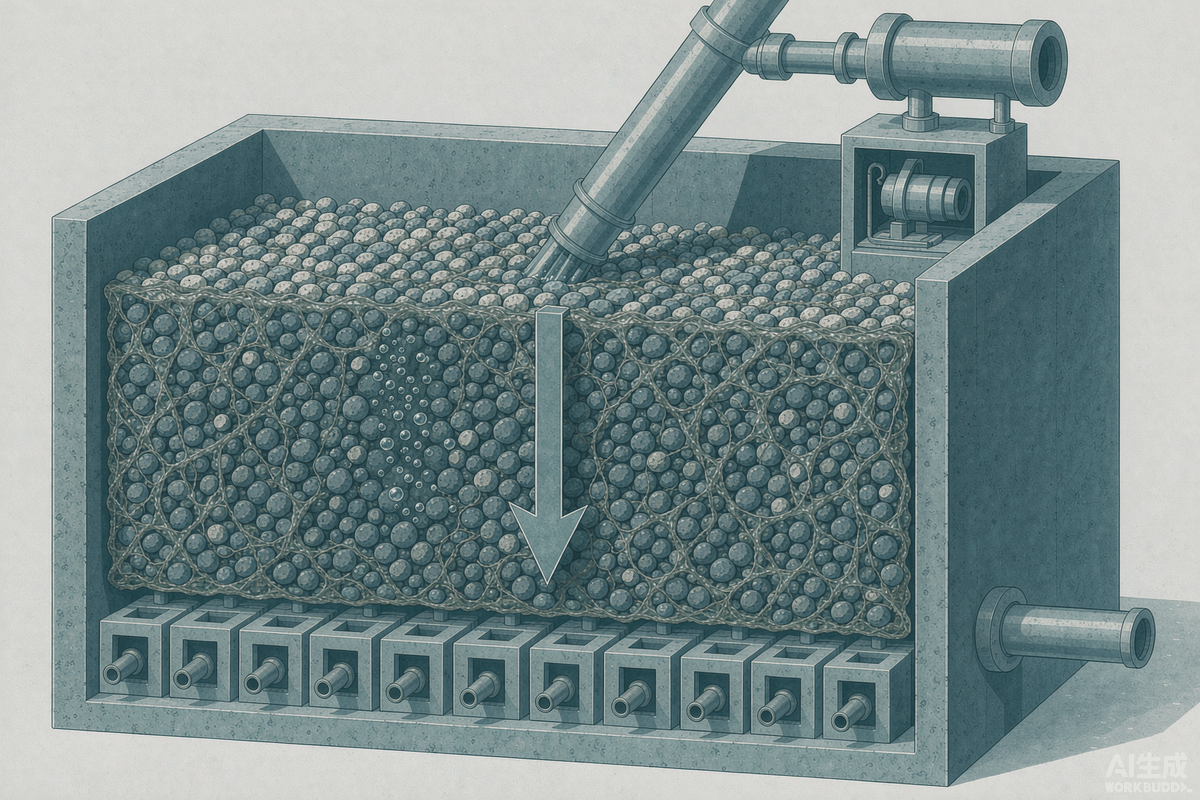
The "multi-purpose in one tank" nature of the deep-bed denitrification filter is the fundamental reason it is widely used in upgrading and retrofitting projects: biological denitrification (denitrifying bacteria attached to the quartz sand surface reduce NO₃⁻ and NO₂⁻ to N₂ under anoxic conditions), physical filtration for SS interception (the homogeneous thick filter bed allows solids to penetrate the surface layer and be intercepted throughout the entire depth, with a solids loading capacity far higher than ordinary filters), and chemical micro-flocculation for phosphorus removal (inorganic metal salts such as PAC are dosed in the influent, and the flocs are intercepted in the filter bed). It is typically installed after the secondary clarifier, and no final clarifier or filter is needed downstream.
However, its capability boundary is equally sharp, and this boundary is often overlooked: it can only remove nitrate nitrogen, not ammonia nitrogen. The interior of the deep-bed filter is an anoxic environment, while nitrifying bacteria require oxygen—the two cannot coexist in the same tank. Therefore, if the upstream biological process (oxidation ditch, AAO, SBR, etc.) does not achieve complete Nitrification and the effluent ammonia nitrogen exceeds the standard, "relying on the deep-bed filter for terminal control" is an ineffective solution—you must go back and fix the upstream process. Conversely, if the TN reduction target is set as the total of "ammonia nitrogen + nitrate nitrogen" during design, the carbon source budget will also be severely inconsistent with reality.
2. Mechanism: One Carbon Source Budget and Three Knobs
2.1 Stoichiometry: How much carbon does denitrification cost
The essence of denitrification is anoxic respiration: nitrate serves as the electron acceptor, organic carbon serves as the electron donor and carbon source, and the product is N₂. According to stoichiometry for reduction alone, the theoretical requirement is approximately 2.86 g COD / g NO₃⁻-N; in engineering practice, due to bacterial assimilation, endogenous metabolism, and effluent residual margin, the actual C/N (expressed as COD) is typically taken as 3.5~5.0. Another commonly cited benchmark is "reducing 1 kg nitrate nitrogen requires 2.47 kg methanol"—converted using methanol's COD equivalent of 1.5 g COD/g, this gives 3.7 g COD/g N, which is self-consistent with the former and can be used for cross-validation.[2][9]
The type of carbon source directly affects the denitrification rate: methanol leaves only CO₂ and H₂O after oxidation, produces no recalcitrant intermediates, and the denitrification rate can reach several times that without carbon source dosing; sodium acetate has good water solubility, no residue, and is non-flammable and non-explosive, making it the most commonly used choice in industrial projects; ethanol and sodium acetate can achieve NO₃⁻-N / TN removal rates of over 90%, while the glucose route achieves over 80%.[9][11]The denitrification process itself also produces alkalinity; each reduction of 1 mg NO₃⁻-N generates approximately 3.57 mg CaCO₃ alkalinity, which can partially compensate for the alkalinity consumption of upstream Nitrification.[9]
Sodium acetate has three commonly conflated bases for its COD equivalent: the theoretical value for anhydrous sodium acetate is about 0.78 g COD/g, some design references use 0.68, while commercial products are mostly 20% / 25% / 30% liquid. In engineering reports, "dosing 108 g/m³" and "maximum dosing 40 mg/L" refer to liquid commercial product; whereas "COD dosing 25 mg/L" refers to pure COD. Between the two lie two conversions: concentration and equivalent. For cross-comparison of prices and calculation of chemical cost per ton of water, only conversion to "pure COD equivalent × unit price" makes them comparable—this is also why the same statement of "saving carbon source 30%" may not hold when the basis is changed.[3][5][8]
2.2 Dissolved Oxygen: The Only Parameter That Can "Burn Money"
Denitrifying bacteria are facultative, but Dissolved Oxygen will preferentially consume the carbon source. The engineering rule is quite direct: when effluent Dissolved Oxygen is greater than 5 mg/L, TN removal rate is less than 20%; when effluent Dissolved Oxygen is less than 1 mg/L, TN removal rate can reach 60%~80%; it is generally believed that DO needs to be maintained at the 0.5 mg/L level for Denitrification to proceed normally.[6]
Where does the oxygen come from? A large part is re-aeration by water drop. A study of a wastewater plant in the Daqing River Basin reported by Water Purification Technology 2024 年 provides a complete account: the Denitrification deep-bed filter is generally an open-air tank, and the sewage fully contacts the atmosphere during the falling process, so Dissolved Oxygen remains at a relatively high value throughout the year. After sealing the top of the filter with a cover, in winter the Dissolved Oxygen of the upper influent of the filter decreased from 8.90 mg/L to 4.80 mg/L, with a certain insulation effect; in winter the carbon source dosage decreased from 191 mg/L to 170 mg/L, and on average each 1 mg/L of Total Nitrogen removed required a carbon source dosage of 23.68 mg/L, with carbon source utilization efficiency increased by about 10%.[1]The plant's annual average monthly carbon source dosage fluctuated between 108~218 mg/L, with influent TN 11.24~16.12 mg/L and effluent TN 4.60~9.67 mg/L, and removal rate 39%~59%—the same tank and the same process had a carbon source demand in summer and winter that differed by nearly a factor of two.[1]
The corresponding engineering measure is to turn "falling" into "submergence": adopt constant-level filtration, change the influent weir to an arc weir, raise the filter liquid level, and add covers where necessary. Such measures are inconspicuous on drawings, but they are directly reflected in the chemical cost per ton of water.[1][6][14]
2.3 Temperature and pH: Winter Is the Watershed
The suitable temperature for Denitrifying bacteria is 20~40 ℃, with the highest activity near 30 ℃; below 15 ℃ the Denitrification rate decreases significantly, and below 5 ℃ the reaction almost stops; the winter water temperature in the Shanghai area is about 10 ℃, and the acclimation period of the deep-bed filter biofilm will be significantly prolonged.[6][9]There are three common paths for coping with low temperature: extending the hydraulic retention time (studies show that an empty bed contact time ≥10 min can still achieve good results at low temperature), increasing the carbon source dosage, and adding cold-tolerant microbial agents.[9][11]The pH window is relatively wider, with the optimum at 6.5~8.0, and the rate decreases significantly below 6.0 or above 8.5.[9]
III. Structure: Filter Media, Filter Bed, Filter Blocks and Backwashing
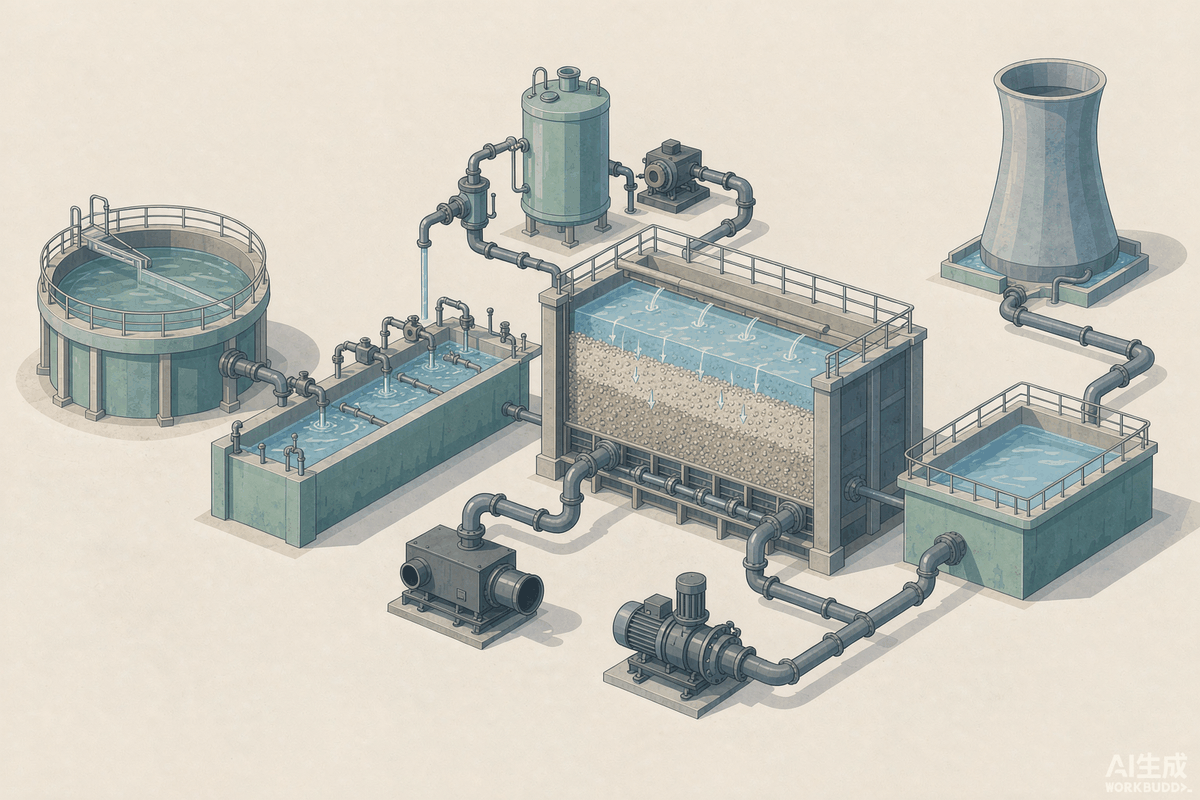
Structurally it is not complex: homogeneous quartz sand filter media + gravel support layer + air-water distribution filter blocks (S-type or T-type HDPE filter blocks, also serving as water and air distribution and support) + backwash water pump and Roots blower + carbon source dosing system + PLC automatic control. In engineering, the classic combination of "1830 mm quartz sand + 380 mm gravel + 300 mm filter blocks" is commonly used, with a filter bed depth of 2~2.5 m.[7][11]The dual-chamber or secondary air distribution design of the filter blocks solves the problem of backwash uniformity—uneven backwashing will form hardened blind zones, and once hardening forms, Denitrification and filtration will fail simultaneously.
| Item | Typical Value / Window | Description and Source |
|---|---|---|
| Filter Media and Filter Bed | Quartz sand 2~4 mm (commonly 2~3 mm); filter bed depth 1.83~2.5 m; support layer 380~450 mm | 1.83 m (6 ft) is the classic baseline depth; a homogeneous thick filter bed can avoid short-circuiting and breakthrough; some projects use volcanic rock, ceramsite, or sponge lightweight composite media[3][7][10][12] |
| Average Filtration Rate | 4~8 m/h (conventional 4~6); peak 5.3~9.7 m/h; forced filtration rate slightly higher | Suzhou 5.26 / forced 6.31; Guangzhou Nansha 4.82 / peak 6.27; Shandong Industrial Park 3.66 / peak 5.34; a certain 5 万 m³/d project adopts 7 / peak 9.66[3][5][7][8] |
| Denitrification Volumetric Loading Rate | 0.4~1.8 kg NO₃⁻-N/(m³·d) (most projects ≤0.55) | Encyclopedia summary 0.46~1.83; Suzhou <0.55; Shandong Industrial Park 0.37; Shenzhen Henggang up to 1.83 (maximum removal 25.8 mg/L)[4][7][11] |
| Empty Bed Contact Time | Approximately 15~25 min | Conventional design 25 min; composite media filter empty bed retention approximately 15 min[2][11] |
| Carbon Source Dosing | Theoretical 2.86 g COD/g N; engineering C/N 3.5~5.0; sodium acetate∶NO₃⁻-N ≤6∶1 | Dosing rate must be controlled by feedforward/feedback combined control based on online nitrate nitrogen + dissolved oxygen + flow rate; excessive dosing will cause effluent COD and SS rebound and filter bed "clogging"[2][3][6] |
| Backwashing | Cycle 24~48 h; air wash 90~120 m³/(m²·h) → air-water combined → water wash 14~25 m³/(m²·h); backwash water volume accounts for 1%~5% | Suzhou: air wash 5 min + air-water 10~15 min + water rinse 5 min, 2 d/cell, backwash water volume 4%; Guirun: single air flush 2~3 min + combined 4~6 min + single water flush 3~5 min, cycle 48~72 h[5][7][10] |
| Nitrogen Stripping | Downflow 2~4 h/time (several short-duration water flushes per day, 1~2 min) | N₂ produced by denitrification accumulates in the filter bed, raising head loss and even causing air binding; upflow can eliminate the need for nitrogen stripping equipment since air flow and water flow are co-current[5][10][11] |
| Dissolved Oxygen Control | In-tank DO as low as possible <1 mg/L; when effluent DO <1 mg/L, TN removal rate 60%~80% | Constant water level filtration, curved weir, water level elevation, covered and sealed[1][6] |
| Temperature and pH | 20~40 ℃ (significant decrease below <15 ℃); pH 6.5~8.0 | Low temperature can be addressed by extending contact time, increasing carbon source, and dosing cold-tolerant microbial agents; denitrification produces alkalinity of approximately 3.57 mg CaCO₃/mg N[6][9][11] |
| Project / Industry | Scale | Influent → Effluent | Process and Key Parameters | Performance / Economics |
|---|---|---|---|---|
| Shenzhen Henggang Water Quality Purification Plant (Phase I) Upgrade·Modular Upflow Denitrification Filter Equipment Added Downstream of Original SBR | 10 万 m³/d scale | Annual average TN removal 10 mg/L, maximum 25.8 mg/L | Upflow denitrification filter + adaptive chemical dosing; average mass dosing ratio of sodium acetate carbon source to TN removed 3.4∶1; maximum denitrification loading rate 1.83 kg NO₃⁻-N/(m³·d) | Effluent superior to quasi-Class IV surface water standard: COD<30, TN≤12, TP<0.3, SS≤5 mg/L; modular construction period only 26 天, no need for new high-efficiency sedimentation tank; chemical savings over 30%[4] |
| Guangxi Certain Wastewater Treatment Plant Upgrade·Upflow Quartz Sand Deep-Bed Filter (Tilting Flap Filter) | 8 cells, 12.0×6.0×4.8 m | Influent TN 41.20~46.60 → effluent monthly average 9.10~9.50 mg/L | Fine screen + intermediate regulating tank + upflow quartz sand deep-bed filter; 20% liquid sodium acetate maximum dosing 40 mg/L; flushing cycle 48~72 h | Effluent COD≤30, BOD₅≤6, ammonia nitrogen≤0.5, TP≤0.3, SS≤6 mg/L, meeting Class IV surface water standard; power consumption 0.048 kWh/m³; annual average sodium acetate 108 g/m³ (summer 100, winter 132), carbon source cost 0.162 元/m³; project investment per unit water volume approximately 380 元/m³[5] |
| Daqing River Basin Certain Wastewater Treatment Plant·Cascade Reaeration Control Engineering Practice | — | Influent TN 11.24~16.12 → effluent 4.60~9.67 mg/L (removal rate 39%~59%) | Filter top covered and sealed; annual carbon source monthly average dosing 108~218 mg/L (low in summer, high in winter) | Upper filter influent DO 8.90→4.80 mg/L; winter carbon source 191→170 mg/L; carbon source dosing per 1 mg/L TN removed 23.68 mg/L, carbon source utilization efficiency improved by approximately 10%[1] |
| Henan Longyu Coal Chemical Phase II Wastewater Station·Composite Media Denitrification Filter | 4800 m³/d (200 m³/h) | Influent TN 20~25 → effluent 8~10 mg/L (removal rate >45%) | 4 cells (2.8×2.8×8.5 m); polymer sponge lightweight media + fine quartz sand, media height 3.2 m; empty bed retention 15 min; backwash air 15 L/(m²·s), water 6 L/(m²·s); reducing 1 kg nitrate nitrogen requires 2.47 kg methanol | Effluent SS 3~5 mg/L, turbidity 1.5~4.5 NTU (average 2.5), directly reused for circulating cooling water; replaces 200 m³ softened water per hour, annual water savings 158.4 万 m³; electricity cost per ton of water 0.4 元 + methanol 0.05 元; investment 350 万 yuan, annual direct benefit approximately 245 万 yuan[2] |
| Shandong Certain Industrial Park Wastewater Treatment Plant Upgrade·Sulfur Autotrophic Parallel Heterotrophic Deep-Bed Denitrification Filter + Ozonation + High-Efficiency Sedimentation Tank | 6 万 m³/d (petrochemical/printing and dyeing/textile) | 2021 年 influent TN average 44.9 → effluent average 7.4 mg/L; post-upgrade effluent average 6.25 mg/L | Sulfur autotrophic and heterotrophic each 4 cells, single cell 24.0×3.56 m, media layer height 2.4 m; average filtration rate 3.66 m/h; denitrification loading rate 0.37 kg NOₓ-N/(m³·d); design influent/effluent TN 18→8 mg/L | Effluent COD, NH₃-N, TP meet Class IV surface water standard, TN meets 12 mg/L; post-upgrade effluent average COD decreased by 13.2 mg/L, TN decreased by 6.65 mg/L; autotrophic denitrification media cost per ton of water 0.09 元 vs heterotrophic sodium acetate 0.21 元 (both calculated per 6 mg/L NOₓ-N removed)[3] |
| Suzhou Certain Municipal Wastewater Treatment Plant Upgrade | 6 cells, total filtration area 471.51 m² | Further removal of TN and SS from secondary clarifier effluent | 1830 mm 2~3 mm quartz sand + 380 mm gravel support + 300 mm air-water distribution filter block; average filtration rate 5.26 m/h, forced 6.31 m/h; denitrification loading rate <0.55 kg NO₃⁻-N/(m³·d) | Backwashing: air wash 5 min + air-water combined 10~15 min + water rinse 5 min; backwash frequency 2 d/cell, backwash water volume accounts for 4% of treated water volume[7] |
| Guangzhou Nansha Shichongxi Wastewater Treatment Plant (Phase I) | 5 万 m³/d (6 cells) | Design SS 20→≤10, TN 20→≤10 mg/L (water temperature 10 ℃) | Average filtration rate 4.82 m/h, peak 6.27 m/h; filter bed depth 2.44 m; air flush 92 m³/(m²·h), water flush 15 m³/(m²·h); micro-flocculation PAC 0.5 mg/L, flocculation 5.65 min; sodium acetate design dosing 33 mg/L | Followed by chlorination disinfection (sodium hypochlorite 10 mg/L), forming a complete upgrade process[8] |
| Shanghai Certain Plant (Yingnan) Winter Operation Accounting | — | — | Winter calculation basis: removing 1 mg TN requires sodium acetate 9.3 mg, requires BOD₅ 4.82 mg | Significantly higher than theoretical value of 2.86 g BOD/g nitrate nitrogen; the authors explicitly note that this value is affected by season and upstream influent[6] |
| Chengdu Texas Instruments / Xi'an LONGi Silicon / Malaysia Kuching LONGi Silicon and other 10+ projects (Denitrification Deep-Bed Filter Advanced Nitrogen Removal Complete Equipment) | 5 万~10 万 m³/d scale standardized production line | — | Industry-academia-research achievement transformation (Nanjing University + Jiangsu Zhongyi Jinda), including slow-release carbon source media, modular water and air distribution, intelligent precision control, and 20+ patents | Effluent stably superior to Grade 1A standard (TN≤15 mg/L); has established an annual production capacity of 15 standardized production lines[12] |
IV. Flow Direction and Process Routes: Trade-offs Among Three Parallel Options
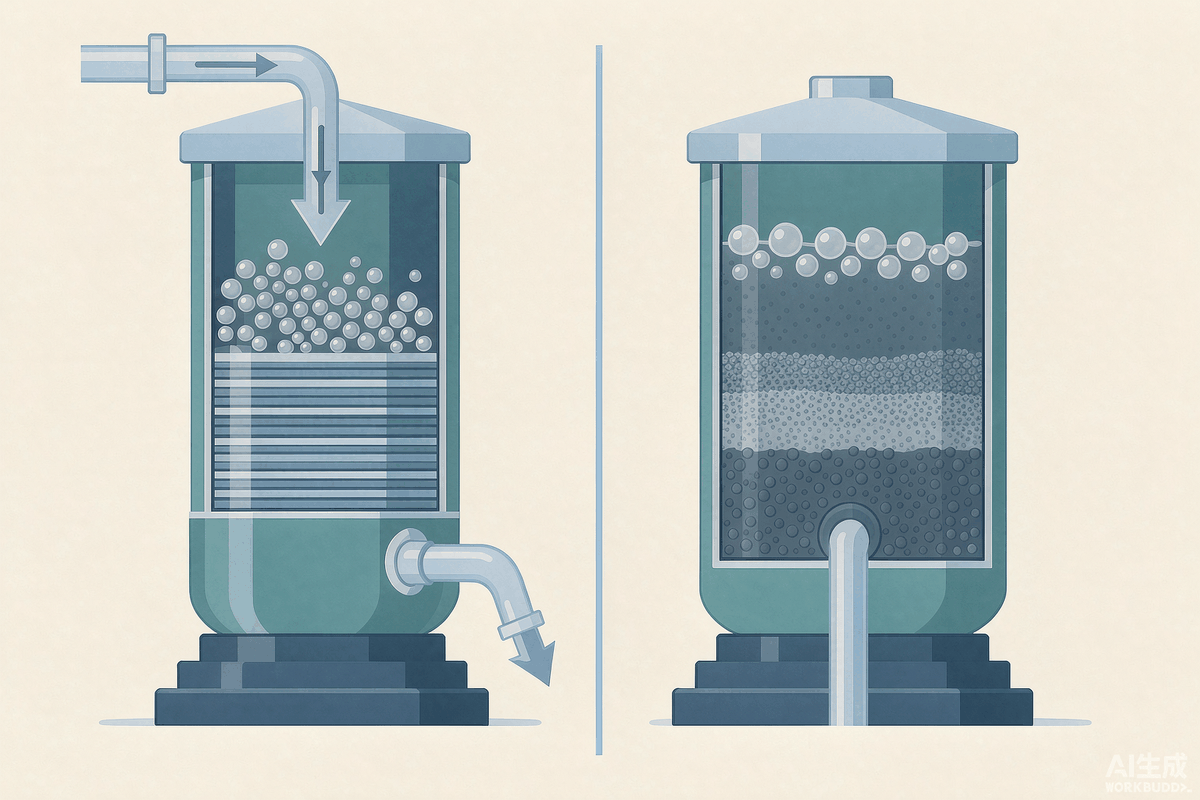
Upflow vs. Downflow. A downflow deep-bed filter generates nitrogen gas during denitrification; the gas accumulates within the filter bed and raises the head loss, so periodic "nitrogen purging" (short-duration water backwash to release gas) is required. An upflow filter adopts bottom influent and top effluent, with the filter media forming a "reverse-graded" bed from coarse to fine along the flow direction, providing greater solids storage depth, and the nitrogen gas release direction is consistent with the water flow direction, which effectively avoids gas binding and eliminates the need for a nitrogen purging device. Published engineering data claim savings of 20%~30% of carbon source compared with conventional downflow.[4][5][11]
Parallel Heterotrophic and Sulfur Autotrophic. Heterotrophic deep-bed denitrification requires carbon source dosing, and when the influent lacks carbon source and dissolved oxygen is relatively high, the removal achieved in a single pass is limited—removing too much requires dosing too much carbon, and the effluent COD and SS instead risk exceeding standards; sulfur autotrophic denitrification uses elemental sulfur, sulfide, or pyrite as the electron donor and inorganic carbon as the carbon source, requiring no external carbon source, but stoichiometrically consumes about 2.51 g of sulfur and produces 7.54 g of sulfate per 1 g N reduced. The approach of a 6 万 m³/d industrial park project in Shandong is to run the two in parallel with mutual switching: the sulfur autotrophic stage has an average influent of 9.75 mg/L and effluent of 3.48 mg/L, approaching the limit of nitrogen removal; the heterotrophic stage achieves almost no removal without carbon source dosing, and the combined average effluent of the two stages is 6.3 mg/L. Interestingly, the measured sulfate increase is only about 3.6 mg/L per 1 mg N removed, roughly half the theoretical value, and the authors list the mechanism as "subject to further study."[3]
Comparison with Conventional Deep-Bed and MBR + Denitrification. The comparison conclusions for a coal chemical project are quite practical: conventional deep-bed denitrification filters achieve good nitrogen removal, but effluent SS and turbidity depend on subsequent filtration, the process train is long, and the guarantee of reuse water quality is insufficient; MBR + denitrification produces good effluent quality, but has high investment and operating costs and requires refined membrane fouling management; the composite-media denitrification filter combines polymer sponge lightweight media with quartz sand, balancing high biomass and precision filtration, and was ultimately selected as the solution that "both meets standards and produces water."[2]
| Route | Carbon Source | Applicable Scenarios | Key Boundaries | By-products / Cost Basis |
|---|---|---|---|---|
| Heterotrophic deep bed denitrification filter (downflow) | External addition required (sodium acetate/methanol) | Total Nitrogen polishing of secondary clarifier effluent, combined with chemical phosphorus removal | Requires nitrogen stripping, sensitive to Dissolved Oxygen and temperature; single-pass nitrogen removal should not be too large | Backwash water return 1%~5%; carbon source cost approx. 0.16 元/m³ level[5] |
| Upflow deep bed denitrification filter | External addition required, lower dosage | Upgrade and retrofit, land-constrained, modular installation | No nitrogen stripping needed, high solids loading capacity, low head loss; filter media gradation and support design are more critical | Claimed to save 20%~30% carbon source; Shenzhen Henggang sodium acetate∶TN = 3.4∶1[4][5] |
| Sulfur autotrophic denitrification filter | No external addition required | Low C/N advanced denitrification, terminal ultimate denitrification | Produces sulfate, consumes alkalinity, H₂S safety risk; effluent sulfate increases | Filter media cost per ton of water 0.09 元 vs heterotrophic 0.21 元 (same basis)[3] |
| Composite media denitrification filter | External addition required | Scenarios such as coal chemical industry requiring low-turbidity reuse | Media height 3.2 m, retention approx. 15 min; constant liquid level control required to avoid re-aeration from water drop | Electricity cost per ton of water 0.4 元 + methanol 0.05 元; reuse replacing softened water can cover operating costs[2] |
| MBR + Denitrification | External addition required | High effluent quality requirements, strict reuse standards | High investment and operating costs; Membrane Fouling requires meticulous management | Electricity consumption per ton of water higher than deep bed filter route[2] |
| Ozonation-Biological Activated Carbon (O₃-BAC) | Not required, but ozone required | Polishing of refractory organics and color | No nitrogen removal, no desalination; bromate risk | Complementary to, rather than a substitute for, deep bed filter positioning |
V. Fact-Checking and Engineering Straight Talk
The interior of a deep-bed filter is anoxic, so nitrification cannot occur. If the upgrading target is "ammonia nitrogen ≤1.5 mg/L", it must be accomplished by the upstream aerobic unit; counting the ammonia nitrogen reduction task toward the TN treatment capacity of the deep-bed filter will simultaneously underestimate the carbon source demand and mismatch the process. The method of judgment is simple: when calculating the nitrogen removal of the filter, only count the difference between the influent nitrate nitrogen (NO₃⁻-N + NO₂⁻-N) and the effluent target.
Two directions of "savings" appeared in this search: upflow saves carbon source by 20%~30% compared with downflow (institution, carbon source)[5]; a certain project achieved "chemical savings of more than 30%" due to the adoption of an adaptive dosing control system (control precision)[4]. The mechanisms of the two are completely different and cannot be added together. At the same time, the span of measured dosing ratios from 3.4∶1 to 9.3∶1 shows that: discussing carbon source unit consumption divorced from water temperature, influent nitrate nitrogen concentration, dissolved oxygen, and removal amount makes the conclusion meaningless.[4][6]
One statement attributes filter bed compaction to excessive biomass growth, while another attributes it to excessively high influent SS causing a rapid rise in liquid level and an increase in backwash frequency in the short term. The actual causality given by engineering data is: high SS in the front-end effluent → rapid rise in liquid level → frequent automatic backwashing → large loss of carbon source with backwash water, ultimately manifesting as "chemicals were added, but nitrogen did not decrease." Therefore, "controlling front-end effluent SS" and "precise nitrogen driving/backwashing" are two sides of the same thing.[6]
① It is a "Total Nitrogen gatekeeping" unit, not a "Total Nitrogen main force" unit. Industry data clearly points out that when deep-bed heterotrophic denitrification is applied to advanced treatment, the influent lacks carbon source and has relatively high dissolved oxygen, so total nitrogen removal cannot be too much; otherwise, more carbon source is dosed, and effluent COD and SS are prone to exceed standards[3]. The single-stage removal range of most projects is in the 5~10 mg/L interval. Shenzhen Henggang's annual average of 10 mg/L and maximum of 25.8 mg/L belong to the high-value end, supported by high denitrification load and precise dosing[4].
② The real operating cost lies in the carbon source, not electricity. The Guirun project has power consumption of 0.048 kWh/m³ and carbon source cost of 0.162 元/m³[5]; Henan Longyu has electricity cost of 0.4 元 per ton of water + methanol 0.05 元[2]. Fluctuations in carbon source prices will directly amplify into the cost per ton of water, which is also why the sulfur autotrophic parallel route is attractive in low C/N scenarios.
③ Backwash water return is a carbon source loop that is easily overlooked. Backwash water volume accounts for 1%~5% of the treated water volume, and the Jiangsu Suzhou case is 4%[7]. Returning it to the front end brings back both SS and residual carbon source, and it should not be ignored when calculating the plant-wide carbon source balance.
④ "Non-mainstream" measures such as covering, constant water level, and curved weirs truly save money. Reducing DO from 8.90 to 4.80 mg/L increases carbon source utilization efficiency by about 10%[1]. This is a deterministic benefit that can be included in the investment payback period.
⑤ Design parameters must be given as a complete set. Filtration rate, load, filter bed depth, contact time, carbon source coefficient, and nitrogen driving frequency—any one of them taken out alone is not comparable. Every value in the tables of this article is annotated with its source and operating conditions; please cite them according to their original conditions.
VI. References
- Zhang Xin, Gao Xingang, Fang Ping, Mi Song, Gao Yao. Engineering Practice of Drop Aeration Reoxygenation Control Measures for Denitrification Deep-Bed Filters in Wastewater Treatment Plants [J]. Water Purification Technology, 2024, 43(6): 120-126. DOI: 10.15890/j.cnki.jsjs.2024.06.014. (Beijing Enfi Environmental Protection / Zhuozhou Zhongsheng Environmental Protection; after covering, influent DO 8.90→4.80 mg/L; winter carbon source 191→170 mg/L; carbon source utilization efficiency increased by about 10%)
- Han Bing. Practice of Composite Media Denitrification Filter in Advanced Denitrification and Resource Reuse of Coal Chemical Wastewater [J]. Henan Chemical Industry, 2026, 43(3): 42-43, 52. DOI: 10.14173/j.cnki.hnhg.2026.03.011. (Henan Longyu Coal Chemical 4800 m³/d; influent TN 20~25 → effluent 8~10 mg/L; reducing 1 kg nitrate nitrogen requires 2.47 kg methanol)
- Zhang Kaihai, Gao Zongren, Sun Zhaoqiang, Liu Zengjun, Zhao Yinhe. Application of Sulfur Autotrophic Parallel Heterotrophic Deep-Bed Denitrification Filter + Ozonation + High-Efficiency Sedimentation Tank Process in the Upgrading and Reconstruction of an Industrial Park Wastewater Treatment Plant. (Shandong Provincial Urban Construction Design Institute et al.; 6 万 m³/d; designed with 8 cells, media layer 2.4 m, average filtration rate 3.66 m/h, denitrification load 0.37 kg NOₓ-N/(m³·d); sulfur autotrophic 1 g N consumes 2.51 g sulfur, produces 7.54 g sulfate)
- Upflow Denitrification Filter and Modular Equipment — Case Study of Shenzhen Henggang Water Quality Purification Plant (Phase I) Upgrading and Reconstruction Project. (Scientific and Technological Achievement Assessment by the Science and Technology and Industrialization Development Center of the Ministry of Housing and Urban-Rural Development; average mass dosage ratio of sodium acetate to TN removal 3.4∶1, maximum denitrification load 1.83 kg NO₃⁻-N/(m³·d), construction period 26 天)
- Case Study of Upflow Quartz Sand Deep-Bed Filter Upgrading Project (Flip-Board Filter 8 cells, 12.0 m×6.0 m×4.8 m) [EB/OL]. Industry Engineering Report. (Influent TN 41.20~46.60 → effluent monthly average 9.10~9.50 mg/L; power consumption 0.048 kWh/m³; 20% liquid sodium acetate annual average 108 g/m³, carbon source cost 0.162 元/m³; upflow saves carbon source by 20%~30% compared to downflow) [Industry report, values pending secondary verification]
- Denitrification Deep-Bed Filter Process for Wastewater Treatment [EB/OL]. Wastewater Treatment Engineering Network, 2020-10-28. (When effluent DO >5 mg/L, TN removal rate <20%; when DO <1 mg/L, 60%~80%; sodium acetate∶NO₃⁻-N ≤6∶1; Yingnan Wastewater Treatment Plant removes 1 mg TN in winter requiring sodium acetate 9.3 mg, BOD₅ 4.82 mg)
- Case Study of Upgrading and Reconstruction Project of a Municipal Wastewater Treatment Plant in Suzhou [J]. Urban Roads Bridges & Flood Control. (Denitrification deep-bed filter 6 cells, total filtration area 471.51 m², average filtration rate 5.26 m/h, forced 6.31 m/h, denitrification load <0.55 kg NO₃⁻-N/(m³·d); filter layer 1830 mm quartz sand + 380 mm gravel + 300 mm filter blocks; backwash water volume accounts for 4%)
- Shichongxi Wastewater Treatment Plant (Phase I) Project (Guangzhou Nansha) Design Data. (5 万 m³/d, 6 cells; average filtration rate 4.82 m/h, peak 6.27 m/h; filter bed depth 2.44 m; air scour 92 m³/(m²·h), water scour 15 m³/(m²·h); sodium acetate design dosage 33 mg/L; micro-flocculation PAC 0.5 mg/L)
- Comprehensive Analysis of Denitrification Deep-Bed Filter Treatment Performance and Key Influencing Factors [EB/OL]. Industry Technical Data. (Carbon source type and denitrification rate, BOD₅/TKN 3~5 criterion, temperature 20~40 ℃ and <5 ℃ nearly stops, pH 6.5~8.0, alkalinity 3.57 mg CaCO₃/mg N, HRT ≥10 min) [Commercial source, pending verification]
- Deep-Bed Filter [EB/OL]. Baidu Baike (Multi-source summary entry: typical filtration rate, empty bed contact time, denitrification load 0.46~1.83 kg NO₃⁻-N/(m³·d), filter bed depth, filter block type, nitrogen stripping differences) [Encyclopedia summary, must trace back to original literature]
- Denitrification Deep-Bed Filter Structure and Technical Parameters [EB/OL]. Equipment Technical Data (design water temperature 10~25 ℃, denitrification load 0.4~0.9 kg NO₃⁻-N/(m³·d), average filtration rate 4~8 m/h, media layer ≥1.8 m, support layer 0.45~0.5 m, air/water backwash intensity, nitrogen stripping 2~4 h/cycle, backwash water volume ≤5%) [Commercial source, pending verification]
- Jiangsu Zhongyi Jinda Environmental Protection Industry Technology Research Institute Co., Ltd. Industry-University-Research Breakthrough in Advanced Total Nitrogen Removal Technology and Industrialization — Typical Case of Scientific and Technological Achievement Transformation [EB/OL]. Yixing Municipal People's Government, 2026-06-29. (In cooperation with Nanjing University; has established standardized production line with annual output of 15 units, treatment scale 5 万~10 万 m³/d; applied in over 10 projects including Chengdu Texas Instruments, Xi'an LONGi Silicon, Kuching LONGi Silicon Malaysia, etc., effluent superior to Grade 1A)
- Compilation of Engineering Cases of Denitrification Deep-Bed Filter Equipment Manufacturers [EB/OL]. Industry Commercial Data (Shanxi Coal Chemical 2.25 万 m³/d project TN≤15 mg/L, SS≤10 mg/L; Shandong 5 万 m³/d quasi-Class IV upgrading TN≤10~12 mg/L) [Commercial source, values pending verification]
- Deep-Bed Denitrification Filter for Wastewater Treatment [EB/OL]. Wastewater Treatment Engineering Network, 2021-03-10. (Carbon source dosing control system logic: influent flow rate, dissolved oxygen, influent/effluent nitrate nitrogen concentration; influent weir shape and liquid level control to reduce drop aeration reoxygenation)
- Advanced Treatment of Municipal Wastewater by Denitrification Deep-Bed Filter and Its Microbial Characteristics [J]. Journal Network Indexed Literature. (When carbon source is dosed, average removal rates of COD / TN / turbidity are approximately 30% / 70% / 75%, description of operating conditions under which effluent TN can be stably maintained below 5 mg/L) [Volume/issue pending supplementation]
- GB 18918—2002 "Discharge Standard of Pollutants for Municipal Wastewater Treatment Plant" and GB 3838—2002 "Environmental Quality Standards for Surface Water". (Standard basis for the "Grade 1A" "Surface Water Class IV/Quasi-Class IV" limit expressions involved in this article; for specific limits, please refer to the original standard text)