




 Learn More


Early water-quality risk warning
Intelligent dosing and aeration optimization
Full-process unattended decision support


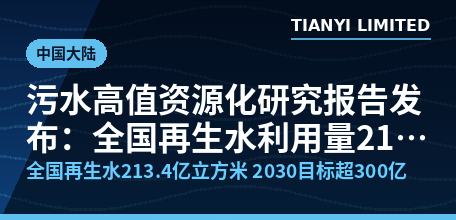
Industry research reports show that in 2025, national reclaimed water utilization reached 21.34 billion cubic meters, with urban utilization rates of 32.4%–35% and the Beijing-Tianjin-Hebei region exceeding 52%. The three major industrial scenarios of the

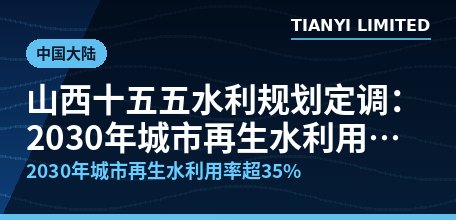
At the special press conference held by the Shanxi Provincial Department of Water Resources, the goals for the 15th Five-Year Plan period were clearly defined: by 2030, the province's total annual water consumption shall not exceed 9.692 billion cubic met

The Phase III expansion of the Wuhan Hanxi Wastewater Treatment Plant has been completed and put into operation, increasing its daily treatment capacity from 600,000 to 800,000 tons. The biochemical tank and secondary clarifier are vertically stacked in a
Tianyi Tech's AI agent covers electroplating, textile dyeing, chemical parks, semiconductor, coal-chemical, and food & beverage industries. It addresses high-salinity, high-COD, and refractory wastewater through real-time dosing, aeration, and membrane fouling control optimization.
Based on extensive delivered-project experience, AI agents effectively reduce per-ton treatment costs, steadily improve compliance rates, and significantly reduce manual inspection workload, typically achieving payback within a short period.
SCADA only handles data acquisition and basic control. A digital twin platform uses 1:1 mechanistic models + AI reasoning to simulate process changes, abnormal conditions, and energy-saving strategies before execution — the key infrastructure for moving from automation to intelligence.
Lightweight AI dosing optimization can go live in 4–6 weeks. Full digital twin projects typically take 3–6 months, delivered in three phases: data integration, model training, and online optimization.
No. Tianyi Tech's AI agent uses non-intrusive deployment via existing PLC/DCS interfaces — commissioning and trial runs complete without production stoppage.
Supports on-premise deployment (customer data center or private cloud), national cryptography standard encryption, fine-grained permission auditing, AD/LDAP & SIEM integration, and Level 3 information security protection compliance.



