



 Multi-industry nationwide (electroplating and surface treatment, acidic water fr
 Pilot to full-scale engineering (tens to tens of thousands of m³/d; influent pH
Neutralization: Adjusting pH 3 to 6.5 — pH-Based Calculation Requires 28 g Lime, Alkalinity-Based Calculation Requires 840 g
The previous article discussed filters, where what got replaced was "filtration rate"; this article discusses neutralization, where what gets replaced is something more fundamental—pH is not a "quantity" at all. It is intensity, not capacity. Water in the same tank at pH 3.00 could be 1 milliequivalents of hydrochloric acid, or it could be 57 milliequivalents of acetic acid, yet the pH meter gives you an identical reading. The entire engineering quantity of the neutralization chapter is hidden in that 57-fold difference.
I. First, Locate It: Neutralization Does Not Change the Total—It Only Changes the Acid's Exit
On a process flow diagram, neutralization is a box: acid goes in, salt comes out, and pH goes from 3 to 7. It looks like "the acid has been eliminated," but in fact not a single hydrogen ion has been eliminated—it combines with hydroxide to form water, and that hydroxide comes from the alkali, whose other half (calcium, sodium, magnesium) remains in the water. So what neutralization really does is: swap the dangerous identity of "acid" for the ordinary identity of "salt," and then decide whether that salt settles out, dissolves in the water, or escapes as a gas.
Once you switch to this perspective, many arguments dissolve on their own. For example, "lime neutralization produces too much sludge" is not lime's fault—it is that lime converts sulfate into calcium sulfate, and calcium sulfate has a solubility of only 2.4 g/L, so the excess must become a solid. "Caustic soda produces no sludge but has high operating costs" is not because caustic soda is expensive—it is that caustic soda converts sulfate into sodium sulfate, and sodium sulfate has a solubility of 280 g/L, so all of it goes along with the water—sludge is saved, but salt enters the water. The same acid, two exits.
GB 50684—2011 "Code for Design of Chemical Industrial Wastewater Treatment and Reuse" draws this boundary right at the beginning of Section 5.5: wastewater with acid content below 4% and alkali content below 2% "has no value for recovery and utilization" and should be treated by neutralization; moreover, "the use of waste to treat waste should be given priority," and where conditions permit, alkali slag, waste alkali liquor, and carbide slag should be used to replace commercial alkali. The subtext of this sentence is: neutralization is spending money to turn acid into salt—if you can avoid turning it into a commercial salt, don't.
| Route | What the acid becomes | Product solubility (20 ℃) | Hard constraint | Who bears the cost |
|---|---|---|---|---|
| Limestone / dolomite (filtration neutralization) | Dissolved calcium sulfate (limestone) Dissolved magnesium sulfate (dolomite) | Calcium sulfate approx. 2.4 g/L Magnesium sulfate approx. 270 g/L | Influent sulfuric acid ≤2 g/L (limestone) ≤3 g/L (dolomite) Heavy metals ≤50 mg/L | Increased salinity in effluent; filter media require periodic replenishment |
| Lime (slaked lime slurry) | Calcium sulfate crystals (gypsum) Metal hydroxides | Gypsum 2.4 g/L, beyond which it becomes sludge | Lime slurry 5%~10%; requires sedimentation and dewatering facilities | Sludge volume calculated at 1.755 kg/kg sulfuric acid; hazardous waste status depends on heavy metals |
| Caustic soda / soda ash | Dissolved sodium sulfate Dissolved sodium chloride | Sodium sulfate 280 g/L Sodium chloride 360 g/L | No concentration limit; but effluent salinity and conductivity increase | High unit cost of chemicals; salt travels with the water, limiting reuse or discharge |
The third column of Table 1 is the backbone of this article. The difference among the three routes lies not in the price of the alkali, but in whether the resulting salt is soluble. Salts with high solubility stay in the water, and you must accept the salinity; salts with low solubility settle out, and you must accept the sludge. There is no third way—unless you turn the salt into a gas, and only carbonates can do that (Section 8 below).
II. The First Misconception: pH Is Intensity, Acidity Is Capacity
The most common estimation phrase on site is "adjust pH from 3 to 7, just neutralize it." Chemically, this targets the wrong thing. pH is the activity of hydrogen ions—"how acidic it is right now"; what neutralization consumes is the total amount of protons the acid can provide—"how much acid it can release in total." The former is intensity, the latter is capacity, and there is no fixed multiple relationship between the two.
Putting the two numbers side by side makes it clear. For one ton of water at pH 3.00, the free hydrogen ion concentration is 10⁻³ mol/L, i.e., 1 eq/m³; to neutralize it to pH 6.5, the hydrogen ions only need to be reduced to 3×10⁻⁷ mol/L, and the difference is still about 1 eq/m³. Converted to CaO at 28 g/eq:
1 eq/m³ × 28 g/eq = 28 g/m³
For the same ton of water, if the measured methyl orange acidity is 1500 mg/L (as CaCO₃), converted at the calcium carbonate equivalent of 50 g/eq, the neutralizable acid is 30 eq/m³:
1500 ÷ 50 = 30 eq/m³; 30 × 28 g/eq = 840 g/m³
The two numbers differ by a factor of 30, and this factor of 30 is not an error—it is the portion of acid that pH does not tell you about. It hides in three places: metal ion hydrolysis (Fe²⁺ precipitating as Fe(OH)₂ consumes two hydroxide ions), weak acids (acetic acid, citric acid, complexing agents), and buffer systems (bicarbonates, ammonium salts). These three things leave almost no trace in the pH readings before and after neutralization, but they account for the bulk of alkali consumption.
The Mine Case: 13–19 Times
The copper-bearing acidic water at a copper mine in Fujian magnifies this account even further. The heap leachate and mine pit water are mixed together, with influent pH 1.22–2.50, iron 7–10 g/L, aluminum 500–1100 mg/L, zinc 200–300 mg/L, and sulfuric acid 9.5–12 g/L. Calculating free hydrogen ions at pH 1.22:
10⁻¹·²² = 0.060 mol/L = 60 eq/m³; 60 × 28 = 1.69 kg CaO/m³
Yet the actual lime consumption at this plant is 22–32 kg/m³ (quicklime, CaO ≥70%), which is 13–19 times the pH-based calculation. The extra ten-plus times becomes visible when the acidity is broken down by component:
| Alkali Consumption Item | Equivalent (eq/m³) | Proportion | Description |
|---|---|---|---|
| Free Sulfuric Acid | 219 | 35% | 10.75 g/L ÷ 49 g/eq (equivalent mass of sulfuric acid) |
| Iron Hydrolysis Precipitation | 304 | 49% | 8.5 g/L ÷ 27.9 g/eq (calculated as ferrous iron); if ferric, then 456, total increases by 25% |
| Aluminum Hydrolysis Precipitation | 89 | 14% | 0.8 g/L ÷ 9 g/eq (equivalent mass of aluminum) |
| Zinc and Copper Precipitation | 10 | 2% | Zn 0.25 g/L and Cu 0.065 g/L combined |
| Total | 622 | 100% | × 28 g/eq = 17.4 kg CaO/m³, on the same order of magnitude as the actual consumption 15.4~22.4 kg (converted based on 70% effective calcium) |
The most important row in Table 2 is not the total, but the second row: what consumes nearly half of the alkali is not the "acid", but the iron. This also explains why the "excess coefficient" of this type of water appears close to 1—because the iron has already been accounted for in the acidity titration, and multiplying by 1.5 again would be double counting. Conversely, if you estimate by pH, you would not even know the iron exists.
III. At the same pH 3.00, three acids differ by 57 times
What was discussed above is "water with metals." So in clean water, can pH represent acidity? The answer is: Strong acids can, weak acids absolutely cannot.
Three acids, all prepared as solutions with pH 3.00: hydrochloric acid 1.0 mmol/L; sulfuric acid about 0.48 mmol/L (the second stage is already 90% dissociated, total equivalent 0.96 meq/L); acetic acid requires 57 mmol/L to push pH down to 3.00, because its dissociation constant is only 1.75×10⁻⁵, and the molecules of 99% are still locked and have not released hydrogen ions.
| Acid | Concentration (mmol/L) | Neutralizable acid (meq/L) | Degree of dissociation | Alkali required to neutralize to pH 6.5 (meq/L) |
|---|---|---|---|---|
| Hydrochloric acid HCl | 1.0 | 1.0 | ≈100% | 1.0 |
| Sulfuric acid H₂SO₄ | 0.48 | 0.96 | First stage 100%, second stage approx. 91% | 0.96 |
| Acetic acid CH₃COOH | 57 | 57 | approx. 1.8% | 56 |
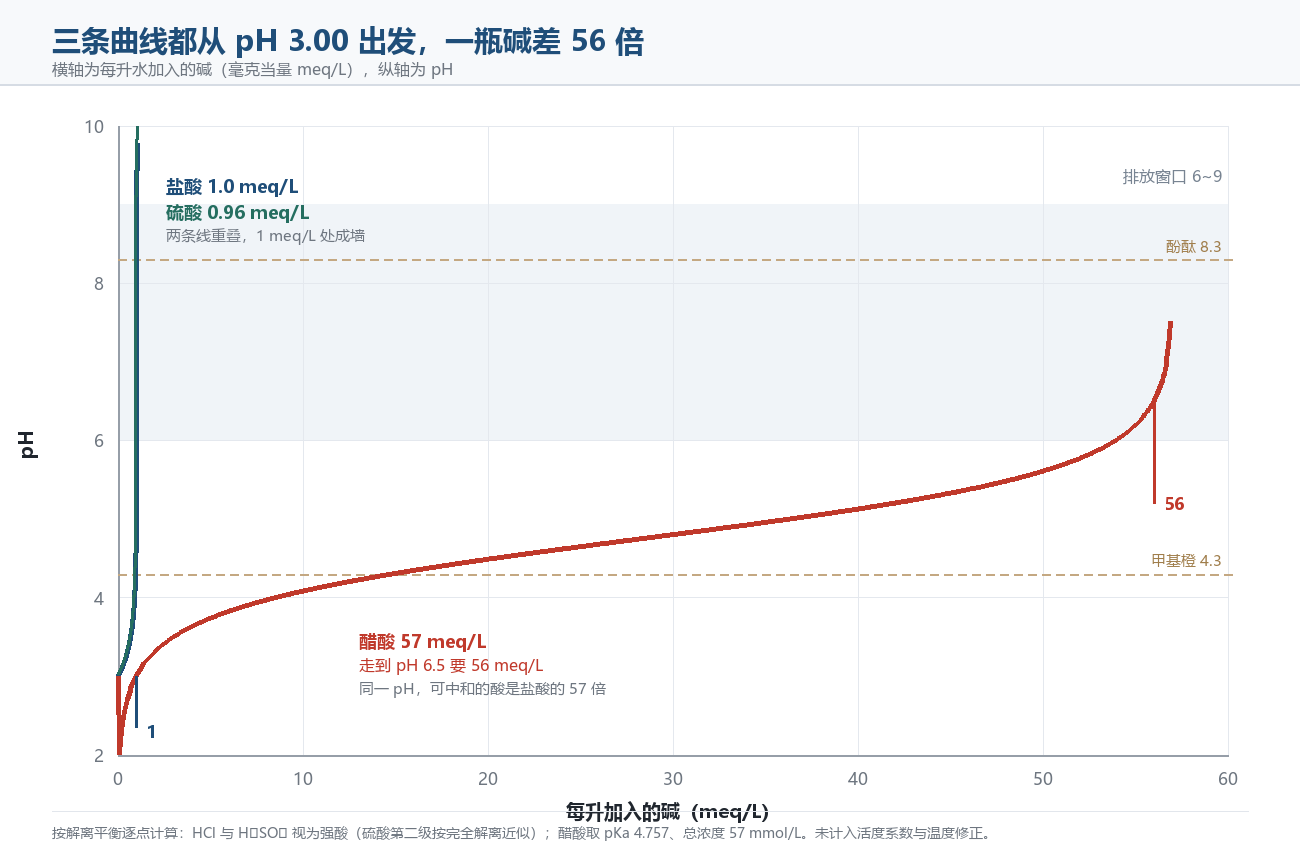
In Figure 1, the two steep lines almost coincide—those are the strong acids; the one climbing slowly is acetic acid. Both are "water at pH 3", yet one requires 1 milliequivalents of alkali and the other requires 56 milliequivalents of alkali. If this water comes from food processing, fermentation, or printing and dyeing desizing, it contains weak acids such as acetic acid and lactic acid, and estimating by pH will be off by two orders of magnitude—which also explains why the dosing pumps at such plants are always "at maximum and still below pH 7".
While we are at it, let us clarify another point: "how much alkali is needed to neutralize 1 kg of acid" depends on what the acid is, and has nothing to do with pH. To neutralize 1 kg of pure sulfuric acid requires 0.755 kg of pure Ca(OH)₂, 1 kg of hydrochloric acid requires 1.014 kg, and 1 kg of nitric acid requires only 0.587 kg. Hydrochloric acid consumes the most alkali, because it has the smallest molar mass and provides the most hydrogen ions per kilogram (27.4 mol/kg, compared with only 20.4 mol/kg for sulfuric acid and 15.9 for nitric acid). For mixed acids, the mole numbers of each component must be summed; you cannot make an estimate from a single "total acidity" figure.
IV. Acidity has two endpoints, and which one you choose determines the chemical dose
Acidity is not a single value. For the same water sample, titration to different endpoints gives two different numbers, and these two numbers correspond to two different things.
| Endpoint | Indicator / pH | What is measured | What it is used for in engineering |
|---|---|---|---|
| Methyl orange acidity (free acidity) | Methyl orange, 4.3 | The portion contributed by strong acids (mineral acids) | Estimating the "strong acid that must be neutralized", corresponding to the load on limestone filtration neutralization |
| Phenolphthalein acidity (total acidity) | Phenolphthalein, 8.3 | Strong acid + weak acid + metal hydrolysis acidity | Estimating the "actual alkali consumption for dosing to neutralize to discharge pH", corresponding to the lime slurry dosage |
The difference between the two numbers is the weak acid and metal hydrolysis portion. For water high in iron and aluminum, the two numbers can differ by more than a factor of two; for water containing acetic acid, they can differ by several tens of times.Using methyl orange acidity to calculate the lime slurry dosage is one of the most typical sources of underestimation on site—because lime slurry must raise the pH to 8~9, while the methyl orange endpoint only reaches 4.3, and the buffering within those four pH units in between is entirely left out of the calculation.
V. Alkali is not a single substance; it is an equivalent
When choosing an alkali, the most common mistake is to compare prices by "ton". There is only one correct way to compare: first convert to equivalents, then compare unit prices.Because the acid that one ton of lime and one ton of caustic soda can neutralize differs by 43%.
| Neutralizing Agent | Equivalent Weight (g/eq) | Neutralizing 1 t Sulfuric Acid (g) | Remarks |
|---|---|---|---|
| Calcium Oxide CaO (Quicklime) | 28.0 | 571 kg | Must first be slaked into Ca(OH)₂; commercially available effective CaO is typically 70%~85% |
| Calcium Hydroxide Ca(OH)₂ (Slaked Lime) | 37.0 | 755 kg | 20 ℃ solubility is only 1.7 g/L, must be dosed wet and reacted in suspension form |
| Sodium Hydroxide NaOH | 40.0 | 816 kg | Extremely high solubility, fast reaction; produces no sludge but produces dissolved salts |
| Sodium Carbonate Na₂CO₃ (Soda Ash) | 53.0 | 1 082 kg | Produces CO₂; suitable for small flow rates and where precise control is required |
| Calcium Carbonate CaCO₃ | 50.0 | 1 020 kg | Also known as limestone; only suitable for filtration neutralization, slow reaction |
| Dolomite CaCO₃·MgCO₃ | 46.0 | 939 kg | The magnesium half forms magnesium sulfate, which has high solubility, thus tolerating higher sulfuric acid concentrations |
The second column of Table 5 contains the numbers most worth memorizing in this entire article. With them, any question of "how much alkali does my water need" reduces to a simple division: Acidity (eq/m³) × Equivalent Weight (g/eq) = Pure Product Dosage (g/m³), then divide by the effective content and multiply by the excess coefficient.
Example: a stream of water with phenolphthalein alkalinity 2000 mg/L (as CaCO₃), i.e., 40 eq/m³. Using quicklime with 85% effective calcium and an excess factor of 1.2:
40 × 28 ÷ 0.85 × 1.2 = 1 581 g/m³ ≈ 1.58 kg/m³
Compare this number with the actual ledger; if the deviation is within ±15%, the accounting is correct; if it is more than double, there are usually two causes: the excess factor has been treated as a safety factor and continuously increased, or the effective calcium of the lime has dropped in the warehouse (moisture absorption forms CaCO₃, nominal 85% but actually only 60% remains).
The four "contents" of lime—do not use one number to represent them all
This is the most easily glossed-over point in the lime line. For the same batch of lime, there are four different "contents," each of which affects the dosage, but none can replace the other three.
| Indicator | Typical Value | What Is Measured | Impact on Dosage |
|---|---|---|---|
| Purity (CaO content) | Quicklime 70%~92% | The mass fraction of calcium oxide determined by analysis | The denominator; directly affects dosage linearly |
| Available calcium (activity) | 5~15 points lower than purity | The portion that can react with acid, neither overburned nor weathered | Overburned particles dissolve extremely slowly, amounting to wasted dosage |
| Slaking rate | 90%~98% | The proportion of CaO converted to Ca(OH)₂ | Unslaked particles continue to slake in the tank, causing local pH spikes |
| Utilization rate | 60%~80% | The share of the added alkali that actually participates in the reaction | The portion encapsulated by gypsum shell and discharged with the sludge |
Only by multiplying the four numbers together can you determine "how much work one ton of lime can do." Using a purity of 90%, available calcium of 80%, slaking rate of 95%, and utilization rate of 70%, the actual equivalent of one ton of lime is only 48% of its nominal value. This is the true source of the excess coefficient 1.2~1.5—it is not a safety margin, but compensation for the four losses. Conversely, if your lime quality is stable, lime slurry is prepared and used fresh, and mixing is sufficient, a coefficient of 1.1 is adequate; if the lime is stored in the open air and the lime slurry tank is not cleaned for three days, even 1.5 may not be enough.
VI. Material Balance of the Three Outlets: Where Did One Ton of Sulfuric Acid Go
Now let us put the three routes into the same account. Assume that 1 m³ of water contains 1 kg of pure sulfuric acid and 100 g of iron, with a pH of about 1.2, and is neutralized to pH 8. Run each of the three alkalis once:
| Item | Limestone route | Lime route | Caustic soda route | Remarks |
|---|---|---|---|---|
| Chemical dosage | CaCO₃ 1 020 g | CaO 671 g | NaOH 816 g | Converted on an equivalent basis 28 / 50 / 40 |
| Gas product | CO₂ 449 g | None | None | Of the three routes, only limestone produces gas |
| Dry sludge | Iron sludge only 161 g (calcium sulfate fully dissolved) | Gypsum 1 754 g Ferrous hydroxide 161 g | Ferrous hydroxide 161 g | The iron quantity is the same for all three routes |
| Increase in dissolved salts | CaSO₄ 1 387 g | ≈0 (calcium goes into the sludge) | Na₂SO₄ 1 449 g | This is the key difference among the three routes |
| Total dry sludge | 0.16 kg | 1.92 kg | 0.16 kg | The sludge from the lime route is 12 times that of the other two |
| 70% moisture wet sludge | ≈0.5 kg | 6.4 kg | ≈0.5 kg | Converted at 30% solids content |
| Increase in effluent salinity | +1.39 g/L | ≈0 | +1.45 g/L | Directly determines whether reuse is possible |
| Applicable to this water stream | No | Yes | Yes | The iron 100 mg/L exceeds the upper limit of 50 mg/L for filtration neutralization; the limestone column is for equivalent comparison only |
Table 7 The last row must be clarified first: this water stream contains iron 100 mg/L, which has already exceeded the applicable boundary of GB 50684 Article 5.5.4 "heavy metal ions should be less than 50 mg/L"; limestone filtration neutralization cannot be directly applied to it in engineering practice. This column is included to compare the product distribution of the three alkalis on the same equivalent basis, not to recommend it.
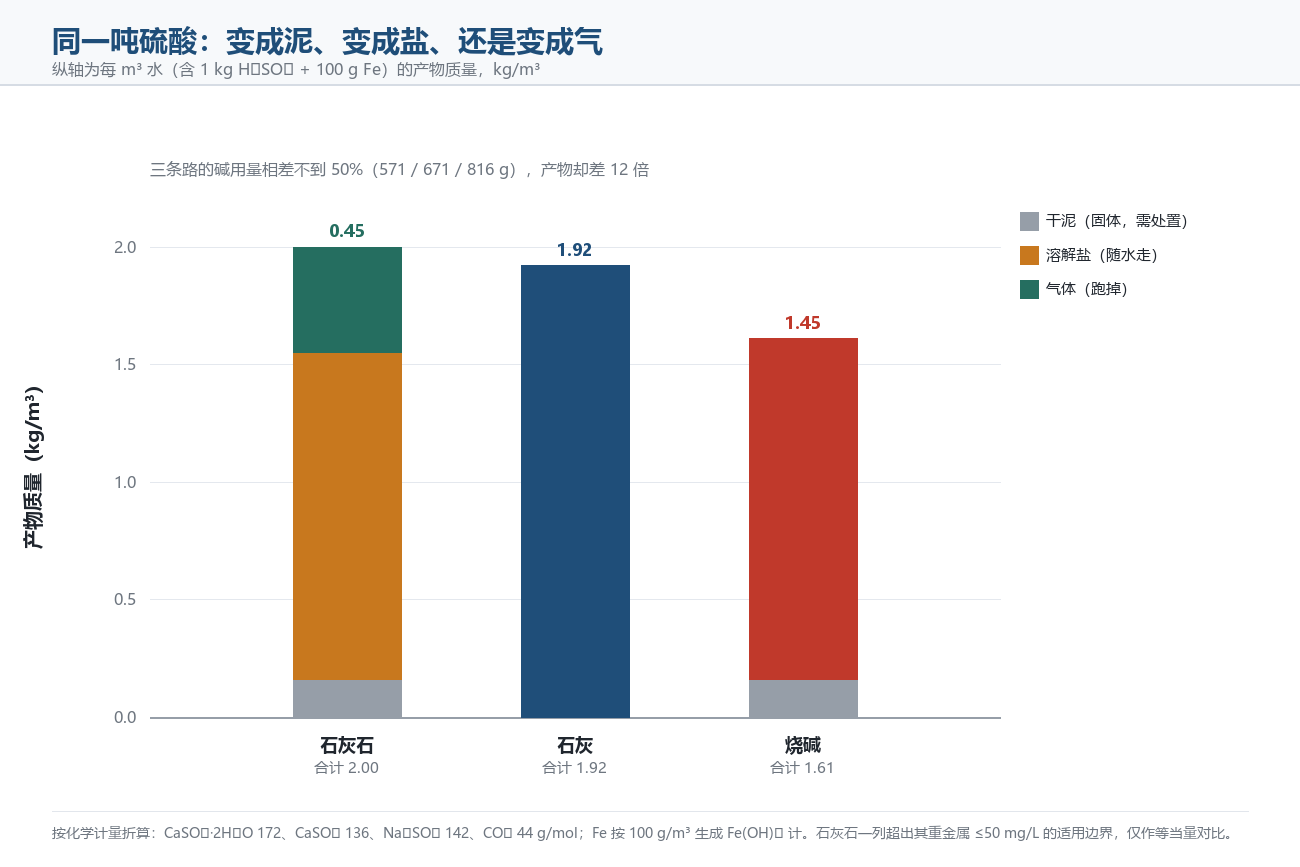
The leftmost bar in Figure 3 illustrates the point best: the limestone route does not "produce no gypsum" — it dissolves the gypsum into the water. 1 387 g/m³, i.e., 1.39 g/L of calcium sulfate, sits exactly four tenths below the 20 ℃ solubility limit of 2.4 g/L. This "exactly below" is no coincidence; it is the entry point to Section 7.
7. The solubility of calcium sulfate is the true source of that "2 g/L"
Article 5.5.4 of GB 50684 sets two hard limits for filtration neutralization: for limestone filter media neutralizing sulfuric acid, "the sulfuric acid concentration should not exceed 2 g/L"; for dolomite filter media it may reach "3 g/L"; and "heavy metal ions in the wastewater should preferably be less than 50 mg/L." The rationale given in the clause explanation is straightforward — calcium sulfate has very low solubility, and at high concentrations it "readily forms deposits on the surface of the filter media, hindering the contact reaction between the acid and the filter media."
Convert 2 g/L into calcium sulfate to see:
2 g H₂SO₄/L ÷ 98 g/mol × 136 g/mol = 2.78 g CaSO₄/L
Meanwhile, the solubility of calcium sulfate at 20 ℃ is 2.4 g/L. In other words, this upper limit permitted by the code corresponds to a supersaturation of 13%. This is not the standard being lax; it is the standard acknowledging one thing: in an upflow expanded filter bed, calcium sulfate will precipitate, but it will not grow on the filter media. With the filter bed expanded by 30%~50%, the particles collide and rub against each other, and the precipitated microcrystals are abraded off and carried away with the water, so a slight supersaturation is permitted.
Compare the more widely circulated figure from textbooks — "for limestone neutralizing sulfuric acid, the concentration should not exceed 1~1.2 g/L" — which converts to 1.36~1.63 g/L of calcium sulfate, only sixty percent of the solubility. The textbook says "no precipitation allowed"; the code says "precipitation allowed, flushed off by collision." The factor-of-two difference is not a difference in conservatism but a difference in tank type: ordinary filtration neutralization tanks have low filtration rates (generally less than 5 m/h), large filter media particle sizes (30~80 mm), and no expansion, so precipitates grow permanently; expanded filter beds with filtration rates of 30~70 m/h, particle sizes of 0.3~3 mm, and expansion of 30%~50% do not.
| Boundary | Value | Why this number |
|---|---|---|
| Limestone + Sulfuric Acid | ≤2 g/L | Calcium sulfate 2.78 g/L is formed, supersaturated at 13%, and carried away by expansion and collision; if a conventional filter is used, it must be reduced to 1~1.2 g/L |
| Dolomite + Sulfuric Acid | ≤3 g/L | The magnesium half forms magnesium sulfate, with a solubility of about 270 g/L, which does not cause encrustation at all; however, the reaction rate is slow and requires a longer retention time |
| Heavy Metal Ions | ≤50 mg/L | Metal hydroxides form a coating on the surface of the filter media, rendering the media ineffective; moreover, the filter cannot discharge sludge |
The second row of Table 8 is a typical example of "change the element and you change the ceiling." Limestone is vulnerable to sulfate, while dolomite is not—not because dolomite is more alkaline, but because the salt formed by its cation is more soluble. This criterion can be extended to all "scaling" type problems: to judge whether a neutralizing agent can be used, look at the solubility of the salt it forms with the target anion, not at the strength of its alkalinity.
There are two other design parameters worth noting down, as they determine whether the filter can run long-term: the limestone filter media requires a calcium carbonate content greater than 75%, with a particle size of 0.5~3.0 mm; the filtration rate is 130~150 m/h in the lower section and 40~60 m/h in the upper section of a variable-diameter tower, and 60~80 m/h for a constant-diameter tower; when the filter layer is newly installed it is 1.0~1.2 m, and when the accumulation of inert substances causes the filter layer to rise to 2.0 m, the media must be completely replaced, with the total tower height taken as 3.0~3.5 m. This "2.0 m media replacement" criterion is very practical—the filter layer height is a consumable indicator, not a structural dimension.
VIII. The Second Ceiling of Limestone Is Carbon Dioxide
Even if the concentration and heavy metals are all within limits, filtration neutralization still has an unavoidable upper limit, and it is not in the water but in the air. Carbonate neutralization produces CO₂:
CaCO₃ + H₂SO₄ → CaSO₄ + CO₂↑ + H₂O
CO₂ dissolved in water becomes carbonic acid, holding the effluent pH at around 5. The clause explanation of GB 50684 states clearly: "CO₂ dissolved in water forms carbonic acid, keeping the effluent pH at around 5; removing CO₂ can raise the effluent pH to 6~6.5. Methods for removing CO₂ include aeration, multi-stage cascade, and other methods."
The lime milk route has no such ceiling, because its product is water rather than CO₂. This is the physical root of "filtration neutralization is cheap but can only reach 6, while lime milk can reach 10 but produces sludge": it is not a question of alkali strength, but of product form.
9. Lime is not "added to pH 9", but "added to a Ca to Zn ratio of 3 to 1"
Once we enter the heavy metals section, "how much alkali to add" and "what pH to reach" begin to diverge. HJ 2002—2010 "Technical Specification for Electroplating Wastewater Treatment Engineering" Section 6.3.4 for treating zinc-containing wastewater does not give a pH, but a molar ratio:
For lime treatment of ammonium-salt zinc plating wastewater, the calcium oxide dosage should be Ca²⁺ : Zn²⁺ = 3 : 1 ~ 4 : 1
Why 3~4 times rather than the theoretical 1 times? Because in ammonium-salt zinc plating wastewater, zinc is complexed by ammonia into Zn(NH₃)₄²⁺, and it will not precipitate at all unless the complex is broken. The same section immediately gives the reaction conditions: for conventional zinc-containing wastewater, "pH should be controlled at 8.0~9.0, reaction time 5~10 min"; while for ammonium-salt zinc plating wastewater using the lime method, "the reaction pH should be controlled at 11~12". The two pH values differ by three units, corresponding to two completely different treatment targets: "free zinc" and "complexed zinc."
Converting to specific consumption is more intuitive. At zinc 50 mg/L (the upper limit given by this standard for continuous treatment), the theoretical calcium requirement is 0.765 mmol/L; at 3~4 times, that is 2.3~3.06 mmol/L, converted to CaO:
2.3~3.06 mmol/L × 56 g/mol = 129~171 mg/L CaO
In other words, to precipitate just 50 mg/L of zinc requires 130~170 mg/L of pure calcium oxide, not counting the amount needed to neutralize free acid. Many plants dose according to "one times the zinc," actually adding only 43 mg/L, so precipitation is naturally unstable.
10. The discharge window is 6~9, the precipitation window is 8.5~10.5, and the two circles do not overlap
This is the one thing in the whole article that most deserves to be drawn as a chart. The pH requirement of the discharge standard is 6~9 (GB 21900 and GB 8978 are consistent), while none of the pH ranges where each metal hydroxide "settles most cleanly" lies in the exact middle of 6~9.
| Metal | Optimal Precipitation pH | Relationship with the 6~9 Window | Key Points |
|---|---|---|---|
| Ferric Fe³⁺ | 6.0~9.0 (hydrolyzes starting at 3.0) | Falls entirely within the window | Easiest to precipitate; precipitates even at low pH and serves as the carrier for co-precipitation |
| Aluminum Al³⁺ | 5.5~7.5 | Falls in the lower half of the window | Amphoteric: above pH 9, aluminate forms and redissolves |
| Copper Cu²⁺ | 7.0~8.5 | Falls within the window | Relatively wide window; at too high pH, copper-ammonia complexes form |
| Zinc Zn²⁺ | 8.5~10.0 | Only half falls within the window | Amphoteric: above pH 10.5, zincate forms and redissolves |
| Nickel Ni²⁺ | 9.5~10.5 | Mostly outside the window | Requires pH around 10; higher in the presence of ammonia, and prone to redissolution |
| Cadmium Cd²⁺ | ≥10.5 | Completely outside the window | HJ 2002 Article 6.3.1.5: pH should be greater than or equal to 10.5 |
| Manganese Mn²⁺ | 9.5~11.0 | Completely outside the window | Usually requires prior oxidation to MnO₂ for effective removal |
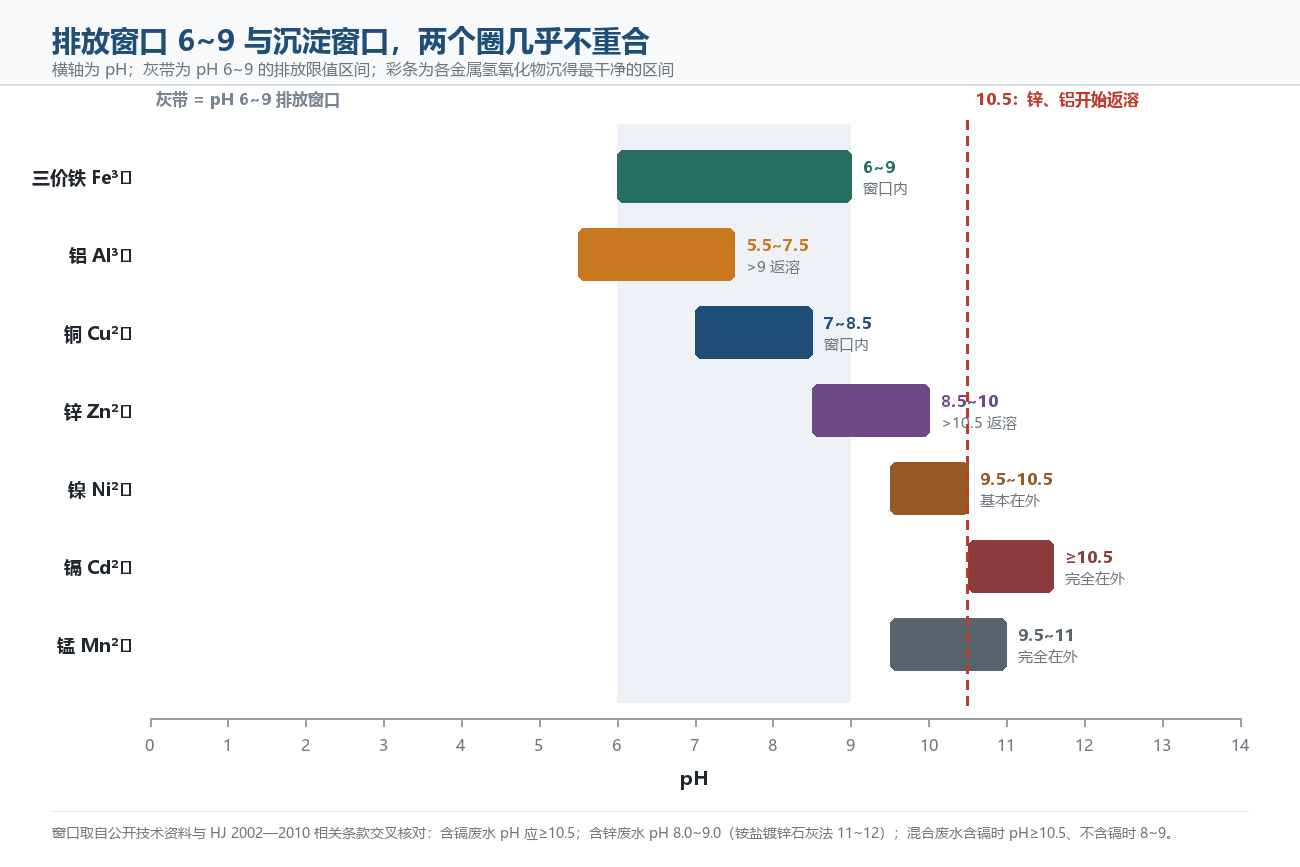
The conclusion from Figure 2 is unequivocal: "effluent pH compliance" and "metal compliance" are two independent tests. Neutralizing the mixed water uniformly to pH 8.5 easily passes the pH item, and copper, iron, and aluminum pass, zinc barely passes, while nickel, cadmium, and manganese all fail. Conversely, pushing the pH up to 10.5 to accommodate cadmium causes zinc and aluminum to begin redissolving, and the pH item then fails the 9 limit.
This is the entire rationale for the existence of two-stage neutralization, and the responsibilities of the two stages are not as vague as "first stage coarse adjustment, second stage fine adjustment"—they have a clear division of labor:
| Stage | pH Control | What Is Precipitated | Why It Is Placed in This Stage |
|---|---|---|---|
| Stage 1 | 7.5~8.0 | Ferric iron, aluminum, partial copper | These precipitate completely at low pH; precipitating them first reduces the sludge volume in Stage 2 |
| Stage 2 | 10~10.5 | Zinc, nickel, cadmium, manganese | Requires high pH; by this time iron and aluminum are already in the sludge and will not re-dissolve at high pH |
| Readjustment | 6.5~8.5 | — | The pH of Stage 2 effluent exceeds 9; acid must be added to readjust before discharge |
The third row of Table 10 is often overlooked: Stage 2 raises the pH to 10.5, and the effluent itself is non-compliant, so acid must be spent to bring it back down. Adding acid at this stage is not waste—it is unavoidable, because the discharge window and the precipitation window do not overlap; you can only shuttle between the two windows once. Criterion: whenever you see the trio of "neutralization—precipitation—acid readjustment" on a process flow diagram, it indicates that there is a metal in this stream that requires high pH to precipitate; the acid consumption in the readjustment step should be counted into the treatment cost of this metal.
XI. Near the Neutral Point, a Dosing Error of 1% Equals 4 pH Units
All the preceding discussion assumes that "how much alkali to add" can be calculated accurately. But the hardest part of neutralization is precisely this: even if calculated accurately, it cannot be dosed accurately.
The reason lies in the shape of the titration curve. For a strong acid water stream, the amount of alkali required to raise the pH from 4 to 5 is 10 times that required to raise it from 5 to 6, and nearly a hundred times that required to raise it from 6 to 7. Viewed in reverse, it is even more striking:
| Target pH | Cumulative Alkali Addition (meq/L) | Increment for This Segment (meq/L) | Converted to CaO (g/m³) |
|---|---|---|---|
| 4.0 | 0.900 | — | 25.2 |
| 5.0 | 0.990 | 0.090 | 2.5 |
| 6.0 | 0.999 | 0.009 | 0.25 |
| 7.0 | 1.000 | 0.001 | 0.03 |
| 8.0 | 1.001 | 0.001 | 0.03 |
| 9.0 | 1.010 | 0.009 | 0.25 |
Look at row 4 to row 5: the cumulative alkali addition changes from 1.000 to 1.001, an increase of one-thousandth, and the pH moves from 7 to 8. In other words, near the equivalence point, a dosing error of ±1% corresponds to a swing of 4 units from pH 5 to pH 9. Meanwhile, the stroke accuracy of a diaphragm metering pump is typically ±2% to ±5%, and lime slurry will drift by a few more points due to precipitation, scaling, and valve wear.
XII. Three numbers for tank volume: 3 min, 20 min, 2 小时
Regarding "how long neutralization takes," at least three numbers can be found, and all are correct, because they answer three different questions.
| Value | What time it is | Source and applicable conditions |
|---|---|---|
| 3~5 min | Mixing reaction time | Article 5.5.3 explanation of GB 50684: for wastewater mainly containing strong acids or strong alkalis with few other pollutant components, the mixing reaction time should preferably be 3~5 min |
| 15~25 min | Retention time per compartment of the pH adjustment tank | Provisions for pH adjustment tanks in electroplating engineering specifications: each group should have no fewer than two compartments, each compartment 15~25 min, effective water depth 2~4 m, with a pH meter installed in each compartment |
| 1~2 h | Neutralization tank volume (based on hourly flow) | Article 5.5.2 of GB 50684: when acid and alkali wastewater is mutually neutralized in continuous mode, the volume shall be determined as 1~2 h of the wastewater flow |
The difference among the three lies in "what is happening in the tank." 3~5 min is the time required by the chemical reaction itself; 15~25 min is the engineering time combining "reaction + mass transfer + pH probe response + control loop lag"; 1~2 h is not for the reaction but for the two streams offsetting each other — mutual neutralization of acid and alkali wastewater has no dosing pump and can only rely on tank volume to flatten fluctuations, so the volume is calculated on an hourly basis.
Conversely, if the chemically dosed tank is also designed according to 1~2 h, a hidden problem will arise: the tank is too large, the pH probe measures water from half an hour ago, and the PID loop will inevitably oscillate. This is also why electroplating standards divide the pH adjustment tank into "no fewer than two compartments, each 15~25 min" — the compartmentalization is to shorten the response time of each compartment, so that each compartment can be controlled independently.
Two other points that are easily overlooked: the neutralization tank must be equipped with agitation (mechanical or air; mechanical is preferable when volatile toxic substances are present); lime neutralization should be dosed wet as a 5%~10% slurry, and the lime storage silo should be designed with a storage capacity of 10~20 天 usage and a stacking height of 1.5 m. These last two sentences look like civil engineering details, but they are actually the prerequisite for stable operation — a lime slurry concentration below 5% will introduce too much water, while above 10% it will precipitate and clog pipes, and a silo holding only 10 天 of the requirement means material must be replenished at least twice a month, so that the available calcium has a chance to remain stable.
XIII. The Sludge Account: Three Sets of Metrics, Which Convert to the Same Range
The last unavoidable issue in neutralization is sludge. Regarding "how much sludge is produced per ton of water," public sources contain at least three sets of figures, with different units, and direct comparison would lead to conclusions differing by a factor of 100.
| Basis | Original value | Converted to dry basis (kg/m³) | Nature |
|---|---|---|---|
| HJ 2002 Article 6.4.6 (acid-base wastewater neutralization) | 0.1%~0.25% of treated water volume | 1.0~2.5 | Dry sludge quantity, for design estimation |
| HJ 2002 Article 6.3.4.7 (zinc-containing wastewater) | 4%~8% of treated water volume (moisture content 99.7%) | 0.12~0.24 | Thickened sludge volume, solids content only 0.3% |
| Guangdong Province Electroplating Industry Solid Waste Management Manual waste generation coefficient | 0.98‰~8‰ (converted at 70% moisture content) | 0.29~2.4 | Declaration basis, used to verify under-reporting |
The three figures appear to differ by a factor of 10, but after conversion to dry basis they fall within the same band (0.1~2.5 kg/m³). The difference comes from water quality: zinc-containing wastewater (zinc ≤50 mg/L) has a low load itself, so it produces less sludge; acid-base wastewater contains multiple metals and sulfate, so it produces more sludge. The first and third rows essentially coincide, indicating that the design estimation value "0.1%~0.25%" and the declaration coefficient "0.98‰~8‰" are two ways of writing the same thing.
And the 1.92 kg/m³ dry sludge calculated in Section 6 of this article falls right in the upper-middle of the 1.0~2.5 range in the first row—this is also a cross-validation: the sludge quantity back-calculated from water quality using the equivalent method matches the estimation range given by the standard, indicating that no items were omitted in this accounting.
The third line also hides a regulatory message: the Guangdong manual divides the waste generation coefficient into three tiers—Tier 1 coefficient 0.98‰ (design theoretical minimum), Tier 2 1.6‰, and commonly used 5‰—and states explicitly that "those below the Tier 1 coefficient carry a major risk of underreporting or omission; those below the Tier 2 coefficient carry a relatively large risk of underreporting or omission; those below the commonly used coefficient may carry a risk of underreporting or omission." This turns "material balance" directly into an enforcement tool: if the sludge quantity you declare falls below the lower limit calculated from the water volume, no other evidence is needed—the account itself does not balance.
XIV. On-Site Checklist
Condense the entire article into one verifiable table. Eight items, each corresponding to a number above.
| No. | Check Item | Criterion |
|---|---|---|
| 1 | Is the dosage calculated based on pH or on acidity | If calculated based on pH, water containing metals or weak acids will be underestimated by 13~57 times; measured values of phenolphthalein acidity (8.3) or at least methyl orange acidity (4.3) should be available |
| 2 | Which endpoint is used for acidity | Using methyl orange acidity (4.3) to calculate lime milk dosage will underestimate it; lime milk must raise pH to 8~9, so phenolphthalein acidity must be used |
| 3 | Are chemicals compared by equivalent ratio or by tonnage | Comparing by tonnage will be wrong by 43% (CaO 28 vs NaOH 40 g/eq); convert to equivalents before comparing unit prices |
| 4 | Are all four lime contents recorded in the ledger | Multiplying purity, available calcium, slaking rate, and utilization rate together may leave only 48% of the nominal value; with only purity as a single figure, the excess coefficient is just a guess |
| 5 | Does the influent sulfuric acid concentration exceed 2 g/L | If exceeded, limestone filtration neutralization cannot be used (calcium sulfate 2.78 g/L becomes supersaturated); either switch to dolomite (up to 3 g/L) or change to lime milk |
| 6 | Is the effluent pH of filtration neutralization raised by adding chemicals | The upper pH limit of carbonate neutralization is determined by CO₂; adding chemicals will only make it lower; aeration or cascade degassing should be used |
| 7 | Is there only one neutralization stage | When the water contains nickel, cadmium, or manganese, a single stage cannot simultaneously satisfy the discharge window of 6~9 and the precipitation window of 9.5~10.5; two stages plus acid readjustment should be used |
| 8 | Is the moisture content clearly stated in the basis for sludge volume | Dry basis 0.1%~0.25% and wet basis 4%~8% (99.7%) differ by 10 times; if the ledger basis is unclear, the material balance cannot be closed |
15. Closing: Neutralization Is a Technology About the "Outlet"
To tie these fifteen sections into one sentence: Neutralization does not change the total amount of acid, only the outlet of the acid. There are only three outlets—precipitated into sludge, dissolved into salt, converted into gas—and which one is chosen is determined by "whether the resulting salt is soluble or not." Calcium sulfate 2.4 g/L, so lime turns it into sludge; sodium sulfate 280 g/L, so caustic soda turns it into salt; calcium carbonate releases CO₂ upon contact with acid, so limestone turns it into gas and then into dissolved calcium salt.
This thread strings together all the seemingly unrelated numbers in this article: why the code allows limestone to neutralize sulfuric acid up to 2 g/L, because that is exactly 1.13 times the solubility of calcium sulfate, and it only holds up through expansion and collision; why dolomite can reach 3 g/L, because magnesium sulfate does not form scale at all; why filtered neutralization effluent can only reach 6, because CO₂ is its product; why two-stage neutralization still requires acid adjustment afterward, because the discharge window and the precipitation window do not overlap; why pH cannot be adjusted accurately by hand, because near the neutral point an error of 1% equals 4 pH units.
As for the two numbers at the beginning—28 grams and 840 grams—they are not a matter of "right" and "wrong," but two different questions. 28 grams answers "how acidic this water is at this moment," while 840 grams answers "how much alkali this water can consume in total." Design requires the latter, because what the pump in the tank adds is the amount of the latter.
All standard clauses in this article are quoted from public texts, and engineering data are all annotated with sources; for any values derived by calculation from clause parameters, the calculation process and assumptions have been noted in the main text. This article contains no names of any commercial institutions or product recommendations.
References
- GB 50684—2011 "Code for Design of Chemical Industrial Wastewater Treatment and Reuse" Section 5.5 "Neutralization and pH Adjustment" and clause explanations (5.5.1~5.5.7).
- HJ 2002—2010 "Technical Specifications for Electroplating Wastewater Treatment Engineering" Section 6.4 "Acid and Alkali Wastewater," Section 6.5 "Electroplating Mixed Wastewater," Section 6.3 "Heavy Metal-Containing Wastewater."
- GB 21900—2008 "Electroplating Pollutant Discharge Standard" Table 3 (special emission limits for water pollutants, pH 6~9).
- GB 8978—1996 "Integrated Wastewater Discharge Standard" Table 1, Table 4 (pH 6~9).
- Department of Ecology and Environment of Guangdong Province, "Solid Waste Management Manual for the Electroplating Industry in Guangdong Province," Table 2-4 "Electroplating Sludge Waste Generation Coefficients" and explanations of Grade I, Grade II, and commonly used coefficients.
- Industrial test on combined treatment of copper-containing acidic wastewater from a copper mine in Fujian by lime neutralization and copper tailings slurry: influent pH 1.22~2.50, iron 7~10 g/L, aluminum 500~1100 mg/L, zinc 200~300 mg/L, sulfuric acid 9.5~12 g/L, lime unit consumption 22~32 kg/m³; with tailings slurry 9.2 g/L, lime reduced to 24.4 kg/m³.
- Li Xuejin, Qian Xianwen, Zheng Leping, et al., "Experimental Study on Acidic Wastewater Treatment in a Certain Iron Mine Tailings Pond": two-stage neutralization, 5% lime milk, lime dosage 0.5~0.8 kg/m³, PAM 2 mg/L, effluent pH 6~8.
- Two-stage neutralization process with limestone fluidized bed as the main process and lime milk as the auxiliary: limestone 3 kg/m³ + lime 0.33 kg/m³, neutralization sludge amount about 1/3 of the traditional lime milk process; compared with traditional lime milk process lime 3.45 kg/m³.
- Public technical review of Dexing Copper Mine's use of alkaline tailings overflow from mineral processing to neutralize mine acidic water (treating waste with waste, two-stage for large water flow, one-stage for small water flow).
- Science Popularization China "Neutralization Method" entry: filter material selection and order of solubility of neutralization products (calcium nitrate, calcium chloride > magnesium sulfate > calcium sulfate > calcium carbonate, magnesium carbonate), and the statement of the upper concentration limit of 1~1.2 g/L for limestone neutralization of sulfuric acid.
- Engineering practice of two-stage neutralization precipitation in an electroplating park: first-stage neutralization with stone powder and sodium hydroxide, pH 7.5~8.0; second-stage neutralization with sodium hydroxide, pH 10~10.5; optimal precipitation pH for mixed water 9.5; after PE pipe filtration, 80% reused.
- "Methods for Monitoring and Analysis of Water and Wastewater" acidity determination (methyl orange endpoint pH 4.3, phenolphthalein endpoint pH 8.3; titration after heating water samples containing heavy metals).
- Metcalf & Eddy, Wastewater Engineering: Treatment and Resource Recovery, 5th ed.: neutralization equivalent mass and chemical precipitation equilibrium.
- Operating data of chemical precipitation process for copper-containing wastewater: copper-containing sludge 0.5~1.5 kg/m³ (moisture content 80%), classified as HW17 surface treatment waste, outsourced disposal 200~500 元/ton.
- Amphoteric behavior and redissolution pH ranges of zinc hydroxide and aluminum hydroxide (cross-checked from multiple chemical manuals and engineering technical data): Zn(OH)₂ optimal 8.5~10, zincate forms when pH exceeds 10.5; Al(OH)₃ optimal 5.5~7.5, meta-aluminate forms when pH exceeds 9.
