



 Multi-industry nationwide (lead-zinc mining and smelting, tin-antimony-mercury,
 Pilot to full-scale engineering (influent 0.6 μg/L to 5 mg/L; effluent 5 μg/L to
Thallium-Containing Wastewater: The Same 0.0173, Compliant Under 0.017, 1.8% Over the Limit Under 0.005
The previous article discussed water injection, where what was replaced was the limit table. This article discusses thallium, where what is replaced is the parentheses—in the seven characters "0.017 (0.005)", the number before the parentheses governs most situations, while the one inside the parentheses only applies to "wastewater discharged separately from mining or ore-dressing production units"; and in a case in 2025 年, the measured value fell exactly between the two numbers.
I. One Measured Value, Two Verdicts
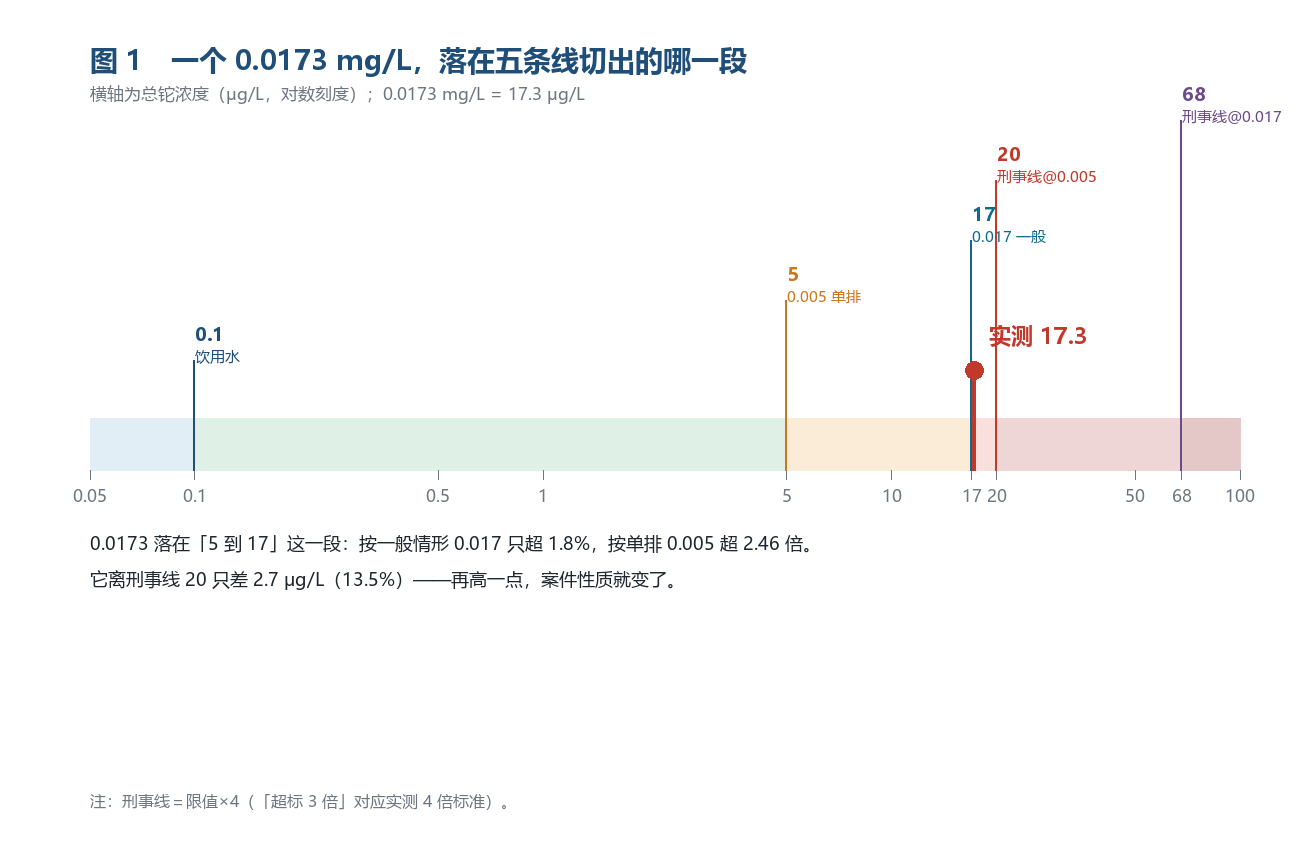
On 7 月, 2025 年, enforcement officers in Hechi, Guangxi, took three samples at the mine water treatment station of a mining company: the inlet, the rainwater collection tank, and the main wastewater discharge outlet. In the report issued by the monitoring center on 22 日, 7 月, the thallium at the main discharge outlet was 0.0173 mg/L. The penalty decision stated the determination as follows: according to the amendment sheet to GB 25466—2010, the total thallium limit for wastewater from mining production units is 0.005 mg/L, and the measured value exceeds it by 2.46 times, constituting excessive discharge, with a fine of 15.85 万 yuan.
This case is worth reading word by word, because the number 0.0173 falls exactly between the two numbers in the amendment sheet.
| Which criterion applies | Limit mg/L | Ratio | Conclusion |
|---|---|---|---|
| Total thallium (general case) | 0.017 | 1.02 | Exceeds by 1.8%, exactly on the line |
| Total thallium (separate discharge for mining/ore processing) | 0.005 | 3.46 | Exceeds by 2.46 times, applicable to this case |
| Criminal threshold (3 times the 0.005) | 0.020 | 0.87 | Not reached, short by 0.0027 |
| Criminal threshold (3 times the 0.017) | 0.068 | 0.25 | Far from reached |
Four conclusions, ranging from "exceeds by 1.8%, almost arguable" to "exceeds by 2.46 times, a fine of 150,000," and then to "short of criminal liability by 0.0027" — the landing points are completely different. And the reason this case applies 0.005 is not because the measured value is high, but because its discharge outlet is called "Mine Water Treatment Station Sewage Main Outlet" — which belongs to the mining production unit. The criterion must be determined first; only then do the numbers have meaning.
II. The One in Parentheses: The Basis for the Two Tiers of 0.017 and 0.005
The original text of the amendment reads as follows: in "Table 2 Effluent Concentration Limits of Water Pollutants for New Enterprises and Benchmark Effluent Volume per Unit Product" and "Table 3 Special Emission Limits of Water Pollutants", a total thallium emission limit is added, 0.017 (0.005), with the monitoring location being "the wastewater discharge outlet of the workshop or production facility"; Table Note 1 states that it "applies to the case where wastewater from the mining or ore dressing production unit is discharged separately".
In engineering terms, this sentence means: 0.017 is the number for "mixed discharge", and 0.005 is the number for "separate discharge". If mine wastewater is discharged together with other water from ore dressing and smelting, 0.017 applies; if the mine underground water is discharged through its own separate outlet, 0.005 applies. Why is separate discharge stricter? Because that stream of water discharged separately is not diluted by other clean water, nor is there any downstream process to back it up—it is the pipe facing the environment directly.
Also released in the same batch were the amendment to the "Emission Standard of Pollutants for Tin, Antimony and Mercury Industries" (GB 30770—2014) and the amendment to the "Emission Standard of Water Pollutants for Iron and Steel Industry" (GB 13456—2012), which likewise add total thallium limits and likewise specify the monitoring location as the wastewater discharge outlet of the workshop or production facility. The fact that three industries were amended together shows that this is not a process problem of any single industry, but the ubiquity of thallium in raw materials—lead-zinc ore, antimony ore, iron ore sintering, and coal burning all carry it.
Why Thallium Is Everywhere: It Follows Potassium
Thallium almost never forms independent ore deposits in nature; it is mainly recovered as a by-product of zinc refining. Global annual production does not exceed 8 000 kg; China's identified thallium resource reserves are 11 818 t, concentrated in two mines, Jinding in Yunnan and Xiangquan in Anhui. This magnitude indicates one thing: thallium is not "something to be mined", but "something dug out together with something else".
What does it follow? Potassium. Tl⁺=0.170 nm, K⁺=0.161 nm, Rb⁺=0.172 nm—the three values are crowded together, so thallium can replace K⁺ in potassium feldspar and mica by way of isomorphism. Any rock containing potassium feldspar or mica may carry thallium—lead-zinc ore, antimony ore, iron ore, coal mines, none can escape it. The data of a certain coking project are very specific: associated thallium in coking coal 0.5~2 mg/kg, enriched during gas purification and finally entering desulfurization waste liquid and ammonia distillation wastewater, reaching concentrations of 100~150 μg/L—from 0.5 mg/kg in coal to 150 μg/L in water, an enrichment of several hundred times.
There is another number worth remembering: thallium in the world's coal ash is estimated at 64 万 t, three orders of magnitude higher than the global identified thallium resource reserves. In other words, coal is the largest "thallium reservoir" on Earth, except that it currently sits there in a dispersed form. Ash from coal-fired power plants, desulfurization wastewater, and gasification ash water are all possible outlets for this thallium.
III. The Workshop Outlet: Why Thallium Cannot Be Diluted
"The wastewater discharge outlet of a workshop or production facility" — these words are the toughest clause in this limit. It means: thallium must be 0.017 (or 0.005) at the workshop outlet, and cannot first be discharged into the plant's main channel, mixed with other water, and then counted.
How big is the difference between this and the "main discharge outlet"? Take an arithmetic example: a certain workshop's thallium-containing wastewater 100 m³/d, concentration 0.05 mg/L, plant-wide main discharge outlet 10 000 m³/d. If mixing were allowed, the main outlet concentration would be 0.05×100/10 000 = 0.0005 mg/L, an order of magnitude lower than 0.005, appearing to "meet the standard with ease." But written at the workshop outlet, this 0.05 exceeds by 9 times. The same stream of water, by changing the monitoring location, goes from exceeding by 9 times to being 10 times lower — a difference of 90 times.
This is also why the amendment specifically adds a table note to define the location of the "wastewater discharge outlet of a workshop or production facility": the mining production unit refers to the discharge outlet of the mining wastewater treatment facility (or, where there is no treatment facility, the outlet of the mine water storage facility); the ore-dressing production unit refers to the discharge outlet of the tailings dam (pond) wastewater treatment facility (or, where there is no treatment facility, the water outlet from the tailings dam). It fixes "what counts as the workshop outlet" in writing precisely to block the route of "finding a pond to mix it in."
IV. 3 times: the criminal threshold and two denominators
The phrase "exceeding the standard by 3 times" is not an adjective in enforcement; it is a line. The Interpretation of the Supreme People's Court and the Supreme People's Procuratorate on Several Issues Concerning the Application of Law in the Handling of Criminal Cases of Environmental Pollution (Fa Shi [2016] No. 29) provides: discharging, dumping, or disposing of pollutants containing lead, mercury, cadmium, chromium, arsenic, thallium, or antimony, exceeding the national or local pollutant discharge standard by three times or more, shall be determined as "seriously polluting the environment." Thallium is among these seven elements.
The "exceedance multiple" is calculated as (measured − standard) ÷ standard, so "exceeding the standard by 3 times" corresponds to a measured value of 4 times the standard. Substituting the two bases:
- By 0.005: the 3-times line = 0.005×4 = 0.020 mg/L;
- By 0.017: the 3-times line = 0.017×4 = 0.068 mg/L.
That 0.0173 in Hechi is only 0.0027 mg/L away from 0.020 — 13.5%. In other words, if the thallium in that stream were 13.5% higher, the nature of this case would change from "administrative penalty of 150,000" to "suspected of seriously polluting the environment," entering criminal proceedings. And if what applied to it were 0.017, it would not even count as exceeding the standard.
What this section is about is not "leniency versus severity," but an engineering matter: the design margin of a thallium removal system should not be set according to "meeting the standard," but according to "how far it is from the 3-times line." Because online monitoring fluctuates, sampling has representativeness errors, and chemicals vary by batch, a system that presses effluent at 0.0173 may cross 0.020 with any fluctuation. Only designing at half of 0.005 (0.0025) provides an operable margin.
Once every six months: frequency itself is also a basis
Article 5.2.2 of the amendment also contains a sentence that is easy to skip: "For total thallium, the self-monitoring frequency shall be at least once every six months." Parallel to this clause is the requirement that key pollutant discharge units should install automatic monitoring equipment and connect it to the ecological environment department's network — but automatic monitoring of thallium is currently not widespread, so for most enterprises, total thallium data are in practice just two instantaneous values per year.
What does it mean statistically for two instantaneous values to represent 365 天? A demonstration: a certain system's effluent fluctuates between 0.004 and 0.018 mg/L with raw material batches, with a mean of 0.011, already more than double the standard; if sampling is done at only two time points, the probability that both fall near 0.004 is not low — over a year "all qualified," while in reality a considerable proportion of the time is exceeding. The reverse is also true: a single accidental high value may judge an otherwise compliant system as exceeding the standard.
Therefore, the evidence chain in such cases usually does not rely on enterprise self-monitoring, but on on-site sampling. The Hechi case is a typical example: 7 月 19 日 law enforcement officers simultaneously sampled at three locations—the inlet of the mine water treatment station, the rainwater collection tank, and the main discharge outlet—7 月 22 日 and the monitoring center issued the report—same time, three locations; only this constitutes the complete evidence of "where this water came from and where it went".
There is also a hard threshold in monitoring methods. There are two statutory methods for total thallium: HJ 700 (ICP-MS, 65 elements measured together) and HJ 748 (graphite furnace atomic absorption). The latter explicitly states that it is not applicable when the chloride ion concentration is greater than 1.2 g/L. For the thallium-containing wastewater mentioned earlier, the chloride ion concentration is often 25 000 mg/L—using the wrong method does not mean inaccurate measurement; it means the method simply cannot be used.
V. Why Thallium Cannot Be Settled Out: It Impersonates Potassium
The previous four sections all discussed "how to judge"; starting from this section, we discuss "how to remove". And the first thing in thallium removal is to understand why it refuses to settle.
Thallium exists mainly as Tl⁺ in wastewater. The six-coordinate effective ionic radius of Tl⁺ is about 150 pm, while that of K⁺ is 138 pm, a difference within 9%; the two values measured in the potassium channel environment are 1.40 Å and 1.33 Å. This similarity in size brings two consequences: first, it can replace potassium in mineral crystal lattices (so thallium is often enriched in potassium feldspar and mica); second, in water treatment, it behaves like an "alkali metal"—the hydroxides of alkali metals are soluble.
A calculation makes it clear. The solubility product of TlOH is about 10⁻⁸; solving inversely according to [Tl⁺] = Ksp/[OH⁻]:
| pH | [OH⁻] mol/L | Residual Tl⁺ mg/L | Compared with 0.005 |
|---|---|---|---|
| 8 | 10⁻⁶ | 2 044 | 40 万 times |
| 9 | 10⁻⁵ | 204 | 4 万 times |
| 10 | 10⁻⁴ | 20.4 | 4 080 times |
| 11 | 10⁻³ | 2.04 | 408 times |
| 12 | 10⁻² | 0.204 | 41 times |
| 13 | 10⁻¹ | 0.0204 | 4.1 times |
| 14 | 1 | 0.00204 | 0.41 times |
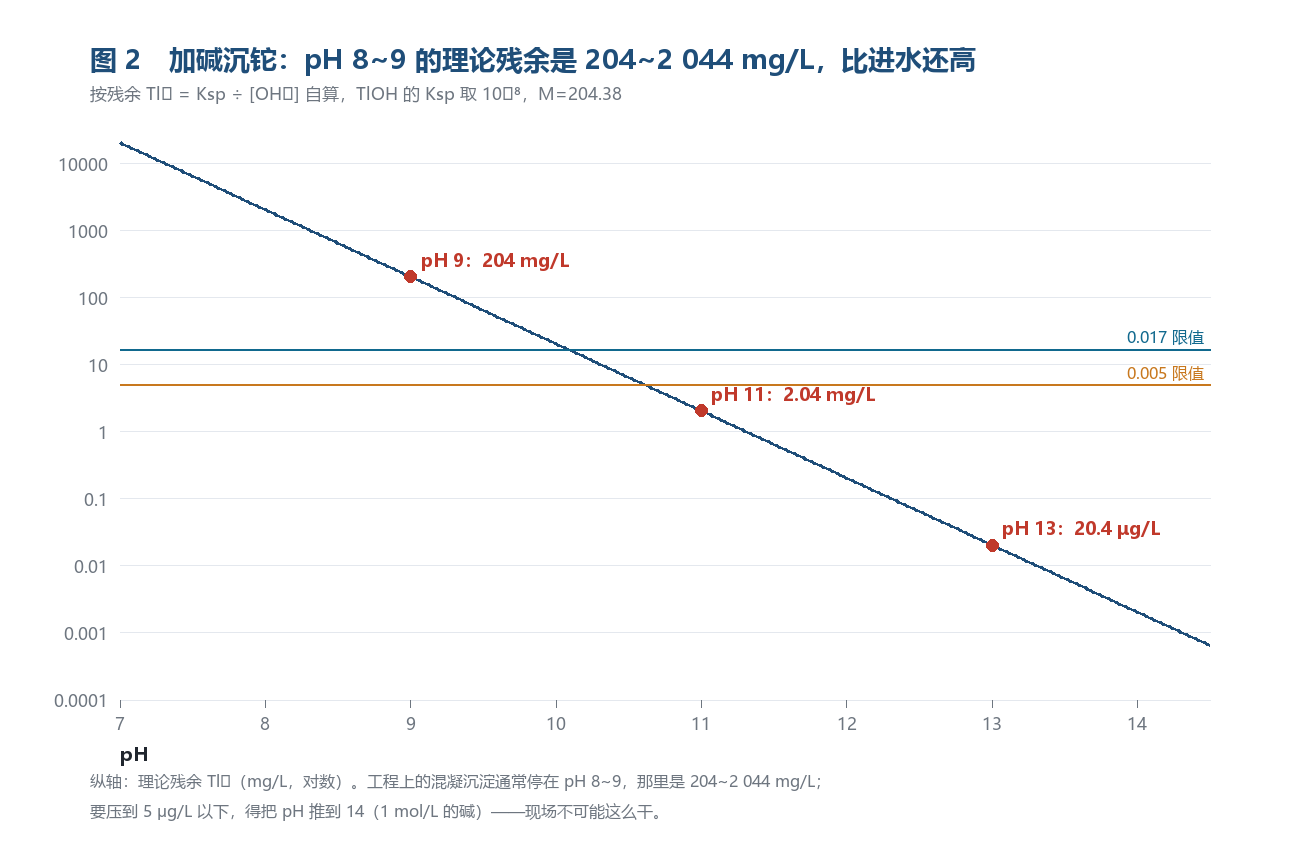
This table explains something commonly misunderstood: the claim that "adding lime, adding caustic soda, and adjusting pH to above 10 removes thallium" does not hold up chemically. At pH 10, the theoretical residual is 20.4 mg/L, four thousand times the limit; at the pH 8~9 commonly used in engineering, the theoretical residual is 204~2 044 mg/L, higher than the influent concentration of most thallium-containing wastewater. It is not that "the effect is poor"—this reaction simply cannot be driven forward.
So why is it that in the field we do indeed see "thallium drops after adding alkali"? Because the portion that drops out is not precipitated by OH⁻, but adsorbed by other solids—usually iron, aluminum, and manganese hydroxide colloids. This point is elaborated in Section 8.
VI. The 1.28 V hurdle: oxidation must come first
Thallium has two valences: monovalent and trivalent. The solubility product of the trivalent hydroxide Tl(OH)₃ is about 10⁻⁴⁵·², which is 37.2 orders of magnitude lower than that of monovalent TlOH. Back-calculating at pH 8, the residual concentration is 1.3×10⁻²² mg/L—this value is already below the detection limit of any instrument, and its physical meaning is "completely precipitated."
| Species / Compound | Ksp (published value) | Theoretical residual at pH 8 | Engineering implication |
|---|---|---|---|
| TlOH (monovalent) | approx. 10⁻⁸ | 2 044 mg/L | Alkali addition ineffective |
| Tl(OH)₃ (trivalent) | approx. 10⁻⁴⁵·² | 1.3×10⁻²² mg/L | Precipitates extremely cleanly after oxidation |
| Tl₂S (sulfidic) | 10⁻²⁵ ~ 10⁻⁵⁰ | — | Effective, but the precipitate is unstable |
Therefore, the first step in thallium removal is always oxidation: converting Tl⁺ to Tl³⁺. This step has a threshold—the standard redox potential of Tl(I)/Tl(III) is 1.28 V, which is a fairly high potential, and only relatively strong oxidants can drive it. This is precisely why the available reagents are limited to just a few: potassium permanganate, hypochlorite, hydrogen peroxide (with catalysis), ozone, and Persulfate.
After oxidation, precipitation should follow immediately; a pH of 8~9 is sufficient, because Tl(OH)₃ has already settled out completely within that range. Therefore, the typical process for thallium-containing wastewater is the three-step "oxidation—pH adjustment—coagulation and precipitation", rather than "pH adjustment—precipitation". If the order is reversed, it is as good as doing nothing at all.
VII. Four Oxidants, Four Sets of Measured Data
There is a batch of comparable experimental data in the public literature, with influent thallium concentrations ranging from 0.6 μg/L to 1.4 mg/L, spanning three orders of magnitude. Looking at them side by side reveals the applicable range of each chemical agent.
| Oxidant + Precipitant | Dosage | Influent μg/L | Effluent μg/L | Conditions |
|---|---|---|---|---|
| KMnO₄ + CaO | 4 g/L + 9.2 g/L | 1 406.5 | <0.1 | Oxidation at pH 2.7, precipitation at pH 8~9, 1 h |
| H₂O₂(30%) + CaO | 8.8 mL/L + 12.9 g/L | — | — | Removal rate 100%, 1 h |
| Ca(ClO)₂ + CaO | 7.4 g/L + 9.2 g/L | — | — | Removal rate 100%, 1 h |
| Persulfate (Fe²⁺/S₂O₈²⁻) | — | 451 | <5 | Fenton-like system |
| KMnO₄ oxidation + coagulation | — | 0.613 | <0.1 | Low-concentration advanced treatment |
| Bleaching powder + Polymeric Ferric Sulfate | — | 20 | <0.1 | Thallium- and arsenic-containing mine pit water, industrial test |
| H₂O₂ + Ferric Sulfate | — | 5 000 | Approx. 50 | Removal rate approx. 99%, lead-zinc smelting wastewater |
Two rows in this table deserve special attention.
The first line is "4 g/L Potassium Permanganate". For thallium at 1.4 mg/L, KMnO₄ must be dosed at 4 g/L—the reagent dose is ten thousand times the pollutant (a mass ratio of 2 857 times). This is not because the reagent is inefficient, but because potassium permanganate here does more than oxidize—it must also generate enough nascent MnO₂ for adsorption. Therefore, its dosage cannot be calculated by stoichiometry; it can only be calculated by "how much manganese sludge is generated".
The last line is "99% leaves 50 μg/L". With influent of 5 mg/L, a removal rate of 99%, the effluent still contains 50 μg/L, which is 10 times the 0.005 limit. This line is the one thing in the whole article most worth remembering—the next section is devoted to calculating this.
VIII. A Removal Rate of 99% Is Meaningless
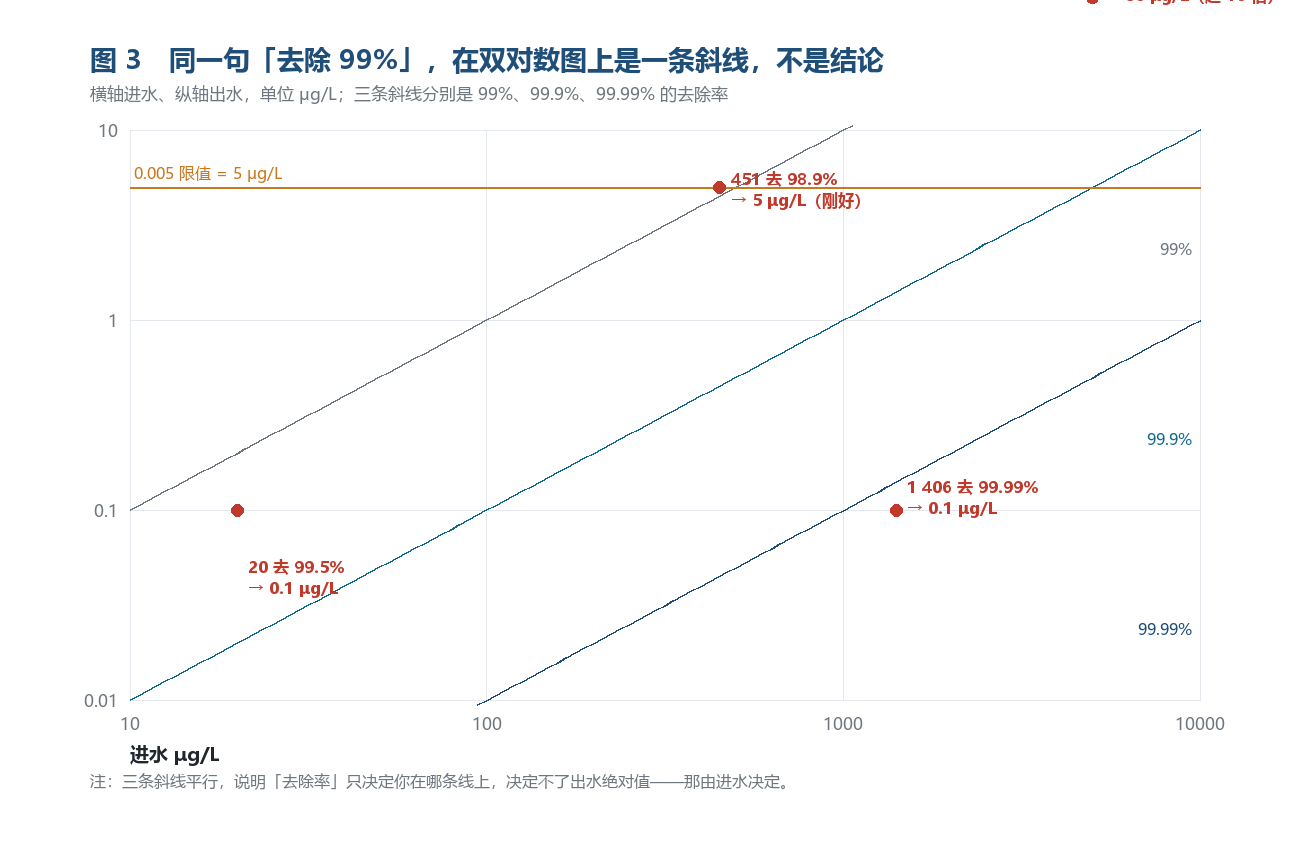
Thallium has one characteristic that differs from other pollutants: the limit is four orders of magnitude lower than typical influent. Water at 5 mg/L must be reduced to 5 μg/L, which is 1 000 times; to reduce it to 0.1 μg/L is 50 000 times. Under this order-of-magnitude relationship, the "removal rate" metric loses its resolving power.
| Influent μg/L | Removal Rate | Effluent μg/L | Relative to 0.005 Limit |
|---|---|---|---|
| 5 000 | 99% | 50 | 10 times |
| 5 000 | 99.9% | 5 | 1.0 times (just barely) |
| 5 000 | 99.99% | 0.5 | 0.1 times |
| 451 | 98.9% | 4.96 | 1.0 times (just barely) |
| 20 | 99.5% | 0.1 | 0.02 times |
IX. The Truth About Precipitation: What Settles Is Manganese, Not Thallium
Back to the question left in Section V: why did thallium "actually drop after adding alkali" on site?
Because what truly removes thallium from the water is not the reaction between OH⁻ and Tl⁺, but adsorption of Tl⁺ onto the surfaces of newly formed solids. The three most commonly used are: nascent MnO₂ (from reduction of potassium permanganate), Fe(OH)₃ (from iron salt coagulation), and aluminum hydroxide.
Among these, MnO₂ has the strongest adsorption for Tl⁺, and the reason is again that "potassium impersonation" — MnO₂ has interlayer potassium sites that Tl⁺ can enter. Public data: MnO₂ sludge 7 g/L, treating 350 mg/L thallium-containing water, 40 min removal 99.1%, corresponding to an adsorption capacity of about 50 mg/g. This capacity is not high, but because it simultaneously performs oxidation (Tl⁺ oxidized to Tl³⁺ is more readily adsorbed), it offers the best cost-effectiveness in engineering.
Conversely, this also explains why "iron salt alone" has limited effect: Fe(OH)₃ adsorption of Tl⁺ is electrostatic and surface complexation, lacking the "size matching" selectivity of K⁺ sites, so it is more suitable as an aid for solid-liquid separation after oxidation, rather than as the main force.
- Oxidation + manganese: the main route, capable of treating 1.4 mg/L to below 0.1 μg/L; the cost is a large volume of manganese sludge (4 g/L of KMnO₄ corresponds to about 2.4 g/L of MnO₂).
- Oxidation + iron: iron salts are cheap, but adsorption capacity is low; usually used only as a coagulation aid, or sufficient at low concentrations (20 μg/L level).
- Alkali only: as calculated in Section V, it cannot drive the removal.
X. Sulfidation: Cheap, but It Rebounds
Another main route is sulfidation precipitation: 2Tl⁺ + S²⁻ → Tl₂S↓. Its appeal lies in the extremely low solubility product (public values range from 10⁻²⁵ to 10⁻⁵⁰, an absurdly wide span, see next paragraph), and it is not limited by pH. Measured: Na₂S 11.4 mg/L with zero-valent iron 100 g/L, treating 300 μg/L thallium-containing water, 1 h removal rate 100%.
But sulfidation has a critical engineering problem: rebound. A gold smelting enterprise used sulfidation precipitation to bring thallium below 5 μg/L; after the precipitate was stored in the open for several days, the aqueous thallium concentration rose back to 15 μg/L — exceeding the 0.005 limit by 2 times. The reason is not hard to understand: Tl₂S particles are extremely fine with large specific surface area; upon exposure to air and light they slowly oxidize, sulfur is oxidized to sulfate, and thallium redissolves.
Therefore, the sulfidation route is almost never used alone in engineering; the common combination is "oxidation—sulfidation—coagulation": first use an oxidant to convert part of the thallium to trivalent (trivalent sulfide is more stable), then use sulfidation to convert residual monovalent thallium into Tl₂S, and finally use iron salts to flocculate the fine particles and dewater and transport them offsite as soon as possible. "Precipitated" does not equal "immobilized"; the storage conditions of thallium-containing sludge are also part of this route.
XI. The Money of 0.1 μg/L: Adsorption and Ion Exchange
If the effluent requirement is 0.1 μg/L (the level of drinking water sources), precipitation methods reach their limit, and adsorption or ion exchange must be used.
Several types of materials are available: modified activated carbon (loaded with iron and manganese, public adsorption capacity about 12 mg/g), manganese-based adsorbents, ferrocyanide types (Prussian blue analogues) — the principle of the latter is still that "potassium impersonation": its crystal lattice has K⁺ sites, and once Tl⁺ enters it is firmly framed, with extremely high selectivity. The same chemical property is an obstacle in precipitation (cannot be settled) and an advantage in adsorption (accurately selected).
Ion exchange, on the other hand, uses a strong-acid cation resin, R–SO₃⁻H⁺ + Tl⁺ → R–SO₃⁻Tl⁺ + H⁺. It has good selectivity for Tl⁺, but is vulnerable to two things: first, high concentrations of Ca²⁺, Mg²⁺, and Na⁺ will compete for occupancy (the hardness of mine water is usually not low), and second, suspended solids in the influent will foul and plug the resin. Therefore, it is generally placed at the end of the process, and qualified pretreatment must precede it.
The common feature of these three types of advanced treatment is: they treat water that has "already been reduced to the μg/L level". If they are placed at the front of the process to treat water at the mg/L level, the regeneration frequency and replacement costs will spiral out of control. The reasonable division of labor is—the precipitation stage is responsible for removing three of the four orders of magnitude, and the adsorption stage is responsible for the last one.
Twelve, Chloride Ions: Another Path at 25 000 mg/L
There is a type of water that distorts all of the above processes: high-chloride thallium-containing wastewater. Typical examples are waste acid from coking and coal gasification systems, as well as some smelting acidic water, where chloride ions can reach 25 000 mg/L.
In this water, thallium no longer exists only as Tl⁺; a considerable portion exists as chloro-complex anions such as TlCl₄⁻. This has two consequences: first, the anionic form cannot be captured by cation resins or cationic adsorbents; second, the ORP control in the oxidation stage becomes sensitive—the approach of a certain coking project was to adjust the pH to 5.0~6.0, dose KMnO₄ at 80 mg/L, and control the ORP at 600~650 mV, with an explicit note to "avoid over-oxidation"; decomplexation relied on dosing a copper salt (copper sulfate, at 10% of the chloride ion concentration) to displace the thallium from TlCl₄⁻.
This case has another layer of significance: it implements the Shanxi Province local standard "Emission Standard of Pollutants for the Coking Chemical Industry" (DB14/1928—2024), with a thallium limit of 1 μg/L—5 times stricter than the national standard's 0.005 mg/L. Local standards can be stricter than national standards, which is the norm for indicators such as thallium. When preparing a proposal, you must first check whether the project location has a local standard; otherwise, a system designed according to the national standard will not match at acceptance.
Thirteen, Process Route Comparison and Key Parameters
| Route | Applicable Influent | Key Control | Achievable Effluent | Main Constraints |
|---|---|---|---|---|
| Oxidation + Manganese (KMnO₄/CaO) | 0.1~1.5 mg/L | Oxidize first at pH 2.7, then precipitate at pH 8~9; KMnO₄ dosed based on manganese sludge generation | <0.1 μg/L | Large manganese sludge volume; residual manganese requires treatment |
| Oxidation + Iron (bleaching powder/PFS) | 10~50 μg/L | Sufficient oxidant dosage; PFS as coagulation aid | <0.1 μg/L | Insufficient capacity at high concentrations |
| Sulfidation (Na₂S + Iron) | 0.1~1 mg/L | pH around 5; no excess S²⁻; sludge must be dewatered promptly | <5 μg/L | Rebound during storage; H₂S risk |
| Adsorption / Ion Exchange | <50 μg/L | Pre-removal of turbidity; watch Ca²⁺ and Na⁺ competition | 0.1 μg/L level | Regeneration and replacement costs |
| Parameter | Value / Basis | Remarks |
|---|---|---|
| Total thallium limit (general) | 0.017 mg/L | At workshop or production facility wastewater discharge outlet |
| Total thallium limit (mining/mineral processing separate discharge) | 0.005 mg/L | Table note 1 |
| Exceedance 3 times line | 0.020 / 0.068 mg/L | Based on 0.005 / 0.017 |
| Drinking water source limit | 0.1 μg/L | GB 3838 Table 2 specific items |
| TlOH solubility product | approx. 10⁻⁸ | Theoretical residual 204 mg/L at pH 9 |
| Tl(OH)₃ solubility product | approx. 10⁻⁴⁵·² | Residual 10⁻²² mg/L level at pH 8 |
| Tl(I)/Tl(III) potential | 1.28 V | Requires strong oxidant |
| Tl⁺ / K⁺ radius | 150 pm / 138 pm | Six-coordinate, difference 9% |
| MnO₂ adsorption capacity | approx. 50 mg/g | 7 g/L sludge, 40 min |
| Modified activated carbon capacity | approx. 12 mg/g | Iron-manganese loaded |
| Monitoring method | HJ 700 / HJ 748 | Graphite furnace method not applicable when chloride >1.2 g/L |
Five most common misjudgments:
- Treating "0.005" as an industry-wide limit. It is the number in parentheses and applies only to standalone discharge from mining or ore-dressing units; mixed discharge is subject to 0.017. The two differ by a factor of 3.4, and a single 0.0173 leads to opposite conclusions under the two bases.
- Treating "exceeding the standard by 3 times" as "3 times the standard." Exceedance multiple = (measured − standard)/standard, so the 3-times line is 4 times the standard. Calculated as 0.005, it is 0.020, not 0.015.
- Using removal rate to evaluate a thallium removal process. The limit is four orders of magnitude lower than the influent, so "99%" carries almost no information for this indicator; if you must write it, give the absolute effluent value.
- Assuming adding alkali can precipitate thallium. The Ksp of TlOH is 10⁻⁸, and the theoretical residual at pH 10 is 20.4 mg/L. The removal observed on site is adsorption by manganese or iron hydroxides.
- Assuming once precipitated, it stays stable. When thallium sulfide sludge is stored in the open for several days, aqueous thallium rises from <5 μg/L back to 15 μg/L. Precipitation, dewatering, packaging, and storage form a complete set; missing any one link causes rebound.
Finally, back to that case. The number 0.0173 deserves a whole article because it sits on four lines at once: two limits, one criminal line, and one drinking water line. And where it falls depends on three things—what the discharge outlet is called, whether the item in parentheses applies, and which denominator you use when calculating the exceedance multiple. None of these three things can be answered by the laboratory.
References
- Amendment Sheet to the Emission Standard of Pollutants for Lead and Zinc Industry (GB 25466—2010), Ministry of Ecology and Environment, issued on 2020 年 12 月 21 日: Tables 2 and 3 add total thallium 0.017 (0.005) mg/L, with the monitoring location "wastewater discharge outlet of the workshop or production facility"; Table Note 1 limits 0.005 to "the case where wastewater from the mining or ore dressing production unit is discharged separately"; Table Note 2 defines the specific location of the workshop outlet.
- Amendment Sheet (Draft for Comments) to the Emission Standard of Pollutants for Lead and Zinc Industry (GB 25466—2010), 2018 年 9 月: the total thallium limit in Tables 2 and 3 is a single value of 0.005 mg/L, with no tiering; existing enterprises shall comply from 2019 年 9 月 1 日.
- Chinese Academy of Environmental Planning, Ministry of Ecology and Environment: Release of 3 Amendment Sheets to Pollutant Emission Standards for National Key Industries Led by Our Academy, 2020-12-30: three amendment sheets, GB 25466, GB 30770 (tin, antimony and mercury industry) and GB 13456 (iron and steel industry), were released in the same batch, all adding total thallium control requirements.
- Hechi Municipal Ecology and Environment Bureau: Administrative Penalty Decision (He Huan (Huan) Fa [2025] No. 9), 2025-09-18: total thallium at the main wastewater outlet of the mine water treatment station was 0.0173 mg/L, judged to exceed the standard by 2.46 times according to 0.005 mg/L, with a fine of 15.85 万 yuan.
- Interpretation of the Supreme People's Court and the Supreme People's Procuratorate on Several Issues Concerning the Application of Law in the Handling of Criminal Cases of Environmental Pollution (Fa Shi [2016] No. 29): discharge of pollutants containing lead, mercury, cadmium, chromium, arsenic, thallium or antimony exceeding the standard by three times or more is determined as "seriously polluting the environment".
- GB 3838—2002 Environmental Quality Standards for Surface Water, Table 2, Specific Items for Centralized Drinking Water Surface Water Sources: thallium 0.0001 mg/L.
- Thallium-Containing Wastewater Treatment Technology in the Nonferrous Metals Industry and Its Industrial Application, Environmental Engineering-type journal (DOI 10.11792/hj20230218): reviews engineering data of oxidation-precipitation, sulfide precipitation and biological agent methods, including KMnO₄ 0.613→<0.1 μg/L, bleaching powder + PFS 20→<0.1 μg/L, persulfate 451→<5 μg/L, H₂O₂ + ferric sulfate 5 mg/L with removal rate 99%, and sulfide precipitation <5 μg/L but rebounding to 15 μg/L after storage.
- Liu et al.: Thallium pollution in China and removal technologies for waters: A review (summary in Table 9): KMnO₄+CaO 4 g/L+9.2 g/L, 1 406.5 μg/L→100%; H₂O₂+CaO and Ca(ClO)₂+CaO removal rate 100%; Na₂S+Fe⁰ 300 μg/L→100%; Fe⁰+H₂O₂ 500 mg/L→96%; MnO₂ sludge 7 g/L, 350 mg/L→99.1% (40 min).
- Reaction Principles and Application Scenarios of Thallium Removal Reagents (industry technical material): TlOH Ksp≈10⁻⁸, Tl(OH)₃ Ksp≈10⁻⁴⁵, Tl₂S Ksp≈10⁻²⁵.
- Typical Case of Thallium Removal from Waste Acid in the Coal Chemical Industry: Advanced Treatment of Thallium-Containing Wastewater at a Coking Plant in Shanxi: influent thallium 100~150 μg/L (Tl⁺ accounting for 85%), Cl⁻ 25 000 mg/L, pH 8.0~9.5; KMnO₄ 80 mg/L, ORP 600~650 mV, pH 5.0~6.0 for complex breaking; implementation of DB14/1928—2024 thallium ≤1 μg/L. (The Tl₂S Ksp=6.3×10⁻⁵⁰ given in this article differs from that in item 9 by 25 orders of magnitude, and has been marked as questionable in the main text.)
- Advanced Purification Treatment Method for Thallium-Containing Metal Mine Wastewater (patent technical material): multi-component synergistic oxidation-adsorption (KMnO₄+NaClO+O₃) + composite sulfide precipitation + staged flocculation + activated carbon adsorption, removal rate >96%, effluent <0.1 μg/L; oxidation pH 6~9, sulfidation pH 8~9, residence time of each stage 60~90 / 30~90 / 20~60 min.
- Notification: Thallium Exceeding Standard in Drinking Water in Yichun, Jiangxi: coagulation and sedimentation after potassium permanganate pre-oxidation can reduce thallium to below 0.1 μg/L; potassium ferrate pre-oxidation + PAC removal rate nearly 98%; sodium sulfide + lime treatment of surface water removal rate up to 85%, effluent 0.077 μg/L; minimum lethal dose for adults 12 mg/kg body weight.
- CN114634888A A Thallium-Oxidizing Bacterium, Microbial Agent and Its Application: standard redox potential of Tl(I)/Tl(III) 1.28 V; Ksp of Tl(III) hydroxide = 10⁻⁴⁵·², strong hydrolysis occurs at pH>1; Tl(I) is difficult to recognize by biomolecules because its ionic radius is similar to that of K⁺.
- Thallium (encyclopedia entry, citing China Geological Survey data): Tl⁺=0.170 nm, K⁺=0.161 nm, Rb⁺=0.172 nm; thallium often replaces K⁺ in potassium feldspar and mica through isomorphism; China's identified thallium resource reserves are 11 818 t; thallium in world coal ash is about 64 万 t.
- HJ 700—2014 Water Quality — Determination of 65 Elements — Inductively Coupled Plasma Mass Spectrometry, HJ 748—2015 Water Quality — Determination of Thallium — Graphite Furnace Atomic Absorption Spectrophotometry (the latter is not applicable when the chloride ion concentration is greater than 1.2 g/L).
