



 Multi-industry nationwide coverage (boiler make-up water, circulating cooling wa
 Pilot to municipal scale (5,000 to 30,000 m³/d groundwater plants; industrial so
Hardness: The Same 0.03 mmol/L, the National Standard General Rule Gives 1.5 mg/L, While the Instrument Conversion Table Gives 3 mg/L
A water softening report says "0.02 mmol/L, compliant." What that number actually is in mg/L depends on which conversion table you consult—and the two tables differ by a full factor of two. More important is another question: why does lime softening almost always stop at around 1 mmol/L. It is not because calcium carbonate cannot settle out, but because the extra lime dosed to push the reaction to completion itself brings calcium in.
Hardness is one of the few conventional indicators in water treatment for which even the units have not yet been unified. mmol/L, mg/L (as CaCO₃), mg/L (as CaO), German degrees, French degrees, British degrees, ppm, and milligram equivalents—eight notations circulate simultaneously in today's reports, tender documents, and equipment manuals. And their conversion factors come in two sets that differ from each other by a factor of two. This article first explains clearly where that factor-of-two difference lies, then follows that thread to calculate, in four accounts, the long-vague matter of "how far softening can go."
I. First, three real reports: the same process differs by a factor of two
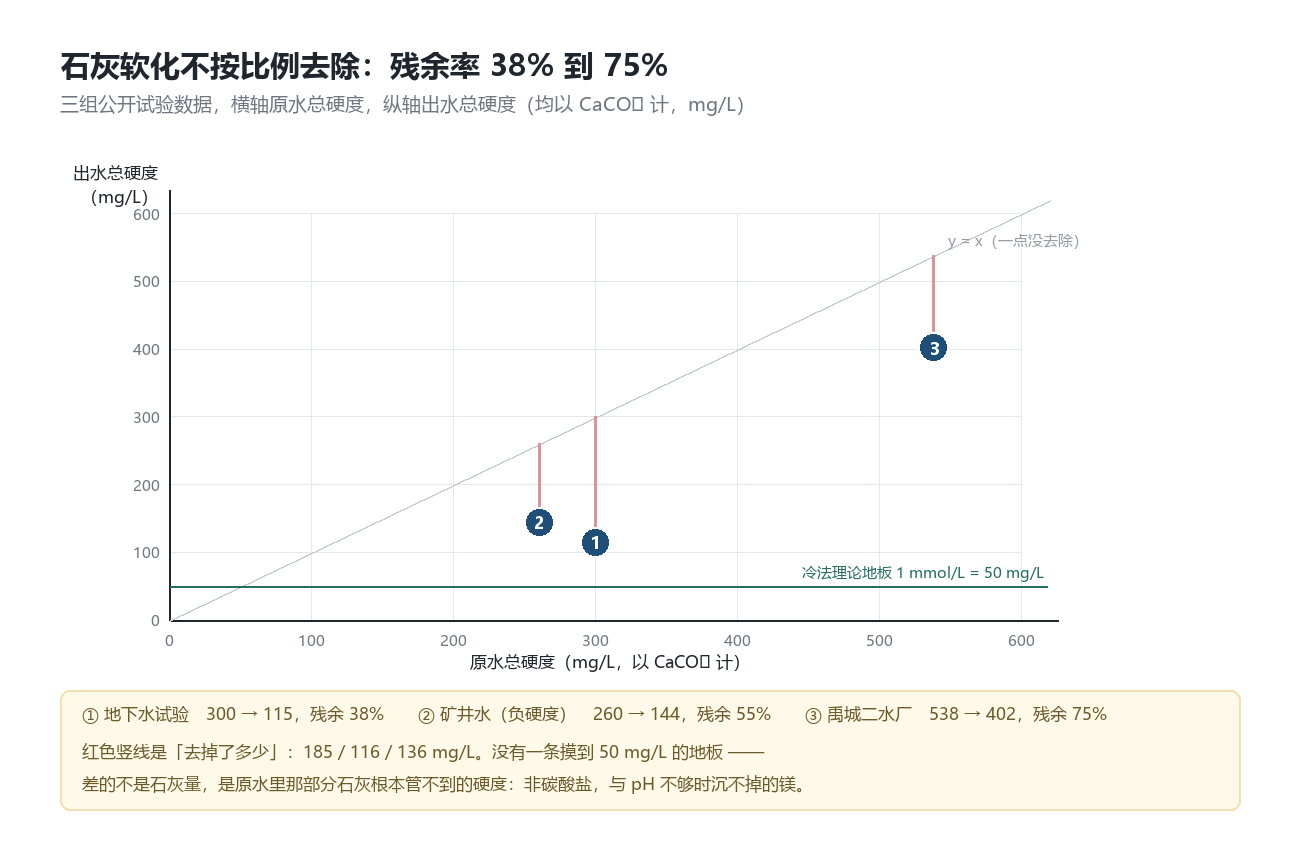
Three publicly available sets of lime softening test data, all for the same process—lime dosing, coagulation, sedimentation, filtration:
- A groundwater source in the north (《Water & Wastewater Engineering》): total hardness 300 mg/L, alkalinity 250 mg/L, lime dose 220 mg/L, pH 8.7–8.9, effluent total hardness 115 mg/L, alkalinity reduced to below 80 mg/L, removal rate 61.7%, chemical consumption about 0.246 元/m³.
- Mine water from Xinzhuanzi Coal Mine, Huainan, Anhui: total hardness 260 mg/L, lime dose 150 mg/L, effluent 144 mg/L, removal rate 44.6%, chemical consumption about 0.214 元/m³, and the effluent no longer forms precipitate after boiling.
- Shandong Yucheng City Second Water Plant (3.0 万 m³/d): raw water total hardness 494–582 mg/L, pH 7.27–7.61, lime slurry dose 140 mg/L, effluent 402 mg/L; carbonate hardness in the raw water accounted for more than 90%, so no soda ash was dosed.
The three influent values range from 260 to 538, and the effluent values from 115 to 402. Converted to "residual rate," they are 38%, 55%, and 75%. With the same set of chemical reactions, why do the results differ by a factor of two? Both explanations hold, and both relate to the two themes of this article: first, what unit basis each of these three data sets is written on; second, how much of the hardness in the raw water lime simply cannot address.
II. The definition of hardness is really a question of "what is the basic unit"
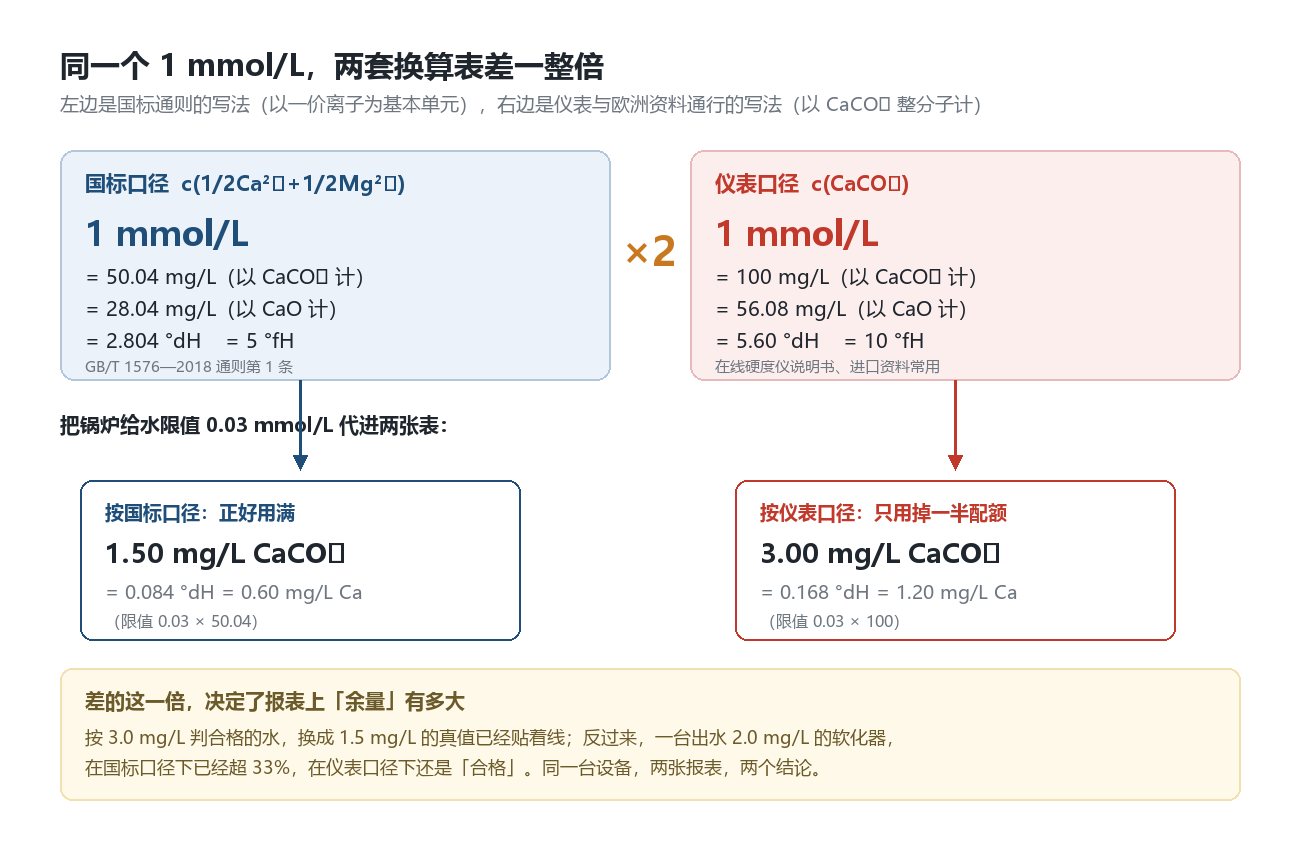
Hardness refers to the total amount of calcium and magnesium ions in water; there is no dispute on that point. The dispute is over how to count the "total amount." Calcium is divalent: one calcium ion occupies two charge positions. If you count by "number of calcium ions," 1 mmol of calcium is 1 mmol of hardness; if you count by "charge equivalent," 1 mmol of calcium is 2 mmol of hardness. These two counting methods give numbers that differ by a factor of two, and both are in use.
The national standard chose the latter. The first general rule of GB/T 1576—2018 "Water Quality for Industrial Boilers" states explicitly: the units of hardness and alkalinity are both based on monovalent ions as the basic unit, i.e., c(1/2Ca²⁺ + 1/2Mg²⁺). This sentence pins the basic unit firmly to "monovalent," that is, charge equivalent.
Why choose charge equivalent? Because it lets hardness speak directly to ion exchange resin. The working exchange capacity of resin is rated in equivalents (001×7 cation resin total exchange capacity 2.0 mol/L wet resin, engineering value 800–900 mol/m³). With water hardness rated in equivalents, dividing one by the other gives the water production:
If one side uses whole molecules and the other uses equivalents, the water production calculated by this division will be off by a factor of two—not a misplaced decimal point, but the water volume of an entire cycle. Such errors are not rare in small softening stations, because they do not trigger an alarm; they only cause the effluent to break through early.
| Basic Unit | 1 mmol/L equals | 0.03 mmol/L equals | Who Uses It |
|---|---|---|---|
| c(1/2Ca²⁺+1/2Mg²⁺) (monovalent ions, charge equivalents) | 50.04 mg/L (as CaCO₃) 28.04 mg/L (as CaO) 20.04 mg/L (as Ca) | 1.50 mg/L (CaCO₃) 0.84 mg/L (CaO) 0.60 mg/L (Ca) | GB/T 1576 general rules; boiler water quality records; resin capacity calculation |
| c(CaCO₃) (whole CaCO₃ molecule) | 100 mg/L (as CaCO₃) 56.08 mg/L (as CaO) | 3.00 mg/L (CaCO₃) 1.68 mg/L (CaO) | Manuals of most online hardness analyzers; European literature; nameplates of some imported equipment |
| German degree °dH | 1 °dH = 10 mg/L CaO = 17.85 mg/L CaCO₃ = 0.357 mmol/L (monovalent basis) | 1.50 mg/L CaCO₃ = 0.084 °dH | Old imported boilers, legacy water treatment manuals |
| French degree °fH / English degree °eH | 1 mmol/L = 5 °fH = 3.50 °eH | 0.15 °fH = 0.105 °eH | European equipment, textile and laundry industries |
III. Two Conversion Tables: The Difference Lies in That Denominator
Put the first two rows of Table 1 side by side: both are 1 mmol/L, one row is 50.04 mg/L, the other is 100 mg/L. This factor-of-two difference is not a calculation error by anyone; it is because the "mmol" in each person's mouth does not refer to the same thing—one refers to "1/2 of calcium carbonate," the other refers to "one whole calcium carbonate." The difference between molar mass 50 and 100 all comes from this.
The German degree row is even more typical. By definition, 1 °dH is 10 mg/L of CaO, and there is no disagreement on this worldwide; 10 mg CaO converted to calcium carbonate is 17.85 mg, and converted to equivalents is 0.357 mmol (monovalent basis). So the correct conversion is 1 °dH = 0.357 mmol/L. But a large amount of instrument documentation states 1 °dH = 0.178 mmol/L—that is the result of treating mmol as whole calcium carbonate molecules, which is exactly half as small. For the same conversion, two manuals give two mutually reciprocal coefficients, and in the field either one can be used to justify itself.
| Expression | Value | Conversion basis |
|---|---|---|
| mmol/L (monovalent basis) | 0.030 | GB/T 1576, General Rules, Clause 1 |
| mg/L (as CaCO₃) | 1.50 | 0.030 × 50.04 |
| mg/L (as CaO) | 0.84 | 0.030 × 28.04 |
| German degrees °dH | 0.084 | 0.030 × 2.804 |
| mg/L (as CaCO₃, integral-molecule basis) | 3.00 | 0.030 × 100 |
| German degrees °dH (integral-molecule basis) | 0.168 | 0.030 × 5.60 |
IV. Where the 0.03 figure comes from: the bill for scaling
Hardness is controlled to the order of 0.03 because its downstream is the heat transfer surface. The thermal conductivity of scale is only about 1/50 that of carbon steel; a scale layer 1 mm thick can reduce heat exchange efficiency by more than 10%, and on the boiler side this directly corresponds to increased fuel consumption and tube wall overheating. A common statement for industrial boilers is that scaling of 1 mm causes a heat efficiency drop of about 5%, and at 3 mm the drop can reach 8%~15%.
GB/T 1576—2018 divides the feedwater hardness of industrial boilers into several grades, with large differences between grades:
| Location and Conditions | Hardness Limit (mmol/L) | Converted to mg/L (CaCO₃, monovalent basis) | Processes Capable of Compliance |
|---|---|---|---|
| Feedwater for steam boilers with external chemical treatment | ≤0.03 | ≤1.5 | Sodium ion exchange; RO; NF depending on raw water |
| 2.5~3.8 MPa boilers, demineralized water makeup | ≤0.005 | ≤0.25 | RO + mixed bed; softening alone cannot achieve this |
| Steam boiler return water | ≤0.06 | ≤3.0 | Softening or return water treatment |
| Makeup water for hot water boilers with external treatment | ≤0.6 | ≤30 | Lime softening is sufficient |
| Hot water boilers with in-boiler water treatment | ≤6 | ≤300 | Raw water without softening (with in-boiler chemical dosing) |
From 0.005 to 6, the same table spans three orders of magnitude. This span reveals one thing: the hardness limit is not a property of the water, but a property of "how much this equipment can tolerate." The 0.005 tier is stringent down to 0.25 mg/L because the heat transfer surfaces of high-pressure boilers carry high heat loads, and once scale forms, localized overheating occurs; the 6 tier can be relaxed to 300 mg/L because atmospheric hot water boilers are backed by in-boiler chemical dosing and regular blowdown. When you see a limit, ask about the equipment first, not the water quality.
V. Softening Is Not a Single Process, but Four Routes
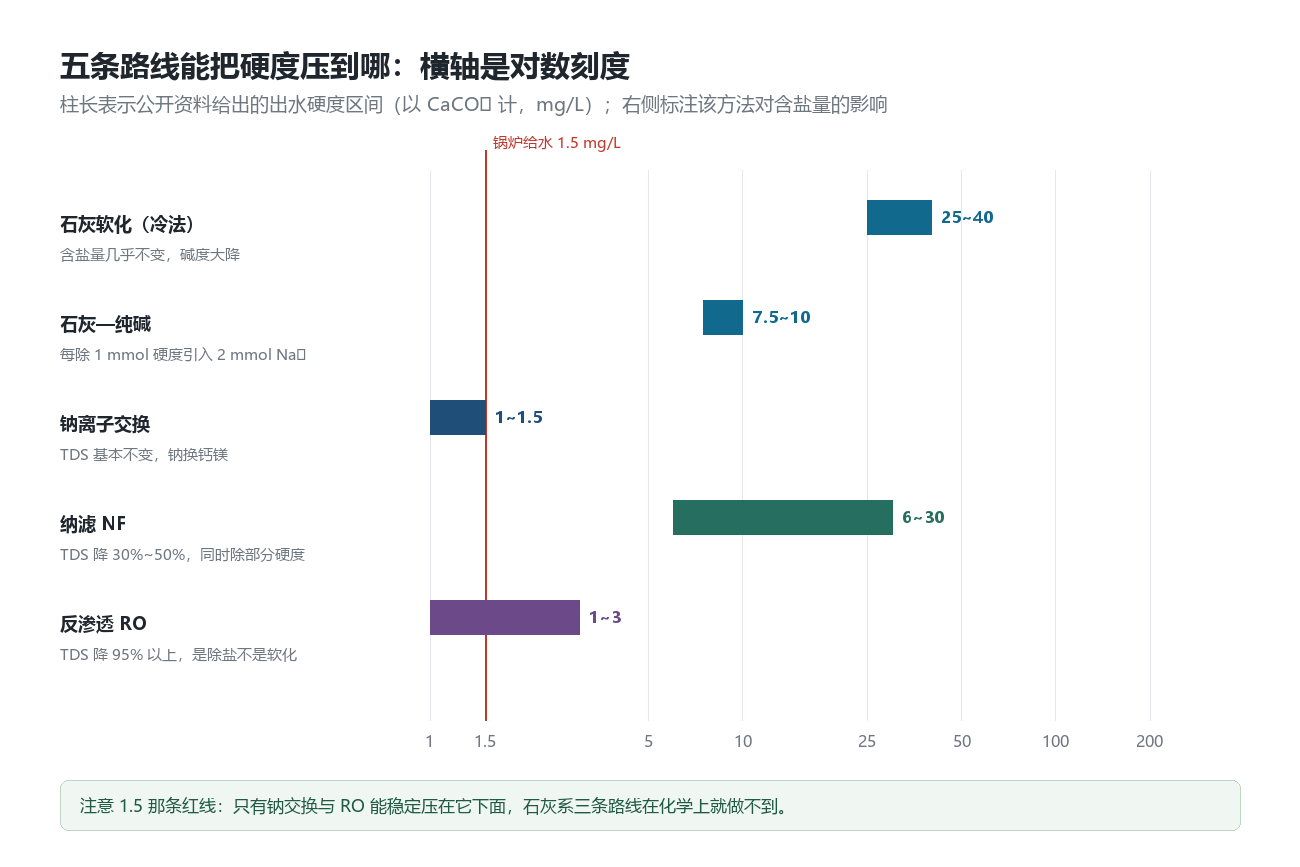
The term "softening" in engineering refers to four completely different types of actions: converting calcium and magnesium into precipitates (lime, lime-soda ash), exchanging calcium and magnesium for sodium (ion exchange), keeping calcium and magnesium outside the membrane (NF, RO), and adding scale inhibitors to prevent crystallization (strictly speaking, this is not softening but scale prevention). The chemical ceilings of these four types of actions are completely different.
| Route | Effluent hardness (mg/L, CaCO₃) | Target of removal | Change in salinity | Main cost |
|---|---|---|---|---|
| Lime softening (cold process) | 25~40 (0.5~0.8 mmol/L) | Carbonate hardness (mainly calcium) | Slight decrease (alkalinity drops substantially) | Large sludge volume; high effluent pH requires adjustment |
| Lime softening (hot process, approx. 100 ℃) | 5~10 (0.1~0.2 mmol/L) | Carbonate hardness, including part of magnesium | Same as above | Requires heating, high energy consumption |
| Lime–soda ash | 7.5~10 (0.15~0.2 mmol/L) | Carbonate + non-carbonate hardness | Sodium ions increase | Soda ash is expensive; each 1 mmol of hardness removed introduces 2 mmol Na⁺ |
| Sodium ion exchange | 0.5~1.5 (0.01~0.03 mmol/L) | All hardness (equivalent exchange) | Basically unchanged, sodium replaces calcium and magnesium | Salt consumption rises linearly with influent hardness; resin requires regeneration |
| NF / RO | 0.5~30 (depending on raw water and recovery rate) | Hardness + most other ions | Substantial decrease (RO reduces by more than 95%) | Capital investment and power consumption; concentrate disposal |
VI. Dosage of Lime Softening: The Z1 in the Formula Is the Primary Variable
The publicly available version of the lime softening dosage formula is as follows (all concentrations expressed on a monovalent basis):
28 is the molar mass of 1/2CaO (g/mol), M total is total alkalinity, H_Mg is magnesium hardness, B is lime excess (generally 0.2~0.4 mmol/L), and Z₁ is the effective purity of industrial lime. The corresponding soda ash formula is [Na₂CO₃] = 53 / Z₂ × ( H permanent + B ), where 53 is the molar mass of 1/2Na₂CO₃, and B is taken as 1.0~1.4 mmol/L.
The term most easily dropped from this formula is not B, but Z₁. Because 28 corresponds to "1/2 of CaO," every concentration in the formula must also be on a "1/2 basis." If someone substitutes hardness calculated on a whole-molecule basis, the dosage immediately differs by a factor of two—this is the real accident mode caused by the second conversion table: not a reporting error, but a wrong stroke setting on the dosing pump.
Then there is Z₁ itself. The effective CaO content of industrial quicklime is often 60%~75%, slightly higher for hydrated lime; lime milk must also account for solubility and settling. The Yucheng data set mentioned earlier can be used to back-calculate purity: lime milk dosed at 140 mg/L, if all calculated as Ca(OH)₂, according to the stoichiometry of Ca(OH)₂ + Ca(HCO₃)₂ → 2CaCO₃ + 2H₂O, 140 mg Ca(OH)₂ (74 g/mol) is 1.89 mmol, and the theoretical upper limit can remove 1.89 mmol of calcium hardness, equivalent to 189 mg/L (as CaCO₃). The measured removal was 538 − 402 = 136 mg/L. 136 ÷ 189 = 72%. This 72% is a very typical composite value of "effective content × reaction completion."
VII. Why Lime Softening Stops at 1 mmol/L: Four Accounts, Only One Is Chemical
Everyone on site says "lime softening can only reach 0.5~0.8 mmol/L," but few ask one level deeper: who set this ceiling. Breaking effluent hardness into four components reveals the answer.
| Additive Term | Determined By | Magnitude | Can It Be Changed by Operation |
|---|---|---|---|
| ① Non-carbonate hardness | Raw water (total hardness − alkalinity) | 0~several hundred mg/L | No, only by adding soda ash or changing the process |
| ② Unprecipitated magnesium hardness | Effluent pH (requires >10.8) | Tens of mg/L | Yes, but pH must be raised and the effluent pH readjusted |
| ③ Residual from calcium carbonate dissolution equilibrium | Solubility product + effluent alkalinity + pH | Approx. 1 mg/L | Almost impossible |
| ④ Calcium introduced by excess lime | Excess B (0.2~0.4 mmol/L) | 10~20 mg/L | Yes, but lowering B reduces the driving force |
Calculating term ③: taking the calcium carbonate solubility product as 3.3×10⁻⁹~4.8×10⁻⁹ (25 ℃), the effluent alkalinity as 1 mmol/L (monovalent basis), and pH 10.3 (at which carbonate accounts for about half of the total carbonate, i.e., 0.5 mmol/L = 5×10⁻⁴ mol/L), the equilibrium calcium concentration = 4.8×10⁻⁹ ÷ 5×10⁻⁴ ≈ 9.6×10⁻⁶ mol/L ≈ 0.96 mg/L (calculated as CaCO₃). That is to say, if constrained only by the solubility product, the effluent hardness could be brought below 1 mg/L.
Item ④ calculated once: excess lime B = 0.25 mmol/L (monovalent basis), meaning 0.25 mmol/L of extra calcium was dosed into the water, equivalent to 12.5 mg/L (as CaCO₃); when B = 0.4, it is 20 mg/L.
This also explains why the three sets of measured data cannot reach the floor line of 50 mg/L. In Case 1, total hardness 300, alkalinity 250, the non-carbonate hardness is 50 mg/L (as CaCO₃); this single item alone accounts for 43% of the effluent 115, and lime cannot control this item at all—only soda ash can. The remaining 65 mg/L is the sum of unsettled magnesium and equilibrium residual, not separately listed in the original text [to be supplemented]. Case 3, the Yucheng Water Plant, is even more direct: raw water hardness 494~582 while carbonate hardness accounts for only 90%; that 10% of non-carbonate hardness remains unchanged in the effluent, and in the 402 mg/L effluent it is the main player.
VIII. Magnesium requires pH 10.8: a second-order reaction versus a first-order reaction
The precipitation of calcium and magnesium has completely different sensitivity to pH. The residual of calcium carbonate depends on the carbonate concentration: the proportion of carbonate in total carbonate is exactly half at pH = pKa₂ = 10.33, approaches 100% upward, and decays by about 10 times per pH unit downward. Magnesium hydroxide is another matter, Ksp = [Mg²⁺][OH⁻]², [OH⁻] is a squared term, and for every 1 increase in pH, the magnesium residual drops by 100 times.
| pH | [OH⁻] (mol/L) | Magnesium Residual (mmol/L) | Converted to mg/L (CaCO₃) | Calcium Residual (at alkalinity 1 mmol/L, mg/L) |
|---|---|---|---|---|
| 9.5 | 3.16×10⁻⁵ | 5.61 | 561 | 3.7 |
| 10.0 | 1.00×10⁻⁴ | 0.561 | 56 | 1.5 |
| 10.3 | 2.00×10⁻⁴ | 0.141 | 14 | 1.0 |
| 10.8 | 6.31×10⁻⁴ | 0.0141 | 1.4 | 0.64 |
| 11.0 | 1.00×10⁻³ | 0.0056 | 0.56 | 0.58 |
Two columns in the table need to be compared side by side. In the calcium column, as pH rises from 9.5 to 10.3, the residual drops from 3.7 to 1.0 mg/L, a decrease of only 3.7 times; raising it further from 10.3 to 11.0 only brings it down from 1.0 to 0.58, a decrease of just 1.7 times. The reason is that the carbonate fraction becomes saturated—beyond 10.33, the alkalinity added by further alkali dosing can no longer be converted into carbonate. The magnesium column behaves quite differently: from 9.5 to 10.8, it falls from 561 to 1.4, a full 400 times.
9. Lime–Soda Ash: for every 1 mmol of hardness removed, 2 mmol of sodium is added
Non-carbonate hardness (sulfates and chlorides of calcium and magnesium) is immune to lime and can only be removed by precipitating calcium as calcium carbonate with soda ash: CaSO₄ + Na₂CO₃ → CaCO₃↓ + Na₂SO₄. The accounting for this step is very clean:
Note that the 23 mg/L on the right side is sodium, not salt. The 20 mg/L of calcium originally in the water is precipitated out, exchanged for 23 mg/L of sodium, and the net increase in total dissolved solids is only about 3 mg/L. Therefore, "lime–soda ash softening" hardly increases the salt content—this is its advantage; but it changes the ionic composition of the water to the sodium salt type, with alkalinity unchanged and hardness greatly reduced. This is good for boilers (no scaling), but not necessarily for downstream RO—the osmotic pressure of sodium salts is almost the same as that of calcium salts, and the desalination load on RO is not reduced at all.
10. Sodium Exchange: the theoretical value of 1.17 kg and the actual value of 82.5 kg
Sodium ion exchange is equivalent exchange, and the accounting is the clearest. Theoretical salt consumption: 1 equivalents of hardness (corresponding to 50 g CaCO₃) requires 58.5 g pure NaCl, equivalent to "removing 1 kg calcium carbonate hardness consumes 1.17 kg salt." This figure is very stable in textbooks.
Actual salt consumption is 2.0~3.5 times the theoretical value. The reason is regeneration efficiency: the resin cannot be 100% regenerated, and engineering practice controls it by "specific salt consumption"—fixed bed 1.2~1.5, moving bed 1.5~2.0. Plugging these two coefficients in and calculating:
How much softened water this 82.6 kg of salt can produce depends on the influent hardness: when influent is 3 mmol/L (monovalent basis), production is 800 ÷ 3 = 267 m³, equivalent to 310 g salt/m³; when influent is 6 mmol/L, production is 133 m³, equivalent to 620 g salt/m³. At industrial salt 600 元/t, that is 0.19 元/m³ and 0.37 元/m³—exactly double.
This property of "salt consumption being proportional to influent hardness" determines the boundary for process selection: for plants with high hardness and large water volume, first use lime to halve the hardness and then apply sodium exchange (two-stage softening), and salt consumption immediately drops by half; for plants with low hardness and small water volume, direct sodium exchange is simpler. Lime is cheap and salt is expensive; this price difference is the entire reason for two-stage softening.
11. Circulating Cooling Water: 1100 is a "sum," not two "individual" limits
In GB/T 50050—2017 "Code for Design of Industrial Circulating Cooling Water Treatment," Table 3.1.7 contains an item written in a very particular way: calcium hardness + total alkalinity (as CaCO₃) ≤ 1100 mg/L. The same table also separately limits calcium hardness to 200 mg/L when the wall temperature is greater than 70 ℃, limits Cl⁻ in two tiers of 1000 and 700 according to tube side/shell side, limits silicic acid (as SiO₂) to 175 mg/L, and Mg²⁺×SiO₂ ≤ 50000 (controlled when pH ≤ 8.5).
The meaning of "sum ≤ 1100" is that these two items share a single quota; if one is higher, the other must be lower. The chemical reason is straightforward: the driving force for scaling is the product of the concentrations of calcium ions and carbonate ions. Calcium hardness provides the cation side, and alkalinity provides the anion side; looking at only one side is meaningless. This is also why in some plants, even though the calcium hardness 800 mg/L does not exceed the individual limit of 1000, 0.5 mm of scale still forms on the heat exchange tubes—their alkalinity is also high, and the sum of the two has long exceeded 1100.
| Make-up Water (Calcium Hardness + Total Alkalinity, mg/L) | N_max = 1100 ÷ Make-up Water | Can It Reach 5 Times? | What Needs to Be Done |
|---|---|---|---|
| 180 (Soft Water or Low-Hardness Surface Water) | 6.1 | Yes | Conventional scale inhibition is sufficient |
| 220 | 5.0 | Just enough | The scale inhibitor formulation must keep up |
| 270 (Typical Groundwater) | 4.1 | No | Add acid or soften; reduce alkalinity or reduce calcium |
| 350 (High-Hardness Groundwater) | 3.1 | No | Softening is mandatory; otherwise, it can only operate at a low concentration ratio |
GB/T 50050, Article 3.1.11 requires that the design concentration ratio of an indirect cooling open system should not be less than 5.0, and shall not be less than 3.0. Putting these two clauses together yields a very practical criterion: "Whether it can be raised to 5 times" is not a matter of management level, but a matter of division after adding two numbers on the make-up water report. If the sum of calcium hardness and alkalinity in the make-up water exceeds 220 mg/L, 5 times is a hard target that cannot be achieved; if it exceeds 275, even 3 times is doubtful.
XII. Putting the Five Routes on the Same Table
Finally, a process comparison. The most informative column in this table is not "Effluent Hardness" but "Salinity Change"—because it determines whether a given route can simultaneously address discharge issues and whether it can reduce the load on RO.
| Dimension | Lime (cold process) | Lime–Soda Ash | Sodium Ion Exchange | NF | RO |
|---|---|---|---|---|---|
| Effluent hardness (mmol/L, monovalent basis) | 0.5~0.8 | 0.15~0.2 | 0.01~0.03 | Depends on feed water and recovery rate | 0.01~0.03 |
| Removal of non-carbonate hardness | No | Yes | Yes | Yes | Yes |
| Salt content | Slightly reduced | Basically unchanged (sodium form) | Basically unchanged (sodium form) | Reduced by 30%~50% | Reduced by more than 95% |
| Main consumption | Lime 100~250 mg/L | Lime + Soda Ash 50~150 mg/L | Salt 300~620 g/m³ | Electricity 0.5~1.5 kWh/m³ | Electricity 1~3 kWh/m³ |
| Sludge / concentrate | Large sludge volume (1%~3% of treated water volume) | Large sludge volume | Regeneration waste liquid (high salinity) | Concentrate 15%~30% | Concentrate 25%~40% |
| Applicable raw water | High hardness, high alkalinity, large flow | High hardness, low alkalinity | Low hardness, small flow | Medium salinity, partial desalination required | Desalination or advanced reuse required |
| Typical scale | 10,000 m³/d level | 1,000 to 10,000 m³/d | 10 to 1,000 m³/h | 1,000 m³/d | 100 to 10,000 m³/d |
XIII. Eight criteria that can be used directly on site
- When you see mmol/L, first ask "what is the base unit?" A number without this clarification is not comparable. The national standard convention is the monovalent basis, 1 mmol/L = 50.04 mg/L (CaCO₃); the instrument convention is the whole-molecule basis, 1 mmol/L = 100 mg/L. The difference is a factor of two.
- The true value of 0.03 mmol/L is 1.5 mg/L, not 3 mg/L. The former is calculated per Article 1 of the national standard general rules, the latter is calculated from the instrument conversion table. Before judging the "margin", first correct this factor of two.
- For the two German degree coefficients 0.357 and 0.178, choose the larger one. 1 °dH = 10 mg/L CaO is the definition, and converting to equivalents necessarily gives 0.357 mmol/L; 0.178 is the result of treating mmol as whole molecules.
- 28 and 53 in the dosage formula are the molar masses of "1/2 molecules". The concentration substituted in must also be on the monovalent basis; mixing them will make the dosing pump stroke off by a factor of two.
- Lime softening stops near 1 mmol/L mainly because of excess lime, not the solubility product. The solubility product gives a floor of 1 mg/L, while the excess amount 0.25 mmol/L gives a floor of 12.5 mg/L, a difference of one order of magnitude.
- First subtract alkalinity from effluent hardness to see how much remains that lime cannot control. Total hardness − alkalinity = non-carbonate hardness; this portion can only be addressed by soda ash or a process change, and no amount of lime will help.
- Calcium removal and magnesium removal are two different pH lines. Magnesium is a second-order reaction (each 1 rise in pH lowers it by 100 times), while calcium is limited by saturation of the carbonate fraction (raising pH beyond 10.33 is basically ineffective); therefore calcium is sufficient at 10.3, magnesium requires above 10.8, and effluent at 10.8 must have its pH adjusted back.
- "Softening" and "desalination" are two different things. Softening only exchanges cations, the salt content remains unchanged, and the boiler blowdown rate remains unchanged; to reduce salt content, only membrane processes or evaporation will work. If you see the claim that "salt content decreases after softening", first check whether NF has been mixed in.
References
- GB/T 1576—2018 "Water Quality for Industrial Boilers", issued on 2018-05-14, implemented on 2018-12-01. General provisions Article 1: the units of measurement for hardness and alkalinity are both based on monovalent ions as the basic unit; feedwater hardness limit 0.03 / 0.005 mmol/L, return water 0.06 mmol/L, hot water boiler make-up water 0.6 mmol/L, in-boiler water treatment 6 mmol/L. (The original clause text is quoted via public technical interpretation and has not been checked against the standard text clause by clause.)
- GB/T 6909—2018 "Analysis of Water Used in Boiler and Cooling Water — Determination of Hardness". Determination ranges of the three methods: Eriochrome Black T method 0.01~5 mmol/L, acid chrome blue K method 1~100 μmol/L, potentiometric titration method 0.25~10 mmol/L.
- GB/T 50050—2017 "Code for Design of Industrial Recirculating Cooling Water Treatment", issued by the Ministry of Housing and Urban-Rural Development. Table 3.1.7: calcium hardness + total alkalinity (calculated as CaCO₃) ≤1100 mg/L; when wall temperature >70 ℃, calcium hardness <200 mg/L; Cl⁻ 1000 / 700 mg/L; silicic acid (calculated as SiO₂) ≤175 mg/L; Mg²⁺×SiO₂ ≤50000. Article 3.1.11: the design cycles of concentration for an indirect open cooling system should not be less than 5.0, and shall not be less than 3.0.
- "Experimental Study on Lime Softening for Treating Hardness of Groundwater Source Water", "Water & Wastewater Engineering". Lime dosage 220 mg/L, pH 8.7~8.9, total hardness 300→115 mg/L (removal rate 61.7%), alkalinity 250→80 mg/L (68.0%), at PAC 40 mg/L the effluent turbidity was 0.15~0.65 NTU, chemical consumption about 0.246 元/m³.
- Zhang Kebing, Gao Jie, Zheng Pengsheng, "Experimental Study on Lime Softening Treatment of Mine Water", "Energy Environmental Protection". Xinzhuangzi coal mine water (negative hardness), optimal lime dosage 150 mg/L, total hardness 260→144 mg/L (removal rate 44.6%), effluent showed no precipitate upon boiling, chemical consumption about 0.214 元/m³.
- "Research on Groundwater Hardness Removal Technology" (degree thesis), targeting the groundwater source of the Second Water Plant of Yucheng City. Raw water pH 7.27~7.61, turbidity 7.6~21.7 NTU, total hardness 494~582 mg/L; at lime milk 140 mg/L the effluent total hardness was 402 mg/L, turbidity 2.35 NTU; carbonate hardness of raw water accounted for more than 90%, so no soda ash was dosed; plant scale 3.0 万 m³/d.
- "Soda-Lime Process" entry, China Science Communication (reviewed by Li Yong, Southwest University). Cold process effluent hardness 0.5~0.8 mmol/L, warm process (about 49 ℃) 0.3~0.6 mmol/L, hot process (about 100 ℃) 0.1~0.2 mmol/L; residual temporary hardness about 2 degrees, residual total hardness after soda ash softening 1~2 degrees.
- Lime–soda ash dosage formulas: [CaO] = 28/Z₁×([CO₂]+M total+H_Mg+B), B taken as 0.2~0.4 mmol/L; [Na₂CO₃] = 53/Z₂×(H permanent+B), B taken as 1.0~1.4 mmol/L. Source is an industry technical data compilation; Z₁ and Z₂ are the purities of industrial lime and soda ash.
- Sodium ion exchange salt consumption and resin capacity: 1 equivalent hardness (50 g CaCO₃) theoretically consumes pure NaCl 58.5 g, equivalent to 1.17 kg/kg CaCO₃; 001×7 cation resin total exchange capacity 2.0 mol/L (wet state), working exchange capacity 800~900 mol/m³; specific salt consumption fixed bed 1.2~1.5, moving bed 1.5~2.0; actual salt consumption is 2.0~3.5 times the theoretical value. Source is an industry technical data compilation.
- Hardness unit conversion table (1 mmol/L = 100 mg/L CaCO₃ = 5.60 °dH; 1 °dH = 10 mg/L CaO = 17.8 mg/L CaCO₃ = 0.178 mmol/L). Source is the technical data of an online hardness meter manufacturer and the technical notes of a reagent manufacturer; this paper cites it as the "second set of conventions" and compares it with the general provisions of the national standard.
- Solubility product values: CaCO₃ 3.3×10⁻⁹ (25 ℃, some sources give 4.8×10⁻⁹), Mg(OH)₂ 5.61×10⁻¹². The residual concentrations in Table 5 and Table 6 of this paper are all calculated by the authors based on the above Ksp and the given alkalinity and pH; they are theoretical estimates and do not consider ionic strength, complexation, or the common-ion effect.
