


 Cavitation Air Flotation Machine, Wastewater Treatment Equipment
 2026-09-22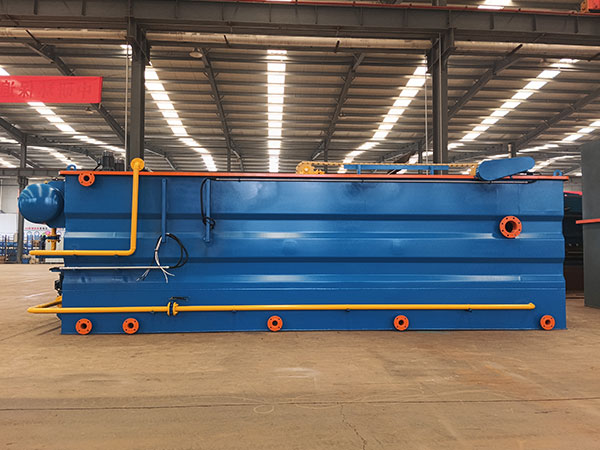
Equipment Overview The Cavitation Air Flotation Machine is an excellent wastewater treatment technology with reasonable design, convenient operation, and economical operation. It generates air bubbles from air and directly removes impurities such as Suspended Solids, grease, and colloidal substances from wastewater. The cavitation aerator injects "microbubbles" directly into the wastewater without the need for prior dissolved air, and then evenly distributes the "microbubbles" in the wastewater through the diffusion impeller, so the entire operation process will not experience clogging. The Cavitation Air Flotation Machine is mainly composed of a tank body, aerator, sludge scraping system, etc., and does not require equipment such as pressure dissolved air, air compressors, and circulation pumps. Equipment Principle: Untreated wastewater first enters the aeration zone and is fully mixed with microbubbles. During the rising process, the microbubbles bring Suspended Solids to the water surface. The sludge scraper runs along the liquid surface to scrape the suspended solids onto the inclined metal plate, and then pushes them into the sludge discharge pipe groove. Through the sludge discharge pipe groove, they flow into the sludge collector. The power of the sludge scraper is only 0.5KW. After purification, before discharge, the wastewater passes through the overflow groove below the inclined plate. The overflow groove is used to control the water level of the air flotation tank to ensure that the liquid in the tank does not flow into the sludge discharge pipeline. The open throat flow pipeline extends from the aeration section along the bottom of the air flotation tank. While generating microbubbles, the cavitation aerator forms a negative pressure zone at the bottom of the tank with a return pipe. This negative pressure effect causes the wastewater to return from the bottom of the tank to the aeration zone, and then return to the air flotation section. This process ensures that air flotation continues continuously even when there is no influent flow. Equipment Parameters:
| Model | Flow Rate (m3/h) | Tank Length (m) | Tank Width (m) | Depth (m) | Total Power (KW) |
|---|---|---|---|---|---|
| WQF-5 | 5 | 2.5 | 1.25 | 1.5 | 2.95 |
| WQF-10 | 10 | 3.0 | 1.25 | 1.5 | 2.95 |
| WQF-15 | 15 | 4.0 | 1.25 | 1.5 | 2.95 |
| WQF-20 | 20 | 4.5 | 1.25 | 1.8 | 2.95 |
| WQF-25 | 25 | 4.8 | 2.0 | 1.8 | 2.95 |
| WQF-35 | 35 | 5.5 | 2.0 | 1.8 | 2.95 |
| WQF-50 | 50 | 6.5 | 2.0 | 1.8 | 2.95 |
| WQF-80 | 80 | 7.5 | 2.25 | 2.0 | 5.15 |
| WQF-100 | 100 | 8.5 | 2.25 | 2.0 | 5.15 |
| WQF-150 | 150 | 11.0 | 2.25 | 2.2 | 7.7 |
| WQF-175 | 175 | 13.0 | 2.25 | 2.2 | 7.7 |
| WQF-200 | 200 | 15.0 | 2.25 | 2.5 | 10.3 |
| WQF-320 | 320 | 16.0 | 2.3 | 2.5 | 12.5 |
| WQF-400 | 400 | 17.0 | 2.3 | 2.8 | 13.2 |
| WQF-500 | 500 | 20 | 4.4 | 3.0 | 13.2 |